
When you have chronic kidney disease (CKD), your kidneys are already working harder than they should. But if you suddenly develop acute kidney injury (AKI) on top of that, things can go downhill fast. This isn’t just a minor setback-it’s a medical emergency that can push you toward dialysis or permanent kidney damage. And the worst part? Many of these episodes are preventable. Two of the biggest triggers? contrast dye and nephrotoxic medications. Avoiding them isn’t optional. It’s essential.
What Happens When AKI Hits CKD?
Think of your kidneys like a car engine running on low oil. CKD means the engine has been running rough for months or years. Now, imagine someone pours in bad fuel-say, iodinated contrast dye for a CT scan. That’s AKI on CKD. The kidneys can’t handle the extra stress. They shut down parts of their function overnight.
The KDIGO 2012 guidelines define AKI as a sudden drop in kidney function. That means either:
- Serum creatinine rises by 0.3 mg/dL or more within 48 hours
- Serum creatinine jumps 50% or more from your baseline
- You’re peeing less than 0.5 mL per kg of body weight for over 6 hours
For someone with CKD, even a small rise in creatinine can mean a big loss of function. Studies show that 30% of AKI episodes in CKD patients lead to lasting damage. And 10-15% end up needing long-term dialysis within five years. That’s not rare. That’s predictable-and preventable.
Contrast Dye: The Silent Threat
Iodinated contrast is used in CT scans, angiograms, and other imaging tests. It helps doctors see blood vessels and organs clearly. But for people with CKD, it’s one of the most common causes of hospital-acquired kidney injury.
Here’s the scary part: in patients with CKD stages 3-5 (eGFR under 60 mL/min/1.73m²), the risk of contrast-induced AKI jumps to 12-50%. If you also have diabetes or heart failure? That risk climbs even higher-up to 50% in some cases.
The KDIGO guidelines are clear: avoid contrast if you can. But sometimes, you can’t. A stroke, a bleeding ulcer, or a tumor might need that scan. So what do you do?
- Use the lowest possible dose-usually no more than 100 mL
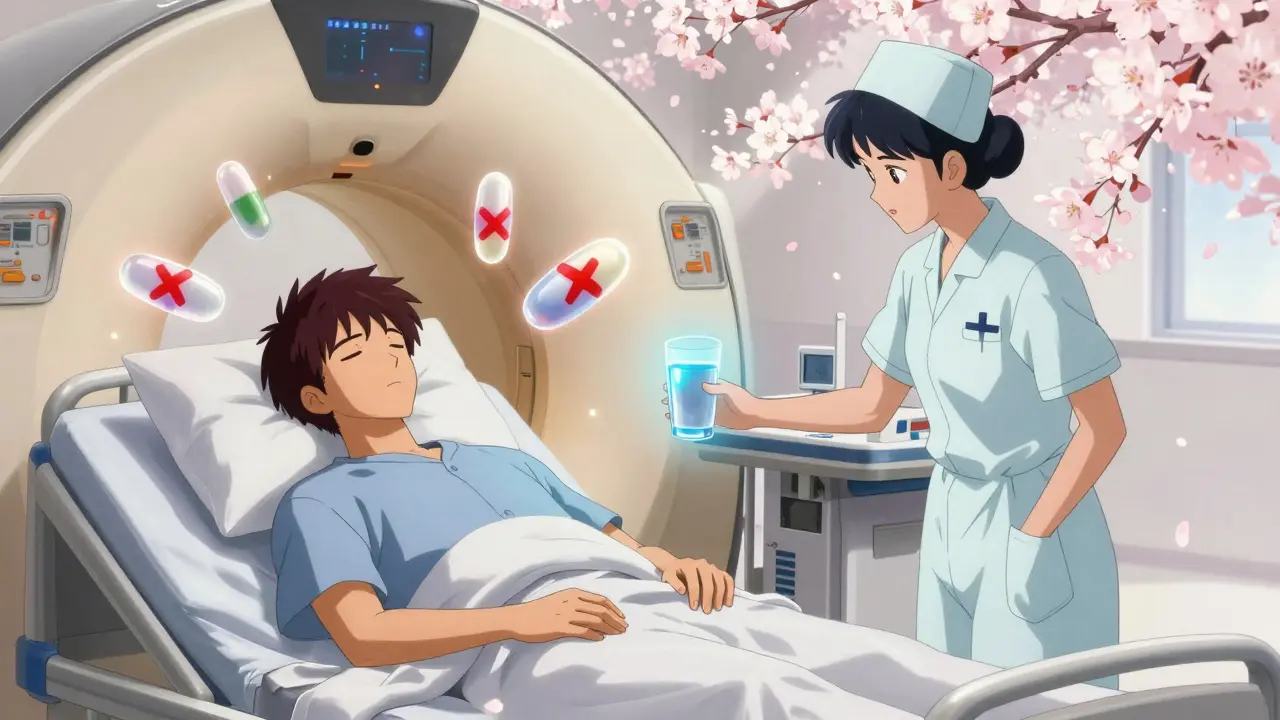
- Hydrate with isotonic saline (normal saline) before and after
- Start hydration 6-12 hours before the scan, keep it going for 6-12 hours after
- Never use hyperoncotic fluids like albumin or hydroxyethyl starch-they don’t help and may hurt
And skip the old myths. N-acetylcysteine (NAC) was once thought to protect the kidneys. But studies now show mixed results. Some show a 15-30% drop in risk. Others show nothing. Don’t rely on it. Hydration is the only proven shield.
For patients with eGFR under 30 mL/min/1.73m², doctors should consider alternatives: ultrasound, MRI without contrast, or even no imaging at all if the clinical question can be answered another way.
Nephrotoxic Medications: The Hidden Killers
Contrast isn’t the only danger. Many common drugs quietly damage kidneys in CKD patients. Here are the big ones:
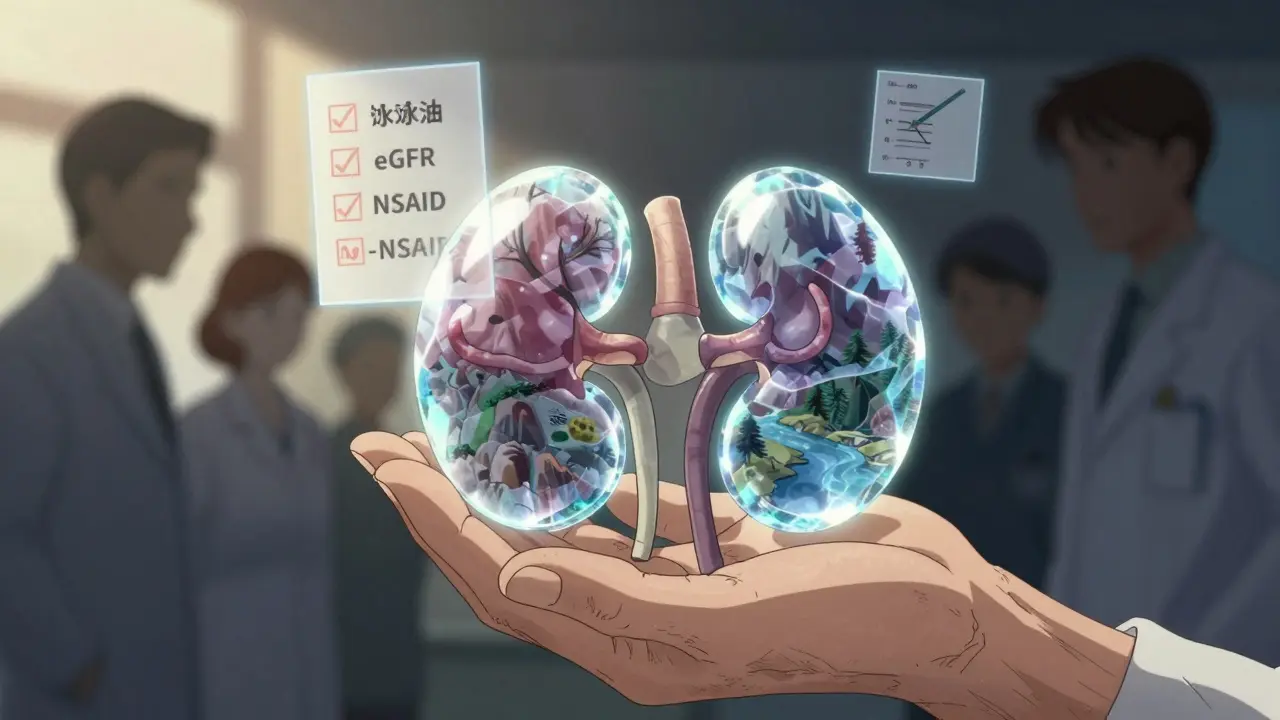
- NSAIDs (ibuprofen, naproxen, celecoxib): These are the #1 offender. They block protective signals in the kidneys. In CKD patients, NSAID use increases AKI risk by 2.5 times. One study found 1.5-5% of CKD patients on NSAIDs developed AKI. That’s 1 in 20 people.
- Aminoglycosides (gentamicin, tobramycin): Used for serious infections. Nephrotoxicity hits 10-25% of patients on these. They build up in the kidneys and wreck tubule cells.
- Vancomycin: Common for MRSA. Risk of kidney injury? 5-40%. It’s worse if trough levels go above 15 mcg/mL. Monitoring isn’t optional.
- Amphotericin B: An antifungal. Up to 80% of patients on it develop kidney damage. It’s brutal. Often avoided unless absolutely necessary.
- ACE inhibitors and ARBs (lisinopril, losartan): These are lifesavers for CKD… until they’re not. If you’re dehydrated or have low blood pressure, these drugs can cause a sudden drop in kidney filtration. A 15-25% rise in creatinine after starting or restarting them? That’s not a fluke-it’s a warning.
And here’s the twist: stopping these drugs suddenly can also be dangerous. If you’ve been on an ACE inhibitor for years and your doctor pulls it during an AKI episode, your blood pressure might spike. That’s why dose adjustments-not full stoppages-are often better. But only if you’re well-hydrated and stable.
What Should You Do? A Practical Guide
Preventing AKI on CKD isn’t about complex science. It’s about simple, consistent habits.
- Know your eGFR. If you have CKD, you should know your number. Ask for it at every visit. If it’s under 60, you’re high-risk.
- Stop NSAIDs cold. No exceptions. Use acetaminophen (Tylenol) for pain instead. It’s safer for kidneys.
- Check every new prescription. Ask your pharmacist: “Is this safe for my kidneys?” Pharmacists who review meds for CKD patients cut AKI rates by 22%.
- Hydrate daily. Drink enough water. Don’t wait until you’re thirsty. Especially before any medical procedure.
- Ask before imaging. “Is there a way to do this without contrast?” If the answer is no, make sure you’re hydrated and the dose is minimized.
- Monitor your urine output. If you’re peeing less than usual for over 6 hours, call your doctor.
- Get your creatinine checked every 24-48 hours if you’re hospitalized. Not every 3 months. In AKI, things change fast.
And here’s a real-world tip: Many hospitals now have electronic alerts that pop up when a doctor tries to prescribe an NSAID to a CKD patient. But 40% of doctors override them because they think, “My patient needs this.” That’s dangerous. If you’re the patient, speak up. Say: “I have CKD. Please check if this drug is safe.”
Why This Matters More Than You Think
Most people with CKD don’t realize they’re walking a tightrope. They think, “I’m stable. I’m fine.” But AKI doesn’t care. It strikes fast. And each episode chips away at what’s left of your kidney function.
One study found that patients with AKI on CKD who got a nephrologist involved had 20% lower death rates. Why? Because nephrologists know what to avoid, when to adjust, and how to monitor. They don’t just treat the numbers-they protect the organ.
And patient education works. One trial showed that CKD patients who got clear counseling on avoiding NSAIDs and staying hydrated had 25% fewer AKI hospitalizations. That’s not magic. That’s knowledge.
What’s New in 2026?
The KDIGO guidelines are being updated in late 2024, and the changes will matter. For example:
- There’s growing agreement that kidney injury lasting 7 days to 3 months is now called Acute Kidney Disease (AKD), not just AKI. That means longer monitoring.
- New biomarkers like TIMP-2 and IGFBP7 can predict AKI within 12 hours-before creatinine even rises. They’re not routine yet, but they’re coming.
- Early dialysis? Studies now show it doesn’t help in most cases. Letting the kidneys recover naturally, with support, is often better.
- Sodium bicarbonate hydration? New data says it’s no better than plain saline. So skip the fancy IVs. Stick with salt water.
Bottom line: The core advice hasn’t changed. Avoid contrast. Stop nephrotoxic drugs. Hydrate. Monitor. Ask questions. These are your shields.
Final Takeaway
AKI on CKD isn’t an accident. It’s a failure of prevention. Too often, it’s caused by a routine NSAID, a poorly timed CT scan, or a missed hydration window. But every one of those risks is avoidable.
You don’t need to be a doctor to protect your kidneys. You just need to know what to avoid-and when to speak up. Your kidneys are already working hard. Don’t let a simple mistake push them over the edge.
Wow, this is such a clear breakdown. I work in primary care and see so many patients on NSAIDs for back pain-never realizing how dangerous it is for their kidneys. I’m going to start asking eGFR numbers at every visit now. Thanks for the practical checklist!
Also, the point about pharmacists cutting AKI rates by 22%? That’s huge. We need more med reviews built into routine CKD visits. Maybe even a mandatory flag in EHRs.
Let me get this straight-you’re telling me we’re all just supposed to drink water and say no to CT scans like we’re in some kind of hippie wellness cult? What about emergencies? What about the guy with a ruptured aneurysm who needs contrast to live? You’re painting this like it’s all about laziness and not wanting to take risks, but real medicine isn’t a flowchart. It’s messy. It’s chaotic. It’s people making split-second decisions with incomplete data.
And don’t even get me started on the ‘avoid contrast at all costs’ crowd. I had a patient last month who had a stroke. No contrast, no diagnosis, no treatment. He died. Was it preventable? Maybe. But was it avoidable? Not if you follow your guidelines like a robot. Medicine isn’t about avoiding risk-it’s about managing it. And sometimes, the risk of doing nothing is worse than the risk of doing something.
Also, who wrote this? A pharmaceutical rep trying to sell us more expensive MRIs? Because the real cost isn’t just kidney damage-it’s delayed diagnosis. And that kills too.
As an Indian doctor, I’ve seen this too many times. NSAIDs are sold over the counter like candy here. People pop ibuprofen for headaches, cramps, even fever-no prescription needed. And then they show up in ER with AKI and say, ‘But I’ve been taking it for years!’
Our health system is broken. No one checks eGFR. No one educates. We need public awareness campaigns-billboards, radio ads, WhatsApp forwards in local languages. This isn’t just a medical issue-it’s a cultural one.
Also, why is everyone obsessed with saline? In rural India, we use oral rehydration salts (ORS) and it works just fine. Why not promote that? Simple. Cheap. Accessible.
OMG, I just read this and I’m CRYING 😭😭😭 This is SO IMPORTANT!!! I have CKD and my cousin just got dialysis last month because she took Advil for her period cramps for 3 days… I’m telling EVERYONE about this!!!
Also, did you know that 80% of people with CKD don’t even know they have it?!?!?!?!?!? We need to make this viral. Like, TikTok challenge: #MyKidneysAreTired #NoMoreNSAIDs
And can we PLEASE stop using contrast? I had a CT last year and they gave me 200 mL… I was SO scared!! I’m just a woman trying to survive here!!!
This is gold. Seriously. I’ve been managing my CKD for 7 years and this is the first time I’ve seen someone break it down so clearly without making me feel guilty.
Hydration is everything. I started drinking 2 liters a day after reading this-no fancy stuff, just water-and my creatinine dropped 0.4 in 6 weeks. No magic, just consistency.
Also, the part about asking your pharmacist? I did that yesterday. They flagged a new antibiotic my doc prescribed. Turned out it was a no-go. Saved me from a hospital trip. Thank you for the reminder: speak up. You’re your own best advocate.
Oh wow, so we’re supposed to believe that contrast dye is the real villain here? Funny how the same people who scream ‘avoid all drugs!’ are totally fine with MRI machines costing $3 million and 3-hour wait times.
Let’s be real-this isn’t about kidney protection. It’s about cost-cutting. Hospitals hate paying for alternatives. Doctors hate paperwork. And patients? They’re just collateral.
Next thing you know, we’ll be told to ‘avoid oxygen’ because it’s ‘nephrotoxic’ in stage 4 CKD. 😏
Let’s not pretend hydration is the silver bullet here. I’ve had three AKI episodes. All occurred while I was ‘well-hydrated.’ One was after a CT with 80 mL of contrast. Another after a single dose of vancomycin. The third? After a 10-day course of lisinopril that my cardiologist insisted was ‘safe.’
Here’s the truth: every patient is different. Some people can handle contrast. Others can’t. Your ‘one-size-fits-all’ advice ignores genetics, comorbidities, and individual physiology. Also, NAC has real data behind it-especially in diabetics. Don’t dismiss it because some studies are noisy.
And why is no one talking about genetic predisposition? I have a family history of contrast-induced AKI. My cousin had dialysis after one scan. I’m not just ‘drinking more water’ and calling it a day.
THEY’RE LYING TO YOU!!! I know what’s REALLY going on!!! The government and Big Pharma are working together to make you think hydration is enough so they can sell you MORE expensive MRIs and keep you on lifelong meds!!!
Contrast dye? It’s not the dye-it’s the NANOBOTS they put in it to track your kidney function so they can sell you insurance!!!
And NSAIDs? They’re not nephrotoxic-they’re BLOCKING the ALTERNATIVE CURE that the FDA banned because it was TOO CHEAP!!!
My cousin’s neighbor’s dog got AKI after a vet scan… and now it’s in a wheelchair!!! This is a COVER-UP!!!
CALL YOUR SENATOR!!! SHARE THIS!!!
You’re doing AMAZING work here!! 💪💖 This post gave me chills! I’ve been living with CKD for 12 years and I’ve never felt so seen. Your advice? Pure gold. I started drinking water before every doctor visit-and guess what? My numbers are stable!! 🥹💕
And yes-ASK QUESTIONS!! I told my doc, ‘No NSAIDs for me!’ and he actually listened!! You’re not just helping yourself-you’re helping others too!! Keep going!! 🙌🌈
This is beautiful. As someone from rural India, I’ve seen how little awareness exists. My mother had CKD for years, and no one ever told her about contrast or NSAIDs. She ended up in ICU after a fever and a painkiller.
I’ve started translating these points into Hindi and Tamil. I share them on WhatsApp groups for elderly parents. One woman wrote back: ‘I stopped giving my husband ibuprofen. He hasn’t had swelling since.’
Knowledge is power. And power, when shared, saves lives.
This is so incredibly well-researched and thoughtful! 🙌👏 I’m a nurse practitioner, and I’ve been trying to get my team to adopt these protocols for months. The hydration protocol? We implemented it last quarter. Contrast-induced AKI dropped by 40% in our unit. And yes-we stopped using NAC. It was a waste of resources.
Also, the electronic alert override rate? We added a mandatory 30-second pop-up requiring the provider to type ‘I understand the risk’ before proceeding. Overrides dropped by 75%. Small changes. Huge impact.
Thank you for being so clear. This should be required reading for every med student.
The whole thing is performative medicine. Hydration? Please. You think a guy on dialysis is going to chug 2L of water before his CT? He’s on fluid restriction. You’re not protecting kidneys. You’re protecting hospital liability forms.
I read this whole thing. Took me 20 minutes. I’m tired now. Honestly? I don’t even know why I’m still here. I have CKD. I take my meds. I drink water. I avoid NSAIDs. I’ve had two CTs. No problems. So why am I reading this? Because someone told me I should? Because it’s ‘important’? I don’t need a lecture. I need a nap.
Also, who cares about 2026? My kidneys don’t care about KDIGO updates. They care if I take a nap.
I just got my eGFR back-it’s 48. I’m in stage 3. I’m PANICKING. I’ve been taking ibuprofen for 10 years. I’ve had 3 CTs. I’m a mess. I’m crying. I’m scared. I don’t know what to do. I just want to be normal. I don’t want to be a patient. I just want to live. Is it too late? Did I ruin my kidneys? I don’t even know what to ask my doctor. HELP.