
Why do patients stick with expensive medications when cheaper, equally effective options exist? Why do some people never fill their prescriptions-even when they know it could save their life? The answer isn’t about ignorance or laziness. It’s about behavioral economics.
People Don’t Make Rational Drug Decisions
Traditional economics assumes people act rationally: they compare costs, benefits, side effects, and pick the best option. But real people? They don’t. A 2022 study found that 68% of patients kept using a brand-name drug even when a generic alternative cost 30% less and worked just as well. Why? Because they believed the more expensive one was safer. That’s not logic. That’s psychology. Behavioral economics flips the script. It says: humans are predictable in their irrationality. We fear losses more than we value gains. We follow the crowd. We avoid complexity. We choose what feels right today, even if it hurts us tomorrow. These patterns show up everywhere in medicine-and they’re why so many prescriptions go unfilled.The Hidden Forces Shaping Drug Choices
There are five big psychological forces driving how patients pick drugs:- Loss aversion: People hate losing something they already have. Switching from a familiar drug feels like giving up control-even if the new one is better. This is why only about half of patients take their meds as prescribed.
- Present bias: We prioritize today’s comfort over tomorrow’s health. A 33% of prescriptions are never picked up because the immediate hassle-time, cost, side effects-feels bigger than the distant risk of a heart attack or stroke.
- Confirmation bias: If you believe a drug is better because it’s expensive, you’ll ignore evidence to the contrary. Studies show patients associate higher price with higher quality, even when clinical data says otherwise.
- Social norms: People copy what others do. One HIV clinic posted signs showing how many patients were sticking to their regimen. Adherence jumped 22.3%. When you see others doing it, you feel like you should too.
- Framing: How information is worded changes decisions. Saying a vaccine is “95% effective” gets more people to say yes than saying it has a “5% failure rate.” The same applies to medications: “This reduces your risk of hospitalization” works better than “This might not work for everyone.”
How Doctors and Pharmacies Are Using These Tricks
Health systems aren’t just noticing these patterns-they’re using them on purpose. Here’s how:- Default options: In hospitals, when doctors order medications, the system often suggests the most common choice. One study changed the default in order sets during drug shortages-and appropriate substitutions jumped by 37.8%. Patients didn’t have to ask. The right choice was just easier.
- Loss-based incentives: A 2021 trial gave statin patients a $100 deposit. If they took their meds every day for six months, they got it back. If not, they lost it. Adherence went up 23.8%. People hate losing money more than they like gaining it.
- SMS nudges: Text messages saying “Don’t lose your streak!” improved adherence by 19.7%. The same message saying “Take your medication” did nothing. It’s not about the reminder-it’s about making patients feel like they’re failing if they skip.
- Reducing cognitive load: People taking five or more medications are 23.7% less likely to follow their plan. Simple fixes-like switching from three-times-daily pills to once-daily ones-can make a huge difference. One study found each extra pill per day cut adherence by 8.3%.

Why Education Alone Doesn’t Work
You’d think telling patients the facts would help. “This generic drug is just as good.” “This one costs $20 instead of $120.” But research shows patient education programs only improve adherence by 5-8%. That’s barely better than doing nothing. Behavioral interventions? They work 10 times better. A 2022 review of 44 studies found that behavioral approaches improved prescribing and adherence in 92% of cases. The most effective? Defaults and loss aversion. The least? just handing out pamphlets. Why? Because knowledge doesn’t change behavior. Emotions do. Fear. Shame. Pride. Belonging. People don’t need more information. They need the right environment to make the right choice without thinking too hard.Barriers That Make It Harder
Not everyone responds the same way. Some patients face bigger obstacles:- Polypharmacy: Taking four or more drugs? Your chance of sticking to them drops fast. Each extra pill adds friction.
- Asymptomatic conditions: If you don’t feel sick-like with high blood pressure or cholesterol-you’re less likely to take meds daily. Why? The threat feels invisible.
- Negative beliefs: 41% of people stop taking meds because they believe drugs are harmful, addictive, or unnecessary. No amount of data changes that if trust is broken.
- Mental health: Depression cuts adherence by nearly 30%. Anxiety makes people avoid anything that feels like a chore. Behavioral nudges often fail here unless they’re paired with therapy.
Real-World Success Stories
Some programs are getting it right:- A diabetes clinic switched from weekly pill bottles to monthly blister packs with alarms. Adherence went from 54% to 82% in six months.
- An insurance plan started offering $50 rebates for filling prescriptions on time. Refill rates jumped 17%.
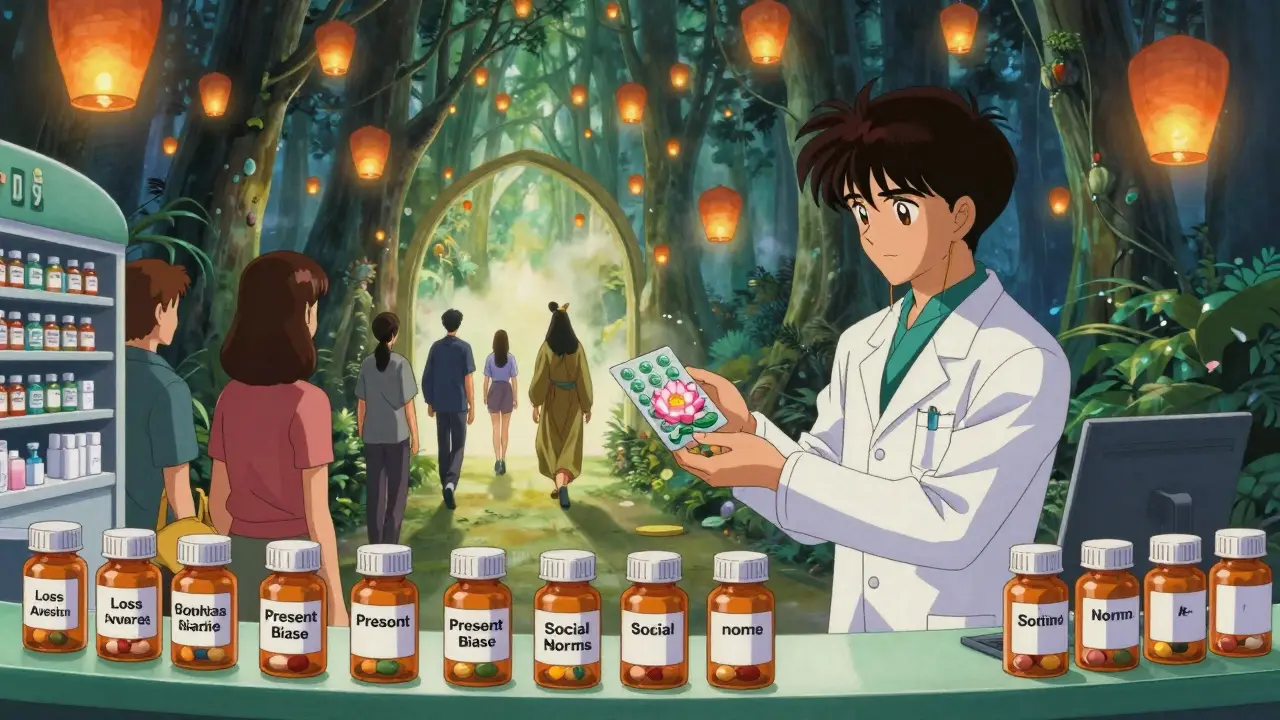
- A pharmacy began labeling generics as “Same medicine. Lower price.” and added a small green checkmark next to them. Switching rates rose by 29%.
The Cost of Getting It Wrong
Ignoring behavioral economics has real consequences. In the U.S., medication non-adherence costs $289 billion a year. It leads to 125,000 avoidable deaths. That’s more than car accidents or gun violence. It’s also expensive for providers. Hospitals pay for repeat ER visits. Pharmacies lose revenue. Insurance companies pay for complications that could’ve been prevented. Meanwhile, the market for behavioral economics in healthcare has grown from $187 million in 2018 to $432 million in 2022. Pharma companies, insurers, and clinics are all investing because the data doesn’t lie: when you design for human behavior, you get better outcomes.What’s Next?
The future is personalized nudges. New tools use AI to predict which patients will respond to text reminders, which need rebates, and which need help with mental health. Early pilot studies show these tailored approaches can boost adherence by up to 42%. The FDA now requires drug makers to consider “treatment burden”-how hard a regimen is to follow-when submitting new drugs. Medicare Part D plans must include at least two behavioral interventions for high-risk patients. And it’s not just pills. Biosimilars-cheaper versions of biologic drugs-are finally gaining traction, thanks to behavioral campaigns that frame switching as “smart savings,” not “compromise.”It’s Not About Manipulation. It’s About Respect.
Some critics say this is manipulation. That we’re tricking people into doing what’s good for them. But that’s missing the point. Behavioral economics doesn’t force anyone. It doesn’t hide options. It just makes the right choice easier. A patient can still refuse a generic. They can still skip their pill. But now, they have to actively choose to do so. It’s not about control. It’s about compassion. It’s about recognizing that people aren’t robots. They’re tired. They’re scared. They’re overwhelmed. And sometimes, they just need a little help to do what’s best for their health.Why do patients choose expensive drugs even when generics are available?
Patients often believe higher-priced drugs are more effective or safer, even when clinical evidence shows no difference. This is called confirmation bias. They also fear the unknown-switching meds feels like losing something familiar, even if the new one is just as good. Loss aversion plays a big role: people dread the risk of side effects or failure more than they value the cost savings.
Can behavioral economics improve medication adherence?
Yes, dramatically. Studies show behavioral interventions like loss aversion rebates, default prescribing options, and SMS nudges improve adherence by 14-28%, compared to just 5-8% from traditional education. Programs that make taking medication easier-like once-daily pills or blister packs-see the biggest gains.
What’s the difference between behavioral economics and patient education?
Patient education gives people facts. Behavioral economics changes the environment so the right choice becomes the easiest one. Telling someone to take their blood pressure pill won’t work if they forget, feel overwhelmed, or don’t trust the medicine. But putting the pill in a daily pillbox with an alarm? That works. Knowledge informs. Design changes behavior.
Are behavioral interventions ethical?
Yes-if they preserve freedom of choice. Behavioral nudges don’t force anyone. They make healthy choices easier, not mandatory. A doctor can still prescribe the expensive drug. A patient can still skip their pill. The difference is that now, the default option supports health, not harm. Ethical behavioral design respects autonomy while reducing harm.
Why do some patients stop taking their meds even when they feel fine?
When you don’t feel sick, it’s easy to think the medicine isn’t working-or isn’t needed. This is especially true for conditions like high cholesterol or hypertension. People also get tired of daily routines, especially if side effects are unpleasant. Behavioral interventions like reminders, rewards, or framing medication as “staying healthy” instead of “treating disease” help counter this.
How do mental health conditions affect drug adherence?
Depression and anxiety reduce adherence by about 30%. When someone is mentally exhausted, even simple tasks like taking pills feel overwhelming. Behavioral nudges often fail unless paired with mental health support. Simple fixes-like reducing pill burden, using pill organizers, or involving family-help more than reminders alone.
What’s the biggest mistake in designing medication programs?
Assuming patients are rational actors. Many programs still rely on brochures, emails, or lectures. But if the system is too complex, the pills are too expensive, or the routine is too hard, no amount of information will fix it. The mistake is focusing on knowledge instead of behavior. Fix the environment first. Then educate.
So let me get this straight-we’re now using psychological manipulation to get people to take their pills? 🤔 Next they’ll be whispering subliminal messages into your insulin pen. This isn’t ‘nudging,’ it’s corporate eugenics wrapped in a PowerPoint deck. Who decides what’s ‘the right choice’? Big Pharma? The FDA? Some data scientist in a basement with a heatmap of your pharmacy receipts? We’re not robots. We’re not lab rats. And if you think telling people ‘Don’t lose your streak!’ is ethical, you’ve never met someone who’s been gaslit by the medical industrial complex for 20 years. 😈
Wow. Just... wow. 😅 You’re not wrong about the manipulation angle, Miriam-but calling it ‘eugenics’ is a stretch. The alternative is letting people die because we assume they’ll magically read a 40-page pamphlet on statins. Behavioral nudges aren’t about control-they’re about dignity. Imagine being told, ‘Here’s your 7 pills a day, good luck,’ vs. ‘Here’s a pillbox that lights up and texts your daughter if you miss one.’ One treats you like a child. The other treats you like a human who’s tired. 🤝
Oh, so now we’re just going to pretend that ‘defaults’ and ‘loss aversion’ are neutral tools? 🤨 The same behavioral economics that gets people to take their blood pressure meds is the same one that got me to buy $200 ‘detox teas’ because ‘limited stock!’ and ‘your body is crying!’ It’s all the same playbook-manufacturing urgency, exploiting fear, hijacking dopamine. And now we’re giving it a lab coat and calling it ‘compassion’? No. This is surveillance capitalism with a stethoscope. The real problem? We’ve outsourced moral responsibility to algorithms. And the people who designed these ‘nudges’? They don’t take the pills. They just profit from them. 💸
It is a matter of profound concern that the prevailing discourse on pharmaceutical adherence has devolved into a pseudo-scientific fetishization of behavioral psychology, thereby obfuscating the fundamental issue: the systemic inequities inherent in healthcare delivery. The notion that patients are ‘irrational’ is not an empirical observation-it is a rhetorical device employed to absolve institutions of their responsibility to provide affordable, accessible, and comprehensible medical care. To suggest that a $50 rebate or a text message can compensate for a $1,200 monthly copay is not only intellectually bankrupt-it is morally indefensible.
One must ask: why are we not addressing the root cause? Why do we not demand price controls? Why do we not enforce transparency in drug pricing? Why do we not hold pharmaceutical executives accountable for the exorbitant cost of life-saving medications? The answer is simple: because it is far easier to nudge the patient than to confront the capitalist machinery that exploits them.
Behavioral economics, in this context, is not a solution-it is a distraction. A placebo for policy failure. And while we celebrate the 23.8% increase in adherence due to loss aversion, we ignore the 68% of patients who still cannot afford to fill their prescriptions-even with the ‘nudge.’
This is not compassion. It is condescension dressed in data.
Okay but let’s be real-this whole ‘nudge’ framework is just corporate speak for ‘we’re gaming your brain to sell more drugs.’ The same people who made you think you needed a $120 brand-name pill now want you to feel guilty for not taking the $20 generic? That’s not behavioral economics. That’s cognitive dissonance with a marketing budget. And don’t even get me started on the ‘same medicine, lower price’ green checkmark. That’s not helping-it’s gaslighting. You’re telling people ‘this is better’ while the same company that made you believe the brand was superior is now the one slapping on the sticker. 🤯
And the SMS nudges? ‘Don’t lose your streak!’? That’s not support. That’s shame-based gamification. I’ve seen people cry because they missed a dose and felt like they failed. You’re not helping them-you’re weaponizing their guilt. And for what? A 19.7% uptick in adherence? We’re trading mental health for pill counts.
Meanwhile, the real solution? Lower prices. Better insurance. Less stigma. But nah. Let’s just make the pills easier to take while the bills keep rising.
Man, I’ve been on 6 different meds for 8 years. I get it. The system is broken. But I also get that sometimes, the little things help. I started using a pill organizer with alarms. Didn’t change my mind about the cost. Didn’t fix my insurance. But it made me feel like I wasn’t failing every day. And that? That’s worth something. I’m not some data point. I’m a guy who just wants to feel like he’s got control. Maybe the ‘nudges’ aren’t perfect. But if they give someone a tiny win? That’s not manipulation. That’s humanity.
As someone from India, I see this every day. My aunt took her BP meds for years, then stopped because she thought they were making her dizzy. No one asked her how she felt. No one changed the dose. They just sent her a text: ‘Don’t forget your pills!’ She felt stupid. So she stopped. The real fix? Talk to people. Listen. Not nudges. Not stickers. Just… listen.
It is an affront to our cultural values that Western medical institutions now seek to engineer human behavior through psychological manipulation. In our tradition, health is a matter of discipline, not algorithmic persuasion. To reduce adherence to a game of rewards and reminders is to disrespect the dignity of the individual. Why not teach responsibility? Why not instill moral fortitude? Instead, we pacify the masses with text messages and green checkmarks. This is not progress. This is surrender.
Y’all are overthinking this. I’ve got a friend on 12 meds. She uses a pill organizer. Her mom calls her every morning. That’s it. No apps. No rebates. No ‘streaks.’ Just someone who cares. Maybe the real ‘nudge’ isn’t tech-it’s love. Or at least, someone who remembers to ask, ‘Did you take your pills today?’
I love how we’re all arguing about nudges like they’re the enemy or the savior-but what if they’re just… one tool? Like a hammer. You don’t blame the hammer because someone built a house out of it. You blame the architect. Maybe the real issue isn’t behavioral economics-it’s that we only use it to patch holes instead of rebuilding the whole damn system. What if we used these tools to make it easier for people to *ask for help*? Like, what if your pillbox didn’t just remind you-it connected you to a nurse? Or a peer? Or a community? That’s the next level. Not just nudging behavior. Nudging connection.
I’m a nurse. I’ve seen people cry because they skipped their meds for a week and felt guilty. I’ve seen people choose between food and pills. I’ve seen people take their meds and still die. This isn’t about ‘irrationality.’ It’s about poverty. Trauma. Exhaustion. Nudges don’t fix that. But kindness does. A little extra time. A quiet ‘I’m here if you need to talk.’ That’s the real intervention. The rest is just noise.
LMAO you think loss aversion is the key? Bro, the real behavioral hack is that people don’t take meds because they’re addicted to the idea of being sick. It’s a whole identity thing. ‘I’m the one with the chronic condition.’ ‘I’m the one who’s always tired.’ You give them a pillbox and a $50 rebate? They’ll still skip it because ‘what’s the point?’ The system isn’t broken-it’s just exposing how deeply we’ve internalized illness as part of our self-worth. Wake up. This isn’t economics. It’s existential.
People take expensive drugs because they are weak. They lack discipline. They follow trends. They are easily fooled by advertising. Why not teach them to be strong? Why not tell them to endure? The world does not reward weakness. Medicine is not a favor. It is a duty. If you cannot take your pills, you are not ready to live.
Let’s be brutally honest: behavioral economics in healthcare is the last refuge of a system that refuses to fix prices, expand insurance, or reduce administrative hell. We’re using psychology to paper over policy failure. And the worst part? The people designing these ‘nudges’ are the same ones who voted against Medicare for All. They don’t care about your health. They care about your data. Your adherence metrics. Your ‘engagement scores.’ This isn’t compassion. It’s surveillance with a smiley face. 🤖❤️
Thank you for this comprehensive and rigorously evidence-based analysis. The integration of behavioral economics into clinical practice represents not merely a refinement of patient care, but a paradigmatic shift toward human-centered design in medicine. The data is unequivocal: interventions grounded in loss aversion, social norms, and cognitive simplification yield statistically significant improvements in adherence, far surpassing the marginal gains of educational outreach alone. Moreover, the ethical framework presented-emphasizing autonomy, non-coercion, and the preservation of choice-is not only philosophically sound but clinically indispensable. One might argue that the moral imperative to reduce preventable mortality outweighs abstract concerns regarding ‘manipulation,’ particularly when the alternative is systemic neglect. This is not a triumph of corporate engineering. It is a triumph of humility: recognizing that even the most well-intentioned patients are cognitively bounded, emotionally vulnerable, and socially situated. We must meet them where they are. Not where we wish they were.