
What Are Over-the-Counter Medications?
Over-the-counter (OTC) medications are drugs you can buy without a prescription. They’re meant for simple, short-term problems like headaches, colds, heartburn, or sore muscles. You’ll find them on shelves in pharmacies, grocery stores, and even gas stations. But just because they’re easy to get doesn’t mean they’re harmless. In fact, misuse of OTC meds sends about 68,000 people to U.S. emergency rooms every year.
The FDA has been regulating these products since 1972, making sure they’re safe and effective before they hit store shelves. In 2020, the CARES Act gave the FDA more power to update OTC rules faster, so better, safer products can reach consumers quicker. Today, there are more than 300,000 OTC products on the market, covering around 80 different health conditions. That’s a lot of choices-and a lot of chances to make a mistake.
Common OTC Medications and How They Work
Not all OTC meds are the same. They fall into a few main categories, each with specific uses and risks.
- Pain relievers: Acetaminophen (Tylenol) is the go-to for general aches and fever. It’s gentle on the stomach but hard on the liver if you take too much. The max daily dose is 3,000 mg-that’s six extra-strength pills. Exceed that, and you risk serious liver damage. In the U.S., acetaminophen overdose causes about 56,000 ER visits each year.
- NSAIDs: Ibuprofen (Advil, Motrin) and naproxen (Aleve) reduce pain and inflammation. They’re great for sprains, arthritis, or menstrual cramps. But they’re not safe for everyone. If you have high blood pressure, asthma, kidney problems, or a history of stomach ulcers, these can cause bleeding or heart issues. The max OTC dose for ibuprofen is 1,200 mg per day. For naproxen, it’s 660 mg.
- Heartburn and digestion: Bismuth subsalicylate (Pepto-Bismol) helps with upset stomach and diarrhea. Antacids like Tums or Rolaids neutralize acid fast. H2 blockers like famotidine (Pepcid) and proton pump inhibitors like omeprazole (Prilosec OTC) work longer but take hours to kick in.
- Cough and cold: Guaifenesin (Mucinex) loosens mucus. Dextromethorphan calms coughs. But many cold formulas combine these with decongestants like pseudoephedrine or antihistamines like diphenhydramine. That’s where things get risky-taking multiple products can lead to accidental overdose.
- Topical and other products: Some things you might not think of as meds are actually OTC drugs. Fluoride toothpaste, dandruff shampoos with zinc pyrithione, antibiotic ointments, and even wart removers with salicylic acid all fall under FDA’s OTC umbrella.
The Drug Facts Label: Your Most Important Tool
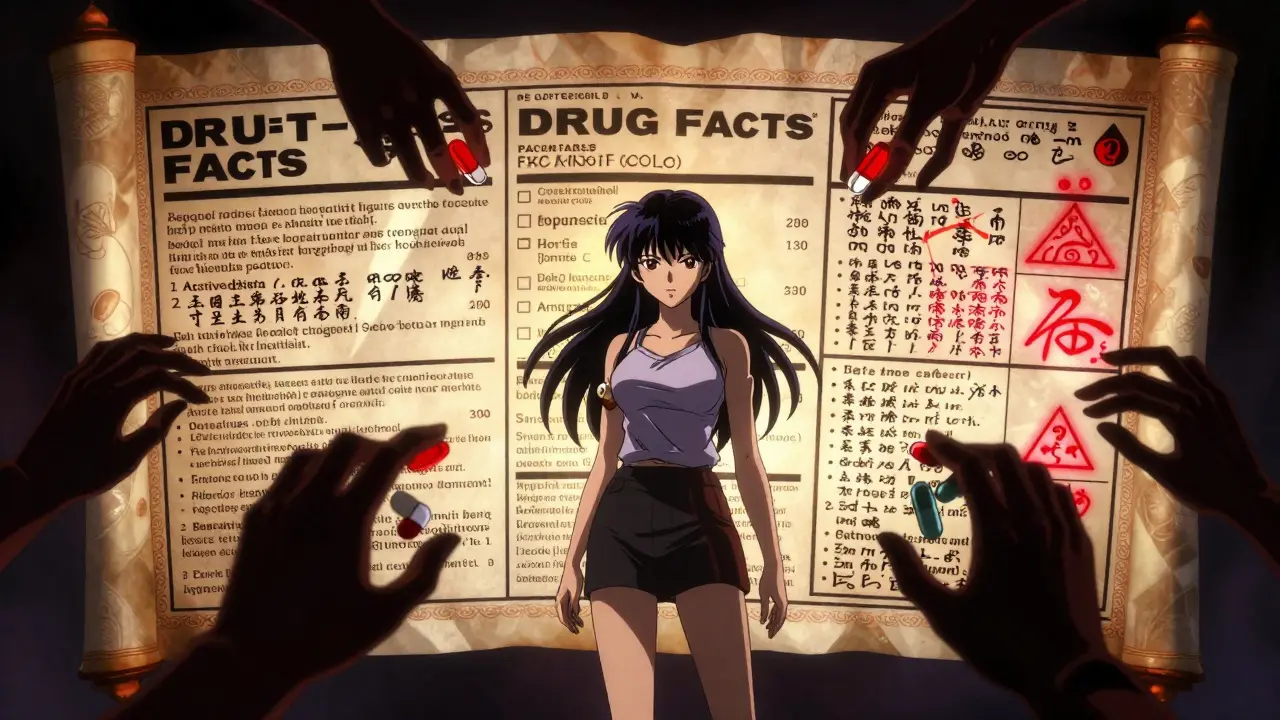
Every OTC product sold in the U.S. must have a Drug Facts label. It’s not just a design-it’s a legal requirement. And yet, only 22% of people read the whole thing. That’s a problem. Here’s what you need to know:
- Active ingredients: This tells you what’s actually working in the pill or liquid. Always check this. If you’re taking two products with the same active ingredient-say, acetaminophen-you could overdose without realizing it.
- Purpose: What’s this medicine for? Headache? Allergies? Cough? Make sure your symptoms match.
- Uses: Lists specific conditions it treats. Don’t use it for something it’s not approved for.
- Warnings: This section is critical. It tells you who shouldn’t take it, what to avoid (like alcohol), and signs of serious side effects.
- Directions: How much? How often? For how long? Never exceed the dose. More isn’t better.
- Inactive ingredients: These are fillers, flavors, dyes. Important if you have allergies. For example, some people react to red dye #40 or lactose.
Look for the expiration date. Most OTC meds last 2-3 years. After that, they lose potency. Storing them in the bathroom? Bad idea. Heat and moisture ruin them. Keep them in a cool, dry place below 77°F (25°C).
Who Should Be Extra Careful?
OTC meds aren’t one-size-fits-all. Certain groups need to be extra cautious.
- People over 65: Older adults often take five or more prescription drugs. Adding an OTC painkiller or cold med can cause dangerous interactions. About 6.7% of adverse drug events in seniors come from OTC misuse.
- People with chronic conditions: High blood pressure? Kidney disease? Liver problems? Asthma? NSAIDs can make these worse. Acetaminophen can harm your liver if you drink alcohol regularly.
- Pregnant or breastfeeding women: Some OTC meds aren’t safe. Always check with a provider before taking anything.
- People with low health literacy: Nearly 9 in 10 U.S. adults don’t have proficient health literacy. That means they struggle to read and understand medical labels. Terms like “do not exceed 6 tablets in 24 hours” can be confusing. Misreading labels leads to 41% of OTC medication errors reported to poison control centers.
What to Avoid
Here are the most common mistakes people make-and how to skip them.
- Doubling up on ingredients: Taking Tylenol for a headache and a nighttime cold med that also has acetaminophen? That’s how you overdose. Always check the active ingredient list.
- Using OTC meds for too long: If your headache lasts more than a few days, your heartburn won’t go away after two weeks, or your cough drags on past 10 days-it’s not an OTC problem anymore. See a doctor.
- Assuming “natural” means safe: Labels like “natural” or “herbal” aren’t regulated the same way. Some herbal products can interact with prescription drugs or cause liver damage. Just because it’s plant-based doesn’t mean it’s harmless.
- Ignoring storage rules: Leaving pills in a hot car or a steamy bathroom? They degrade faster. Expired meds won’t work-and might break down into harmful chemicals.
- Sharing meds: Your friend’s ibuprofen isn’t right for you. Dosing is based on weight, age, and health history. Never give someone else your meds-or take theirs.
When to Call a Pharmacist (And Why You Should)
Pharmacists are trained to help you with OTC meds-and they’re more accessible than you think. In the U.S., 92% of people live within 5 miles of a pharmacy. And 68% of Americans talk to a pharmacist about OTC meds at least once a year.
Here’s what they’ll check for you:
- Drug interactions with your prescriptions
- Correct dosing for your age and weight
- Contraindications based on your health history
- Whether you’re buying the right product for your symptoms
Chain pharmacies now offer free medication reviews. In places like Melbourne, many pharmacists will sit down with you, look at your whole list of meds (prescription and OTC), and tell you what’s safe to take together. Studies show this cuts inappropriate OTC use by 42%.
What’s Changing in the OTC Market
The OTC industry is evolving. In 2023, the FDA required all NSAID labels to include clear warnings about heart attack and stroke risk. That’s a big deal-70 million Americans use these daily.
By 2025, the FDA plans to overhaul the entire OTC monograph system. That means products without solid proof of safety and effectiveness could be pulled from shelves. Around 15-20% of current OTC meds might disappear.
More people are using apps to compare products. In 2022, 63% of consumers used apps to check ingredients-up from 41% in 2020. And pharmacists are getting more authority. In 27 states, they can now prescribe emergency contraception and some OTC drugs without a doctor’s note.
But the biggest challenge? Waste. About $3.1 billion worth of unused OTC meds get thrown away every year. Why? People buy them on impulse, forget they have them, or don’t know how to dispose of them safely.
How to Use OTC Medications Safely: A Simple Checklist
- Identify your symptom: Is it a headache? A cold? Heartburn? Don’t guess.
- Read the Drug Facts label: Find the active ingredient. Match it to your symptom.
- Check your other meds: Do you already take something with the same active ingredient? If yes, skip this one.
- Check your health conditions: Do you have high blood pressure, liver disease, asthma, or ulcers? Look for warnings.
- Follow the dose: More isn’t better. Stick to the label.
- Don’t use it longer than directed: If it doesn’t help in 3-7 days, see a doctor.
- Store it right: Cool, dry place. Not the bathroom.
- Ask your pharmacist: If you’re unsure, just ask. It’s free.
Frequently Asked Questions
Can I take OTC pain relievers every day?
No. Taking OTC pain relievers daily-even at the recommended dose-isn’t safe long-term. Acetaminophen can damage your liver over time. NSAIDs like ibuprofen can cause stomach bleeding or kidney problems. If you need daily pain relief, talk to a doctor. There may be a better, safer solution.
Are store-brand OTC meds the same as name brands?
Yes, if they have the same active ingredient, dose, and form. Store brands like CVS Health or Walmart’s Equate contain the same amount of acetaminophen or ibuprofen as Tylenol or Advil. They’re cheaper because they don’t spend money on ads or fancy packaging. Always check the active ingredient list to be sure.
What should I do if I take too much OTC medicine?
Call Poison Control immediately at 1-800-222-1222 in the U.S. Don’t wait for symptoms. Overdoses can be silent at first. For acetaminophen, liver damage can start within hours. For NSAIDs, stomach bleeding or kidney failure can follow. Save that number in your phone.
Why do some cold meds make me sleepy?
Many nighttime cold formulas contain diphenhydramine or doxylamine-antihistamines that cause drowsiness. If you take one during the day, you’ll feel sluggish or foggy. Always check the label. If you need daytime relief, look for products labeled “non-drowsy” and avoid anything with these ingredients.
Is it safe to give OTC meds to kids?
Only if the label says it’s for children and you use the right dose based on weight or age. Never give adult meds to kids. Liquid forms are especially risky-measuring spoons aren’t accurate. Always use the dosing cup or syringe that comes with the product. For kids under 6, avoid cough and cold meds entirely unless a doctor says so.
Can I take OTC meds with alcohol?
No, especially not with acetaminophen or NSAIDs. Alcohol increases the risk of liver damage with acetaminophen. With ibuprofen or naproxen, it raises your chance of stomach bleeding. Even one drink can be dangerous. If you drink regularly, talk to your doctor before using any OTC pain reliever.
Next Steps: What to Do Today
Here’s what you can do right now to use OTC meds safely:
- Go through your medicine cabinet. Toss anything expired or that you haven’t used in over a year.
- Write down every OTC and prescription med you take. Bring it to your next pharmacy visit.
- Next time you buy OTC meds, read the Drug Facts label. Don’t just grab the box.
- If you’re unsure about anything, walk into a pharmacy and ask a pharmacist. No appointment needed.
OTC medications are powerful tools-but only when used wisely. They’re not candy. They’re not harmless. They’re medicine. And medicine, no matter how easy to get, deserves respect.
I used to think OTC meds were harmless until I accidentally doubled up on acetaminophen during a bad cold. Ended up in the ER with liver enzymes through the roof. Now I always check the active ingredients before I touch anything. Seriously, read that Drug Facts label like it’s a contract you can’t break. It’s not just advice-it’s survival.
The data presented here is statistically sound, though the emotional framing undermines its scientific credibility. The FDA’s regulatory framework for OTC monographs remains fundamentally flawed due to its reliance on outdated risk-benefit models that fail to account for polypharmacy in aging populations. A structural overhaul, not just labeling changes, is required.
Yeah, and people still think ‘natural’ means safe. I saw a guy at the gas station buy a ‘herbal liver detox’ that had the same active ingredient as a banned Chinese supplement from 2018. He didn’t even know what ‘kava’ was. We’re not just dumb-we’re proudly, loudly, dangerously dumb.
AMERICA IS THE GREATEST COUNTRY FOR OTC MEDS!!! 🇺🇸 Nobody else lets you walk in and grab painkillers like candy! Other countries? They make you beg a doctor for Tylenol. We’re free! We’re smart! We’re not scared of labels! #BuyAmerican #OTCFreedom
It is an epistemological imperative to recognize that the commodification of pharmacological intervention has fundamentally altered the phenomenological relationship between the individual and bodily autonomy. The Drug Facts label, while ostensibly a tool of transparency, functions as a neoliberal artifact that displaces medical authority onto the consumer, who is then held accountable for systemic failures in health literacy.
Wait… so you’re telling me the FDA doesn’t know what’s really in these pills? I’ve been saying for years that Big Pharma and the government are hiding the truth. Those ‘inactive ingredients’? They’re microchips. They track you. That’s why your phone buzzes when you take a pill. I saw it on a documentary. Also, the expiration date? It’s just when they want you to buy more. The pills are fine for 20 years. They’re just making you waste money.
Y’all are overthinking this. Just read the label. Ask the pharmacist. Don’t be scared. I used to take ibuprofen every day for my back and thought I was fine-until I started feeling weird. Went to the pharmacy, and the pharmacist said, ‘Sweetie, you’re one pill over the limit.’ I cried. Then I bought a yoga mat. Life’s better now. You got this. 💪
Just a quick note: if you’re on any blood thinners, even baby aspirin, avoid NSAIDs completely. I didn’t know that until my mom had a GI bleed after taking Aleve with her warfarin. She’s fine now, but it was scary. Always double-check with your pharmacist-even if you think you know what you’re doing. It’s literally five minutes of your time.
LOL at people who think they need to ‘read the label’. I just grab whatever’s cheapest and hope for the best. Also, ‘acetaminophen’? That’s just Tylenol. Why do they make it sound like a spell? 🤦♀️
I used to be one of those people who took three different cold meds at once because ‘they all do different things’. Then I started having heart palpitations and couldn’t sleep for a week. Turns out I was ingesting like 1,500 mg of dextromethorphan and 1,200 mg of pseudoephedrine-basically a street drug cocktail. I went to the pharmacy and the pharmacist didn’t judge me. She just said, ‘Honey, let’s look at what’s in here.’ We made a chart. I’ve been doing that ever since. It’s not hard. It’s just… you have to care enough to try. And honestly? That’s the hardest part.
THEY DON’T WANT YOU TO KNOW THIS BUT THE FDA IS IN BED WITH PHARMA TO KEEP YOU DEPENDENT ON OTC MEDS! They let you buy Tylenol but they banned turmeric supplements because they’re TOO EFFECTIVE! And why do they put fake expiration dates? So you buy more! Also, did you know that fluoride in toothpaste is a neurotoxin? They’re poisoning us slowly. Wake up! 💀
In India, we don’t need labels. We know what works. My grandmother used to crush aspirin, mix it with honey, and give it to me for fever. I never went to a doctor until I was 25. Now I see Americans buying $10 bottles of ginger tea for a cold. We have real medicine here-cheap, effective, and passed down for centuries. Why do you need a 500-word guide to take a pill? You’re overcomplicating your lives. Stop listening to Western propaganda. The real solution? Trust your body. And your grandma.