
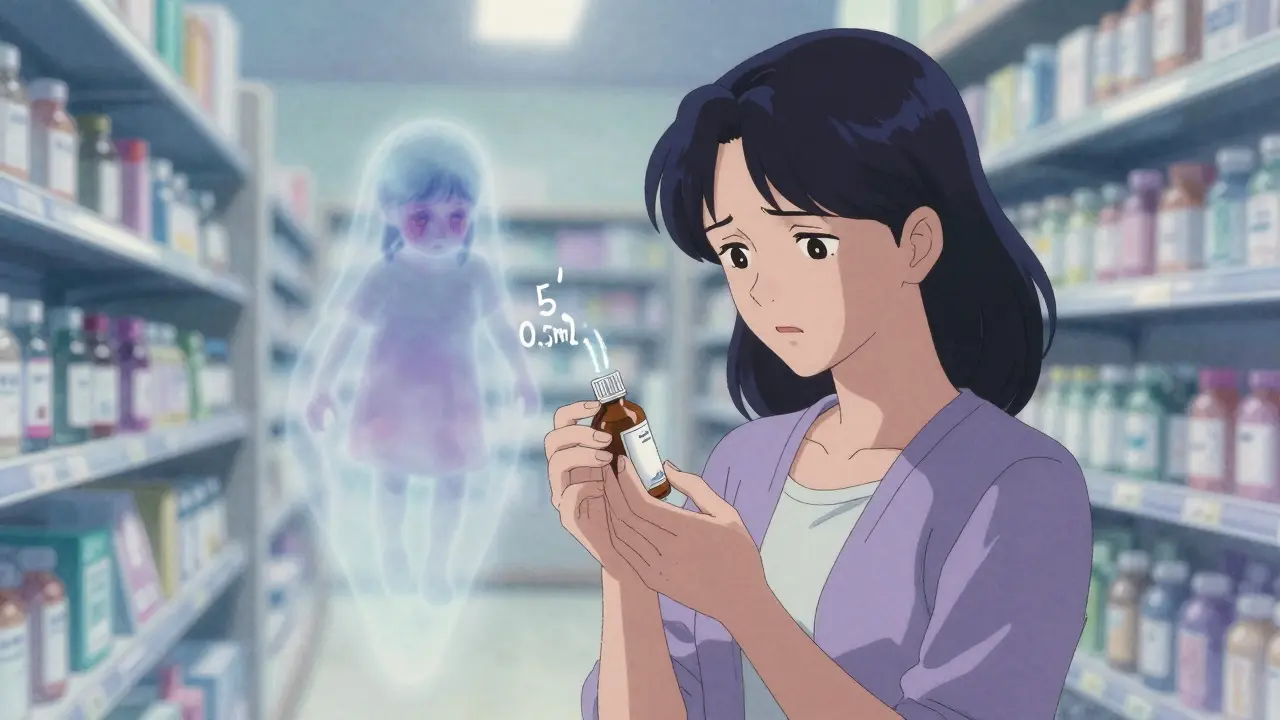
Imagine this: you pick up your child’s liquid antibiotic from the pharmacy. The label says 5 mL twice a day. You use a kitchen teaspoon. Two days later, your child is vomiting, lethargic, and in the ER. The pharmacy gave you 5 mL per dose-but the prescription was for 0.5 mL. The difference? A tenfold overdose. This isn’t rare. It happens more often than you think-and it’s almost always preventable.
Why Double-Checking Medication Strength and Quantity Matters
Every year, tens of thousands of patients in the U.S. suffer harm from medication errors. About 63% of fatal errors involve high-alert drugs like insulin, opioids, and blood thinners. The biggest culprit? Mistakes in medication strength and total quantity. A prescription might say “10 mg/mL,” but if the bottle contains 100 mL, the total drug amount is 1,000 mg-not 10 mg. Patients, and even some healthcare workers, confuse concentration with total dose. That’s why the final check before handing over the medication isn’t just good practice-it’s life-saving.The Institute for Safe Medication Practices (ISMP) made this a formal best practice in 2018. By 2023, their updated guidelines stressed that every pharmacist or technician must independently verify two things: the strength per unit (like mg/mL) and the total quantity in the container (like mL or tablets). This isn’t a suggestion. It’s a standard backed by the FDA, the Joint Commission, and the National Coordinating Council for Medication Error Reporting and Prevention (NCCMERP).
What Exactly Do You Check?
It’s not enough to glance at the label. You need a system. Here’s what a proper double-check looks like:- Confirm the strength per unit: Is the prescription for 5 mg/mL? Does the bottle say the same? Look for the primary strength label-not the small print below it.
- Calculate the total amount: If the prescription is for 20 mL of a 5 mg/mL solution, the total drug is 100 mg. Does the bottle contain 20 mL? Does the label show “Total: 100 mg”? If not, stop. Something’s wrong.
- Check the units: Did the prescriber write “mg” or “mcg”? Did the pharmacy label it correctly? A misplaced decimal or missing “c” can turn a safe dose into a lethal one.
- Verify the quantity: Is it 30 tablets or 300? Is it 10 mL or 100 mL? Count the tablets. Measure the liquid. Don’t assume.
For liquid medications, the FDA and USP require that the total drug amount (e.g., “Total: 100 mg”) be displayed in a font size at least 50% larger than the concentration (e.g., “5 mg/mL”). If the label doesn’t follow this, the pharmacy is out of compliance-and putting patients at risk.
Why Visual Checks Alone Aren’t Enough
Many pharmacies rely on a quick visual scan. “Looks right.” That’s not good enough. A 2022 study found that simple visual verification catches only 38% of strength errors. Why? Because humans miss what they expect to see. If you’ve filled 20 insulin prescriptions that day, your brain expects “100 units.” But if the script says “10 units,” you might overlook it.Independent recalculation is the gold standard. One person reads the prescription. Another person recalculates the total dose using a calculator or pharmacy software. This catches 92% of decimal errors-like confusing 0.5 mL with 5 mL. It takes about 47 seconds per prescription. That’s not a lot of time. But it’s the difference between going home safely and ending up in the ICU.
Technology Helps-but Doesn’t Replace Human Judgment
Barcode scanning reduces dispensing errors by 83%, according to the American Journal of Health-System Pharmacy. But here’s the catch: barcodes only work if the data in the system is correct. If the prescriber entered “5 mg/mL” but meant “5 mcg/mL,” the barcode won’t catch it. The same goes for e-prescribing systems that don’t highlight the total drug amount.Technology is a tool, not a safety net. The most effective systems combine barcode scanning with manual double-checking. Hospitals using both have seen a 78% drop in strength-related errors. Community pharmacies that skip the manual step, even with scanners, still report high error rates.

The Hidden Danger: Household Spoons and Poor Labeling
One of the most dangerous practices? Giving patients a kitchen teaspoon for liquid medication. A teaspoon holds 5 mL. A tablespoon holds 15 mL. But not all spoons are the same. Some hold 3 mL. Others hold 7. In 93% of pediatric dosing errors involving household utensils, parents gave the wrong amount because they didn’t know the difference.Best practice? Always provide a metric-only dosing device. Oral syringes for doses under 10 mL. Measuring cups with mL markings for larger doses. The cost? Less than $2 per unit. The benefit? A 76% drop in pediatric dosing errors. The FDA and ISMP have been pushing this for years. Yet, many pharmacies still hand out spoons because they’re “easier” or “cheaper.” That’s not an excuse. It’s negligence.
Real Stories, Real Consequences
A pharmacist in Florida shared on a pharmacy forum that her independent pharmacy cut strength-related errors from 1.2% to 0.15% after implementing a mandatory double-check. In the first month, they caught three insulin errors-one where a patient was supposed to get 10 units, but the label said 100. Another case: a patient got 5 mL of levothyroxine instead of 0.5 mL. The result? Hospitalization, cardiac arrhythmia, weeks of recovery.On Reddit, a pharmacy tech admitted they skipped double-checks during a staffing crisis. The outcome? A tenfold overdose of levothyroxine. The patient didn’t die-but they came close. That tech lost their license.
And then there’s the parent who gave their child 5 mL of acetaminophen because the pharmacy gave them a teaspoon. The child’s liver failed. They needed a transplant. The pharmacy didn’t provide an oral syringe. They didn’t counsel the parent. They didn’t double-check.
What Stops Pharmacies from Doing This Right?
You’d think every pharmacy would follow these rules. But they don’t. Why?- Speed over safety: Corporate chains push for 35+ prescriptions per hour. That’s less than 2 minutes per script. There’s no time for recalculation.
- Staff shortages: In independent pharmacies with fewer than five staff, 68% admit to inconsistent double-checking. No backup means someone skips steps.
- Training gaps: 92% of errors happen in the first three months after a technician starts. Many pharmacies don’t provide proper training-or refresher courses.
- Outdated systems: Some pharmacies still use old labels that don’t follow FDA/USP guidelines. The total amount isn’t bold. It’s buried.
And here’s the kicker: the government is starting to penalize bad behavior. Medicare Part D now requires proof of strength verification for pharmacies to stay in their network. Hospitals with high error rates face 0.75% payment cuts. The Joint Commission lists failure to verify strength as a “sentinel event”-meaning if a patient dies or is permanently harmed, the pharmacy must undergo a full investigation.

What You Can Do as a Patient or Caregiver
You’re not powerless. Even if the pharmacy skips the double-check, you can protect yourself:- Ask: “Can you show me how much total medicine is in this bottle?”
- Check the label: Is the total amount clearly printed and larger than the concentration? If not, ask for clarification.
- Request a dosing device: Never accept a kitchen spoon. Ask for an oral syringe or measuring cup with mL markings.
- Verify the dose: If the prescription says “0.5 mL twice daily,” make sure the syringe measures 0.5 mL-not 5 mL. Look at the numbers, not the lines.
- Speak up: If something feels off, say so. You’re the last line of defense.
Medication safety isn’t just the pharmacist’s job. It’s a team effort. And if you’re the one giving the medicine, you have the right-and the responsibility-to make sure it’s right.
What’s Changing in 2025?
The FDA is pushing for even stricter rules. By Q3 2025, all injectable medications must display the total drug amount in bold font, at least 50% larger than concentration. E-prescribing systems must now highlight total dose in liquid prescriptions. USP is testing a new digital verification system that will cross-check medication strength against national databases in real time.The goal? A 50% reduction in strength-related errors by 2027. That’s not a dream. It’s a target backed by $14.7 million in federal grants for community pharmacies to upgrade their systems.
Double-checking medication strength and quantity isn’t a bureaucratic hoop. It’s the final, critical step that stops a mistake from becoming a tragedy. It takes seconds. It saves lives. And it should never be skipped-not once, not ever.
Why is double-checking medication strength so important?
Double-checking prevents deadly dosing errors, especially with high-alert medications like insulin, opioids, and blood thinners. Many errors happen because patients and providers confuse concentration (e.g., 5 mg/mL) with total amount (e.g., 100 mg). A simple misread can lead to a tenfold overdose. Studies show this step prevents 87% of strength-related dispensing errors.
What should I look for on a medication label?
The total drug amount (e.g., “Total: 100 mg”) must be the most prominent text on the label, printed in a font size at least 50% larger than the concentration (e.g., “5 mg/mL”). Look for metric units (mL, mg) only. Avoid labels that use teaspoons or tablespoons. If the total amount isn’t clearly stated, ask the pharmacist to clarify.
Is using a kitchen spoon to measure liquid medicine safe?
No. Kitchen spoons vary in size and are not accurate. A 2022 study found 93% of pediatric dosing errors involving household utensils resulted from confusion between teaspoons and tablespoons. Always use an oral syringe or measuring cup marked in milliliters (mL). Pharmacies are required to provide these devices for liquid medications.
Can barcode scanning replace manual double-checking?
No. Barcode scanning reduces errors by 83%, but it only works if the system data is correct. If a prescriber enters the wrong strength or concentration, the barcode won’t catch it. Manual recalculation by a second person is still the most reliable way to catch human errors in prescribing or labeling.
What should I do if I think my medication dose is wrong?
Stop. Don’t take it. Call the pharmacy and ask them to confirm the strength and total amount with the original prescription. If they dismiss your concern, contact your prescriber or go to another pharmacy. You have the right to safe medication. Never assume the dose is correct just because it came from a pharmacy.
Are pharmacies legally required to double-check medication strength?
Yes. The Joint Commission, FDA, and NCCMERP all require verification of medication strength and quantity. Medicare Part D now requires proof of these protocols for pharmacies to remain in their network. Failure to comply can result in fines, loss of accreditation, or legal liability if a patient is harmed.
Next Steps: How to Make This a Habit
If you’re a pharmacist or technician: Start tomorrow. Make double-checking mandatory for every prescription-not just controlled substances. Use a checklist. Time yourself. 45 seconds per script is all it takes. Train new staff. Don’t skip refresher courses. And if your pharmacy pressures you to rush, speak up. Your name is on that label too.If you’re a patient or caregiver: Don’t be shy. Ask questions. Demand a proper dosing device. Verify the numbers. You’re the last line of defense. And if you ever feel unsure-trust your gut. It’s better to be safe than sorry.
Medication errors don’t happen because people are careless. They happen because systems fail. Double-checking strength and quantity isn’t just a step-it’s a promise. A promise that no one will be hurt because someone skipped a check. Make that promise real.
Man, I never thought about how dangerous kitchen spoons can be until I read this. My cousin’s kid ended up in the ER last year because they used a soup spoon for antibiotics. Turns out it held like 8 mL instead of 5. Scary stuff. I now always ask for a syringe - no excuses.
Also, why do pharmacies still hand out spoons? It’s not like they cost anything. $2 for a syringe is nothing compared to an ER visit.
The data presented here is unequivocal: independent verification of concentration and total quantity reduces dispensing errors by over 85%. The Institute for Safe Medication Practices (ISMP) guidelines, reinforced by the FDA and Joint Commission, are not advisory but mandatory standards for accredited institutions. Failure to comply constitutes a breach of professional duty of care.
bro i work at a small pharmacy in mumbai and we dont even have barcode scanners. we just check the label twice and write the total mg on a sticky note and stick it on the bottle. its not fancy but it works. we caught 3 wrong doses last month just by asking "wait, this says 5mg/ml but the script says 0.5?"
people think tech fixes everything but human eyes still matter. also, we give out syringes for free. no one complains.
My mom used to give my brother his medicine with a spoon and I always freaked out. I didn’t know it was that dangerous until I read this. Now I carry a little syringe in my purse just in case. It’s so simple but so important.
Why don’t more people know this?
Every time I pick up a prescription now I check the total amount. I even say it out loud: "So 0.5 mL times 2 doses a day for 10 days is 10 mL total?"
Pharmacists look at me weird but I don’t care. I’d rather be annoying than bury my kid.
Also, if they don’t give you a syringe, just ask again. They’re not mad. They’re just busy.
This is not merely a procedural recommendation - it is a sacred covenant between healthcare provider and patient. To neglect the dual verification of concentration and total quantity is to flirt with moral bankruptcy. The technology exists. The protocols are codified. The consequences are fatal. To proceed otherwise is not negligence - it is malice cloaked in convenience.
Every syringe provided is a prayer whispered against death. Every label with bolded total dosage is a vow. Will you honor it?
USA is so soft. In India we just trust the doctor. If you can’t read a label, don’t give medicine. Problem solved.
Also why are you giving kids liquid drugs? Just give pills. Less mess. Less chance for error. Your culture is too obsessed with overcomplicating things.
I used to work at a pharmacy and we got pressured to do 40 scripts an hour. We’d skip checks just to keep up. Then one day we almost gave a 10x overdose of levothyroxine. The tech cried. The owner apologized. We started double-checking after that.
You’re not a machine. You’re a person. Take the 47 seconds.
Also - yes, ask for the syringe. They’ll give it. Promise.
Everyone thinks pharmacies are perfect but they’re not. I’ve seen labels where the total dose was written in tiny font under the concentration. I asked and they said "it’s there if you look". No. It should be obvious. I’ve been trying to get this fixed for years. No one listens.
And don’t even get me started on the people who use spoons. I swear half the parents don’t know what mL means.
This is why America is collapsing. You turn a simple act of taking medicine into a federal audit. We used to trust doctors. Now we have to be pharmacists too? What’s next? Do you need a degree to use a thermometer?
And why are you forcing pharmacies to spend $2 on syringes? That’s taxpayer money wasted. Just tell people to read the label. Problem solved.
How quaint. In the UK, we have standardized dosing units and mandatory pharmacist training. No one uses teaspoons. No one needs to "double-check" because the system is designed to prevent error. This post reads like a 1990s American safety manual. Progress is possible - but only if you stop treating medicine like a DIY project.