
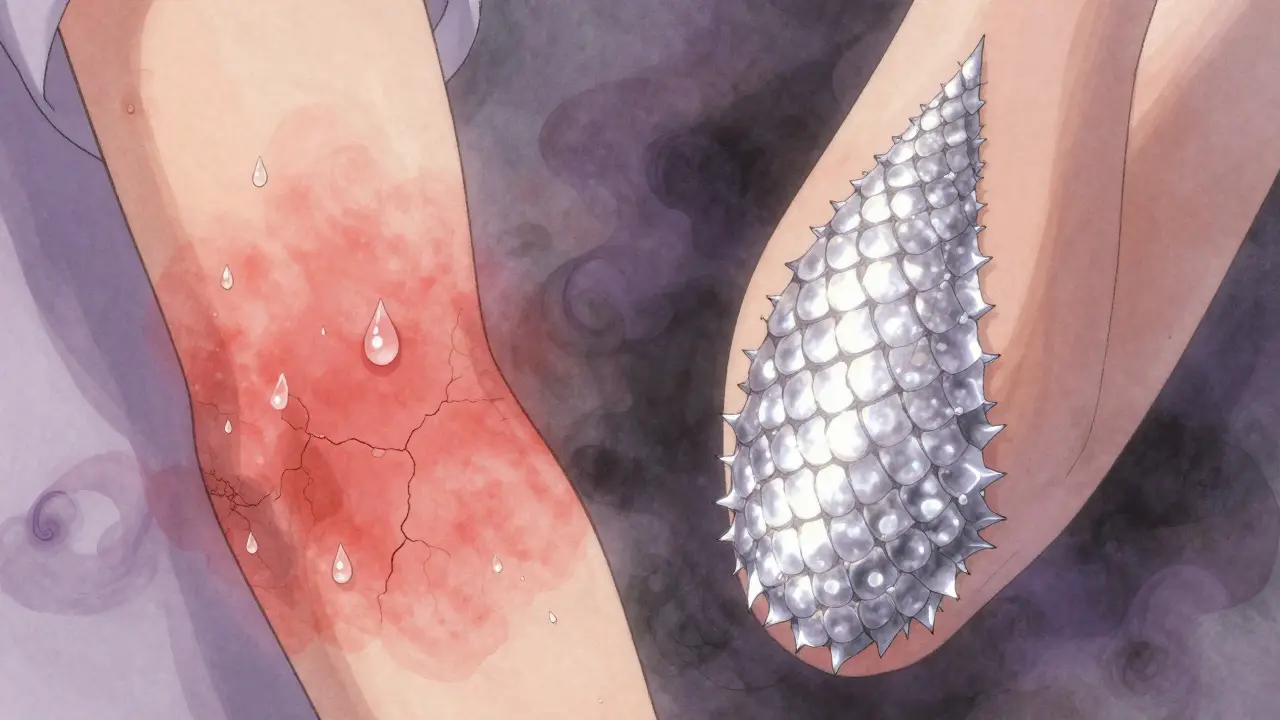
Two skin conditions that look almost the same at first glance - eczema and psoriasis - can send people down the wrong treatment path for months, even years. If you’ve ever stared at a red, itchy patch on your arm or leg and wondered whether it’s eczema or psoriasis, you’re not alone. Misdiagnosis happens in 15-20% of cases, especially when skin is darker. But the truth is, they’re not the same disease. They don’t just feel different - they look different. And learning how to spot those visual clues can save you time, money, and unnecessary stress.
Where the Rash Shows Up Tells You a Lot
One of the fastest ways to tell eczema and psoriasis apart is by location. Think of your body like a map. Eczema likes the folds. It settles in the inner elbows, behind the knees, on the neck, wrists, and ankles. In babies, it’s often on the cheeks and scalp. This isn’t random. These are areas where skin rubs against skin or where moisture gets trapped. Eczema thrives in those spots. Psoriasis, on the other hand, prefers the outside edges. It shows up on the outer elbows, front of the knees, scalp, lower back, and around the nails. If you see thick, scaly patches on the outside of your elbow - not the inside - it’s far more likely to be psoriasis. A 2020 study of over 1,200 patients found that 94.7% of eczema cases involved flexural (bendable) areas, while 88.6% of psoriasis cases hit extensor (straight-side) areas. That’s a huge gap. There’s one exception: inverse psoriasis. It shows up in skin folds - armpits, groin, under breasts - but it looks different. Instead of thick, scaly plaques, it’s smooth, shiny, and red without the white flakes. If you see scaling in a fold, it’s probably eczema.The Look of the Skin: Flaky vs. Weepy
Now look closer at the rash itself. Eczema often looks raw. In its active phase, the skin may weep, ooze, or crust over. It’s not dry all the time - sometimes it’s wet. The borders are blurry. It doesn’t have sharp edges. On lighter skin, it’s bright red. On medium to dark skin, it turns ashen, purple, or gray. The texture is thin, sometimes cracked, and always itchy. Psoriasis is the opposite. It’s dry, thick, and stubborn. The classic form - plaque psoriasis - looks like raised, silvery-white scales sitting on top of red or violet patches. The scales don’t flake off easily. They stick. And when you do scrape them off, you might see tiny spots of blood underneath. That’s called the Auspitz sign. It doesn’t happen with eczema. A 2023 study found that 78% of psoriasis lesions had visible, thick scaling. Only 32% of eczema cases did. And when they did scale, it was fine, powdery, and not thick. Psoriasis scales average 0.5mm thick. Eczema scales? Around 0.1mm. That’s five times thinner.Nails Don’t Lie
Check your fingernails. If you see small pits - like someone tapped them with a pin - that’s a strong sign of psoriasis. About half of people with psoriasis get this. Nail separation - where the nail lifts from the bed - happens in 80% of psoriasis cases with nail involvement. It’s rare in eczema. If your nails are just ridged or discolored, it’s more likely eczema. But even then, it’s not common. Only 5-10% of severe eczema cases affect nails at all.
What Happens When Skin Gets Injured?
Here’s a trick most people don’t know: if you scratch, scrape, or burn your skin, and new rashes appear right where the injury happened, that’s called the Koebner phenomenon. It happens in 25-30% of psoriasis patients. It’s rare in eczema. So if you got a cut on your arm and a week later, a rash formed exactly where the cut was - that’s a red flag for psoriasis.How It Looks on Darker Skin
This is critical. Most medical images show eczema and psoriasis on light skin. But 70% of the world’s population has skin tones that are medium to dark. On these skin tones, both conditions look very different. Eczema doesn’t turn bright red. It becomes darker brown, gray, or purplish. The scaling is subtle - you might miss it. Psoriasis doesn’t look red either. It appears as deep violet or dark brown plaques with fine white scales. In fact, a 2023 study found that 68% of psoriasis lesions on darker skin show a pale halo around the edges - something you won’t see with eczema. The problem? Doctors are often trained on light-skin images. A 2023 survey found that 68% of dermatologists felt underprepared to diagnose these conditions on darker skin. As a result, people of color wait an average of 14.3 months for a correct diagnosis - nearly three times longer than white patients.What Patients Say About Their Rashes
Real people describe their rashes in ways that match the science. On patient forums, 87% of eczema users say their skin feels “raw,” “weepy,” or “cracked.” They talk about bleeding from scratching. Meanwhile, 76% of psoriasis users describe their skin as “armor-like,” “thick,” or “covered in silver plates.” One Reddit user wrote: “It looks like someone glued paper to my skin and then painted it white.” Another key difference: eczema flares up and fades with triggers - soap, stress, dry air. Psoriasis plaques stay stubborn. They don’t disappear overnight. Even when they improve, the scale lingers.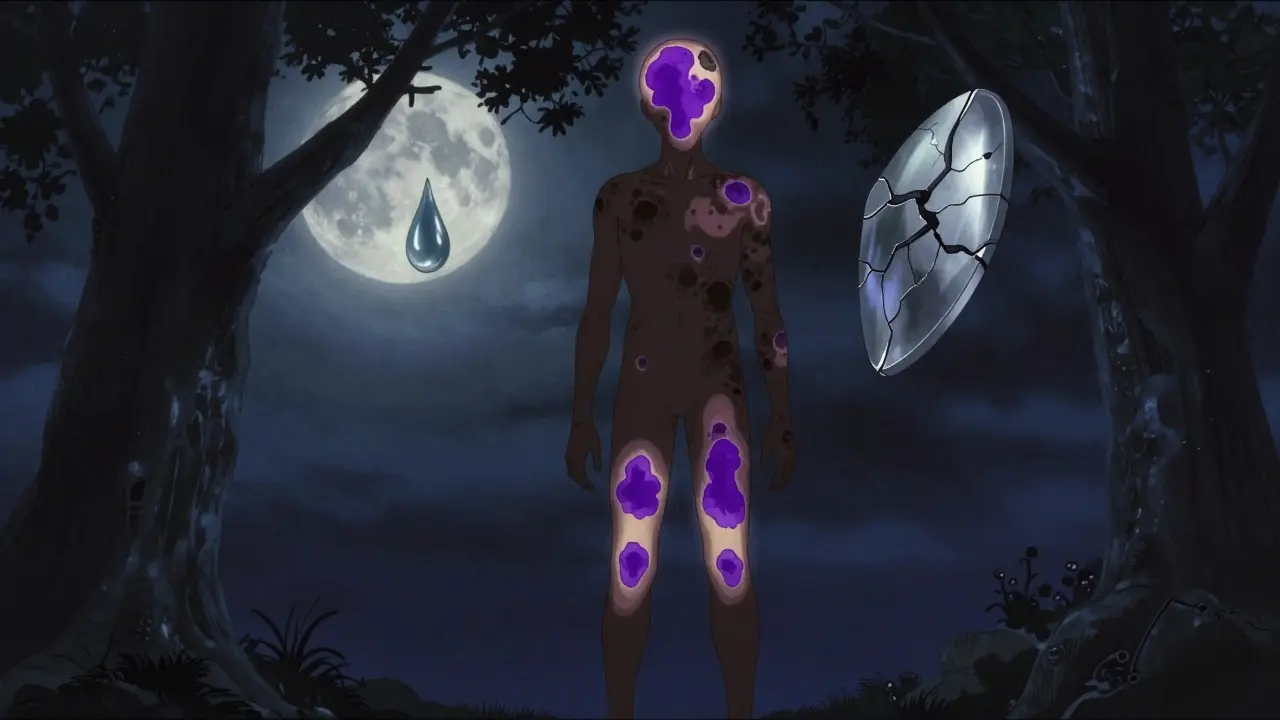
Simple Tests You Can Do at Home
You don’t need a doctor to spot some clues. Try this: gently scrape the edge of the rash with a clean glass slide or credit card. If you get thick, silvery scales that bleed slightly underneath - that’s psoriasis. If you get fine, powdery flakes with no bleeding - it’s likely eczema. Also, take photos. Use the same lighting, same angle, same time of day. Psoriasis changes slowly. Eczema changes fast - sometimes in hours. Tracking that helps you and your doctor see patterns.What’s New in Diagnosis
Technology is catching up. In January 2024, the FDA approved the first AI tool - DermAI Psoriasis/Eczema Classifier - that analyzes smartphone photos to help tell the two apart. It’s trained on 250,000 verified cases. It’s 85% accurate. But here’s the catch: it’s less accurate on darker skin. Current AI tools are 22% less reliable for Fitzpatrick skin types V and VI. That’s because most training data came from light-skinned patients. A 2023 study in Nature Medicine used multispectral imaging to detect differences in how skin reflects light. Psoriasis reflects more at 540nm (oxygenated blood), while eczema reflects more at 660nm (water content). This tech isn’t in clinics yet - but it’s coming. The Global Registry of Skin of Color Dermatology launched in 2024 to fix this. It’s collecting 100,000 images from diverse skin tones to build better diagnostic tools. By 2029, experts believe this could cut diagnostic delays by 60%.What to Do Next
If you’re unsure what you’re dealing with, don’t guess. See a dermatologist. Bring your photos. Tell them where it shows up. Mention if it bleeds when scraped. Say if it’s weepy or dry. If your skin is dark, ask if they’ve been trained to diagnose skin conditions on your tone. There’s no home cure. But knowing the difference helps you ask better questions. Eczema treatment focuses on moisturizing and calming inflammation. Psoriasis needs therapies that slow skin cell growth - like topical steroids, light therapy, or biologics. Using the wrong treatment can make things worse. The bottom line: eczema is about barrier failure and irritation. Psoriasis is about immune overdrive. They look similar. But the details? They’re worlds apart.Can eczema turn into psoriasis?
No. Eczema and psoriasis are two separate conditions with different causes. One cannot turn into the other. But it’s possible to have both at the same time - though that’s rare. If your rash changes suddenly in texture or location, see a dermatologist. It might mean your condition is worsening or you’ve developed a second issue.
Does psoriasis itch as much as eczema?
Both can itch, but the way they itch is different. Eczema usually causes intense, constant itching that leads to scratching and skin damage. Psoriasis can itch too, but many people describe it as more of a burning or stinging sensation. Some psoriasis patients say the itching is mild compared to the discomfort of thick, tight skin. The key point: if you’re scratching so hard your skin bleeds, it’s more likely eczema.
Can I diagnose myself using online photos?
You can use photos to track changes and prepare for your doctor visit, but don’t rely on them for a diagnosis. Many online images are outdated, poorly lit, or show only light skin. Even AI tools can misread darker skin tones. A proper diagnosis requires a physical exam - sometimes with a skin biopsy. Self-diagnosis can lead to wrong treatments, which may worsen your condition.
Why does my rash look different in winter?
Both conditions often flare in winter because of dry air. But eczema usually gets worse - skin cracks, weeps, and becomes more inflamed. Psoriasis may also flare, but it tends to stay thick and scaly. If your rash becomes more red and weepy in cold weather, it’s likely eczema. If it stays scaly but gets thicker, it’s probably psoriasis. Tracking seasonal patterns helps your doctor identify the condition.
Are there any home remedies that work for both?
Moisturizing daily helps both. But that’s where the similarity ends. For eczema, fragrance-free ointments like petroleum jelly are best. For psoriasis, thicker creams with salicylic acid or coal tar can help break down scales. Avoid harsh scrubs or hot showers - they trigger both. But don’t use psoriasis treatments on eczema, or vice versa. They work differently. Always check with your doctor before trying new products.
Is one condition more serious than the other?
Neither is “worse” - but both can affect your life deeply. Psoriasis is linked to higher risks of arthritis, heart disease, and diabetes. Eczema is linked to asthma, allergies, and sleep loss from itching. Both can cause emotional distress. The real danger is misdiagnosis. Treating psoriasis like eczema (or vice versa) can delay proper care. That’s why accurate identification matters more than which one is “more serious.”
Let’s cut through the noise: eczema = barrier dysfunction, psoriasis = Th17-driven autoimmunity. Location, scale thickness, and Auspitz sign are your trifecta for differential diagnosis. No more guessing. If you’re seeing silvery plaques on extensor surfaces? It’s psoriasis. Period.
Stop treating it like dry skin. You’re wasting time and money.
i’ve been dealing with this for years and honestly, i never knew the difference until i read this. the part about the folds vs. edges made so much sense-my rash was always on the back of my knees but i thought it was just ‘bad eczema.’ turns out it’s psoriasis. thanks for clarifying. i’ll finally book that derm appt.
ps. sorry for the typos, typing on my phone in the car lol
OMG I’M SO RELIEVED I’M NOT ALONE 😭😭😭
I’ve been told it’s eczema for 5 years but my nails have been pitted since college and my skin feels like armor??? I’ve been crying in the shower every night thinking I’m just ‘sensitive’ and ‘dramatic’…
IT’S PSORIASIS. I’M NOT CRAZY. THANK YOU. 🙏💜
Wow, so we’re supposed to believe that a Reddit post with ‘2023 study found’ and zero links is now the gold standard of dermatology?
Let me guess-you also think ‘natural remedies’ cure cancer and your yoga mat fixes your autoimmune disease.
Meanwhile, real doctors are still waiting for a biopsy and a 30-minute consult. But sure, scrape your rash with a credit card and call it a day. 😂
This is actually one of the clearest breakdowns I’ve seen. The Koebner phenomenon detail? Game-changer. I had a burn from a hot mug last winter and a plaque popped up exactly where it happened-never connected it until now.
Also, the AI tool stats are concerning. We need more diverse training data. If you’re a dev or researcher reading this-reach out to the Global Registry. This is the kind of equity work that matters.
And yes, moisturizing helps both. But don’t slap hydrocortisone on psoriasis and expect it to vanish. Been there. Did that. Regretted it.
You people are so obsessed with labels. Why not just accept that your skin is messed up and stop trying to diagnose yourself? You’re not a doctor. Stop reading blogs and go see a professional. This post is giving people dangerous ideas. Eczema and psoriasis are both just ‘skin problems.’ Why make it so complicated?
Man, this post saved me. I’ve been using eczema cream on my elbows for 2 years and it just made it worse. Now I know why-it’s psoriasis. I just started salicylic acid cream last week and the scaling is already fading.
Also, the nail pitting thing? Yeah, mine’s been like that since I was 16. Never thought it was connected.
Big thanks for the photos tip too. I’m gonna start a folder on my phone. Seriously, this is the kind of info that should be in med schools.
It is with profound gratitude that I express my appreciation for the meticulous delineation of clinical distinctions between atopic dermatitis and plaque psoriasis as presented herein. The geographical predilection of lesions, the histopathological variance in scaling thickness, and the differential manifestation of the Koebner phenomenon are not merely academic curiosities-they are foundational to equitable dermatological care, particularly in populations historically underrepresented in dermatological literature. I am particularly moved by the data regarding diagnostic latency in Fitzpatrick skin types V and VI; such disparities constitute a public health imperative. The Global Registry of Skin of Color Dermatology represents a paradigmatic shift toward justice in medical visualization. May its repository expand with urgency and precision. I shall forward this to my departmental chair forthwith.
-Amy Cannon, MD Candidate, Johns Hopkins
THIS. IS. EVERYTHING. 🙌
I’ve spent $3,000 on useless creams, missed work because my legs were cracked open, and my mom kept telling me to ‘just moisturize more.’ I didn’t know psoriasis could look dark violet on my skin. I thought I was just ‘getting older.’
Now I’m taking my photos to my derm tomorrow. And I’m asking if they’ve trained on non-white skin. If they haven’t, I’m walking out. No more guessing games. I’m done being ignored.
Thank you for writing this. I’m not broken. I’m just misdiagnosed.