
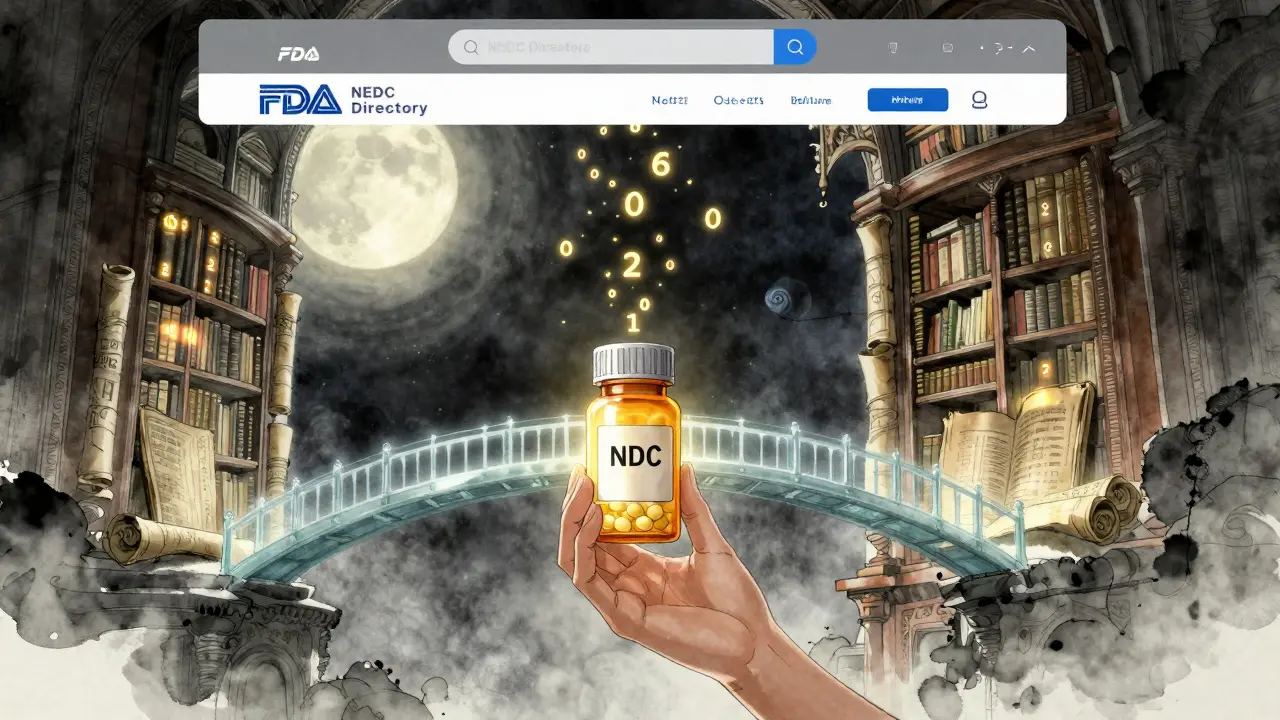
Every year, millions of people take prescription meds without ever checking if they’re real. That’s a problem - because counterfeit drugs are more common than you think. The FDA doesn’t just regulate drugs; it runs a set of public databases that can tell you if a medication is legitimate. You don’t need to be a pharmacist to use them. You just need to know where to look and what to look for.
What the FDA Databases Actually Do
The FDA doesn’t keep a public list of every pill sold in the U.S. But it does track who makes them, where they’re made, and what they’re supposed to look like. Three key systems do this work: the National Drug Code (NDC) Directory, the Drug Establishments Current Registration Site, and the Electronic Drug Registration and Listing System (eDRLS).
The NDC Directory is your best starting point. Every FDA-approved drug has a unique 10- or 11-digit number - the NDC. It’s split into three parts: the first part identifies the manufacturer, the second identifies the drug (like its strength and form), and the third tells you the package size. If a pill doesn’t match the NDC in the FDA’s database, it’s not supposed to be there.
The Drug Establishments Current Registration Site shows you which companies are legally allowed to make or distribute drugs in the U.S. If a company isn’t listed here, they’re either not registered or their registration expired. And eDRLS? That’s where companies submit their drug data electronically. It’s not public, but the data it feeds into the NDC Directory is.
How to Check if a Drug Is Real
Let’s say you bought a bottle of metformin online, and the packaging looks off. The label is blurry. The pills are a different color. Here’s what to do:
- Find the NDC on the packaging. It’s usually printed near the barcode.
- Go to the FDA’s NDC Directory.
- Enter the full NDC number - no spaces, no dashes.
- Check the results. Does the drug name match? The manufacturer? The strength? The dosage form?
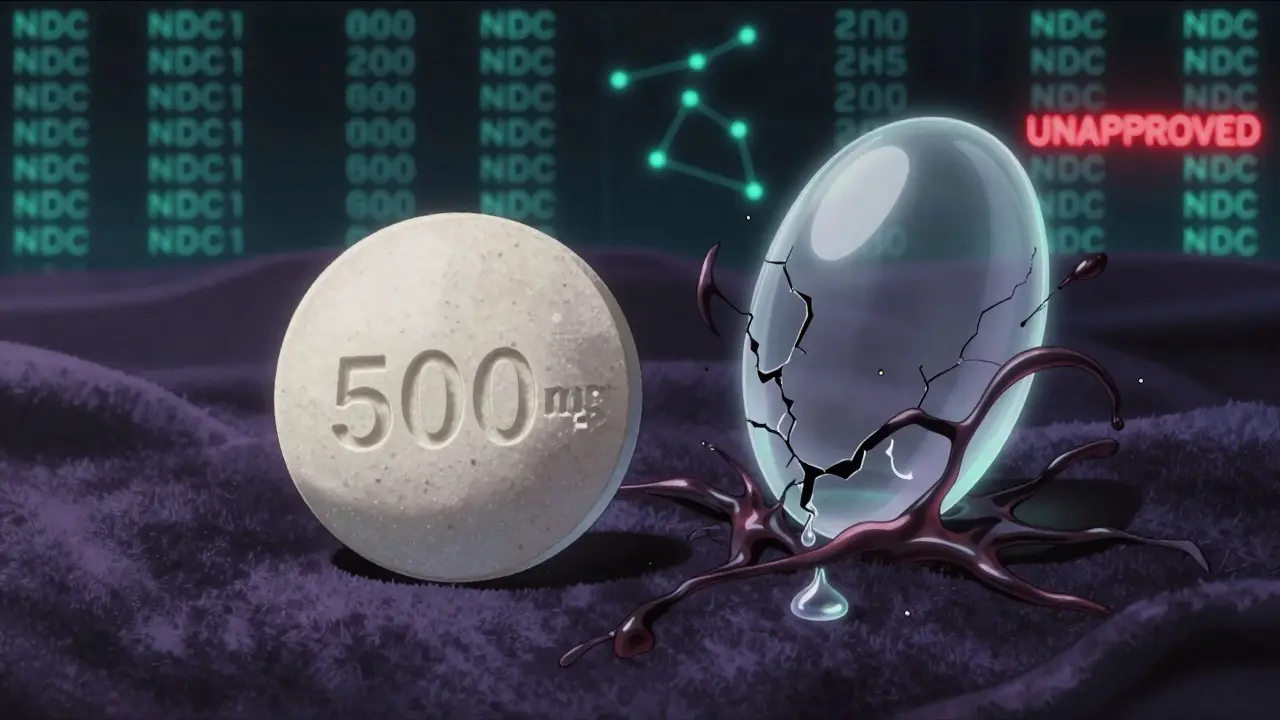
If it doesn’t match exactly - if the manufacturer says “ABC Pharma” but your bottle says “XYZ Meds” - it’s fake. Or at least not approved. The FDA doesn’t approve generics from unknown companies. If you see a brand-name drug listed as “unapproved,” that’s a red flag.
For example, the NDC for a 500mg metformin tablet made by Teva is 0093-4095-02. If you search that number and get back a different manufacturer or dosage, something’s wrong. Real drugs have consistent, verifiable data. Counterfeits don’t.
Spotting Fake Drugs in the Wild
Counterfeit drugs aren’t always easy to spot. Some look perfect. Others are obvious fakes: wrong color, misspelled names, no batch number. But here’s what to watch for:
- **No NDC on the package** - if it’s not there, the drug isn’t regulated.
- **Unusual packaging** - flimsy bottles, mismatched fonts, no tamper-proof seal.
- **Too cheap** - if a brand-name drug is 80% cheaper than at your local pharmacy, it’s likely fake.
- **Selling online without a prescription** - U.S. law requires prescriptions for most meds. If a website sells them without one, they’re breaking the law.
Also, check the company. Go to the Drug Establishments Current Registration Site. Search for the manufacturer’s name. If it’s not there, or if it was canceled in 2022, walk away.
Why This Matters - Real-World Risks
In 2022, the FDA reported a 18% jump in counterfeit drug incidents. That’s not just about money - it’s about life and death. Fake insulin can spike your blood sugar. Counterfeit antibiotics might not work at all. A 2021 FDA study found that 32% of seized counterfeit drugs contained no active ingredient. Another 19% had the wrong dose. Some even had toxic chemicals like lead or rat poison.
Most fake drugs come from overseas. Only 35% of foreign manufacturers fully comply with U.S. tracking rules. That’s why the FDA’s system is so important. It’s the only way to trace a drug back to its source.
Companies that use the FDA’s systems correctly have 78% fewer counterfeit incidents, according to Supply Chain Insights. That’s not luck - it’s data.
What’s Changing in 2024 and Beyond
The FDA isn’t done. In 2023, new rules kicked in requiring every drug package to have a unique 2D barcode - a product identifier that links to a digital chain of custody. By 2026, the NDC format will shift to a 12-digit standard, making tracking even more precise.
The FDA also plans to add product images to the NDC Directory by Q3 2024. That means you’ll be able to compare your pill’s shape and color to an official image - right on the website.
And it’s not just the FDA. Companies like IBM and Google are testing AI tools that scan supply chain data for anomalies. One pilot project using machine learning caught 99.2% of fake drugs - far better than the current 87% rate.
What You Can’t Do - And What You Shouldn’t Trust
Don’t rely on third-party apps or websites that claim to “verify” drugs. Many are scams. Only trust the FDA’s official databases. No app, no chatbot, no Google search result is as reliable as the NDC Directory.
Also, don’t assume that because a drug is sold in the U.S., it’s safe. The FDA doesn’t inspect every shipment. That’s why the verification system exists - to let you double-check what you’re taking.
And if you’re a patient: if you notice a change in how a drug works - side effects, no effect, strange taste - report it. The FDA’s MedWatch program lets you report suspected counterfeits. That data helps them track outbreaks.
Bottom Line: Know Your Meds
You don’t need to be an expert to protect yourself. Just learn to read the NDC. Check the manufacturer. Compare the packaging. Use the FDA’s tools - they’re free, public, and built for exactly this.
Counterfeit drugs are a growing threat. But they’re not invisible. With a few minutes and the right tools, you can tell real from fake. And that simple step? It might save your life.
How do I find the NDC number on my medication?
The NDC number is usually printed on the packaging near the barcode or lot number. It’s a 10- or 11-digit number, often formatted like 12345-678-90. Look for a sequence of numbers that matches this pattern - it’s not the lot number or expiration date.
Can I trust online pharmacies that sell drugs without a prescription?
No. U.S. law requires a valid prescription for most prescription drugs. Pharmacies that sell them without one are breaking the law. Many are fronts for counterfeit drug operations. Always use a pharmacy licensed in your state - you can verify that through your state’s board of pharmacy website.
What if the NDC number in the FDA database doesn’t match my pill?
If the manufacturer, drug name, strength, or dosage form doesn’t match what’s on your bottle, the drug is likely counterfeit or mislabeled. Stop taking it. Contact the FDA’s MedWatch program to report it. Do not return it to the seller - they may be part of the problem.
Are generic drugs less likely to be fake?
No. Generics are just as targeted as brand-name drugs because they’re cheaper and in high demand. Fake generics often have the same NDC as the real version. That’s why checking the manufacturer and NDC details is critical - even for generics.
Do FDA databases work for drugs bought outside the U.S.?
Only if the drug was approved and registered for sale in the U.S. Many foreign drugs - even if they’re real in their home country - aren’t approved by the FDA and won’t appear in the NDC Directory. That doesn’t mean they’re fake - just not legally sold here. Always check with your doctor before taking foreign meds.
How often is the FDA’s database updated?
The NDC Directory is updated daily. Drug establishment registrations are updated every business day. If a company loses its registration or a drug is pulled from the market, it’s removed within 24 hours. That means the data is current - not outdated.
Is there an app for checking FDA drug info?
The FDA doesn’t have an official app for this. Some third-party apps claim to verify drugs, but they’re not connected to the FDA’s systems and can’t be trusted. Always use the official FDA website: https://www.accessdata.fda.gov/scripts/cder/ndc/.
Can I report a suspected counterfeit drug?
Yes. Use the FDA’s MedWatch program. You can report online at fda.gov/medwatch or call 1-800-FDA-1088. Include the NDC number, manufacturer name, where you bought it, and a photo if possible. Your report helps the FDA track outbreaks and shut down illegal operations.
I don't have time to check NDC codes for every pill I take. My doctor prescribes it, my pharmacy fills it - that's enough. Why am I supposed to become a forensic pharmacist just to take blood pressure meds? This feels like overkill.
And don't get me started on how the FDA doesn't even inspect every shipment. If they can't do their job, why should I?
Also, why do I need a 2D barcode? My phone can't even scan QR codes reliably. This whole system is built for people who have too much free time.
Oh wow. The FDA has a database. Groundbreaking. I'm sure the 32% of counterfeit drugs with zero active ingredient were just a statistical anomaly.
Let me guess - the same people who told us 'pharmaceuticals are safe' are now the ones telling us to 'check the NDC.'
Here's the real jargon: 'regulatory capture.' The FDA is a gatekeeper for Big Pharma, not a public safety watchdog. The databases? A PR stunt. The real problem is the monopolistic patent system that lets companies charge $1000 for a pill that costs $2 to make. But hey, at least you can verify your $1000 counterfeit is officially counterfeit. Congrats.
You think this is about safety? Nah. The NDC system is a tracking mechanism. They're not protecting you - they're tracking your medication history. Who's behind the database? Who owns the data? Who's feeding it to insurance companies? Who's cross-referencing your prescriptions with your mental health records?
And don't forget - the FDA's system is built on corporate submissions. What if a company lies? What if they're owned by a foreign entity with ties to the Chinese military? You think they'd tell you that? You think they'd update the database if they were caught?
This isn't verification. It's surveillance with a Band-Aid.
The question is not whether the database works but whether the system that produces the database is just
When you reduce life to a 10-digit number you erase the humanity of medicine
A pill is not a code it is a promise between human beings
The FDA database pretends that truth can be encoded in a barcode
But truth is not a database entry truth is the silence between the pharmacist and the patient when they hand over the bottle and say take it slowly
Technology does not heal only care does
And care cannot be verified by a government server
So yes check the NDC if you must
But do not mistake verification for healing
That is the tragedy of our age
This is one of the most important public health tools we have - and honestly, it's underused. Most people don’t know their meds can be fake. I’ve had patients come in with bottles that looked legit but the NDC didn’t match - turned out they bought it from a shady site that looked like CVS. One guy was on fake metformin for six months. His A1C was through the roof. He thought his diabetes was getting worse.
It’s not paranoia. It’s literacy. Think of it like checking the VIN on a used car. You wouldn’t buy a car without verifying its history. Why treat your health any differently?
The FDA’s system is free, public, and updated daily. That’s a gift. Use it. Teach your parents. Share it with your friends. It’s not complicated. Five minutes could save your life. Seriously - do it.
I just found out my blood pressure pills are fake??? I’ve been taking them for 3 years??? My husband thinks I’m overreacting but I can’t sleep I keep thinking about what’s in them what if they have lead what if they have rat poison what if I’m slowly dying and no one told me??? I looked up the NDC and the manufacturer was different??? I’m calling the FDA right now I don’t care if it’s 3am I need to know if I’m poisoned??? I hate this I hate this I hate this I hate this I hate this
India produces 20% of the world's generic drugs. We have the most stringent quality controls. The FDA's database is a tool for American paranoia, not global truth.
Why do you assume every drug from outside the US is fake? Many Indian manufacturers are WHO-GMP certified. Your fear is colonial. You distrust our medicines because you don't understand them.
Stop using American databases to judge global health. Our generics save lives worldwide. Your NDC obsession is not safety - it's nationalism.
Love this breakdown. Seriously. I showed my mom how to check her pills last week and she was shocked - she’d been taking a fake version of her cholesterol med for over a year. No one told her. She thought the pharmacy was just ‘selling a different brand.’
It’s wild how little we’re taught about this. I think every high school should have a 10-minute module on how to check NDCs. It’s like teaching CPR - you hope you never need it, but if you do, you’ll be ready.
Also, the 2D barcode rollout in 2026? That’s gonna be a game-changer. Imagine scanning your pill bottle and seeing its entire supply chain history. That’s next-level transparency.
The NDC Directory is publicly accessible and reliable. The data is standardized and updated daily. Verification requires no special tools beyond a web browser and attention to detail. This is not a complex process. It is a fundamental responsibility of informed patient care.
i just checked my insulin and it matched!! i was so scared bc the bottle looked weird but i was too lazy to look it up till now… thank u for this post!! i’m telling everyone i know. also i found out my cousin was taking fake adderall 😭 we need to spread this