
Counterfeit drugs are killing people - and the tools to stop them are changing fast
Every year, millions of people around the world take pills that don’t contain the right medicine. Some have no active ingredient at all. Others are laced with toxic chemicals. These aren’t mistakes - they’re counterfeit drugs, deliberately made to look real. The World Health Organization says 1 in 10 medical products in low- and middle-income countries is fake or substandard. In some places, the number is even higher. And it’s not just happening overseas. Fake antibiotics, cancer drugs, and even insulin are showing up in legitimate-looking pharmacies and online stores worldwide.
The old ways of fighting fakes - simple holograms, basic barcodes, or paper-based tracking - are failing. Counterfeiters now use high-quality printers, AI-generated labels, and even cloned QR codes. But a new wave of technology is stepping in. From smartphone taps to digital fingerprints made of DNA, the tools to catch fake drugs are becoming smarter, faster, and harder to copy.
Serialization is the baseline - but it’s not enough
The most common defense today is serialization: giving every pill bottle, box, or blister pack a unique code. Think of it like a license plate for medicine. In the U.S., the Drug Supply Chain Security Act (DSCSA) requires every prescription drug to have this code by November 2025. The EU’s Falsified Medicines Directive already enforces it. These codes are scanned at every step - from factory to warehouse to pharmacy.
It sounds simple, but it’s not. Implementing serialization means upgrading entire supply chains. Pharmacies need new scanners. Warehouses need new software. Manufacturers have to retool packaging lines. One European distributor spent €2.3 million and 14 months just to get it running. Throughput dropped by 37% during the transition.
And here’s the catch: serialization alone doesn’t stop fraud. If the code is just a printed barcode or QR code, counterfeiters can copy it. In fact, research from ForgeStop shows 78% of pharmaceutical QR codes fail security audits because they’re not encrypted. A fake drug with a copied code can slip through - and no one knows the difference.
NFC: The smartphone that checks your medicine
The next leap is NFC - the same technology your phone uses to pay for coffee. Now, it’s being built into medicine packaging. Tap your phone on the box, and instantly, it verifies if the drug is real. No app needed. No scanning. Just tap.
How does it work? The NFC chip inside the package holds encrypted data - a digital signature tied to the manufacturer’s system. If someone tries to copy the chip, the data won’t match. The phone knows it’s fake. In Latin American trials, pharmacies using NFC saw 98% fewer fake drugs within six months. Pharmacists now verify over 1,200 packages a day, adding just 3-5 seconds to each check.
It’s not just secure - it’s convenient. Nearly 9 out of 10 smartphones sold in 2025 support NFC. That means patients, pharmacists, and even paramedics can check medicine authenticity on the spot. Unlike barcodes, NFC doesn’t need perfect lighting or a clear angle. It works through packaging, even if the box is slightly damaged.
And the speed? Verification takes under two seconds - 37% faster than barcode scanners. False positives drop by 92%. That’s not just better security. It’s less wasted time, fewer false alarms, and more trust.
Blockchain: The unbreakable ledger of medicine
Imagine if every time a drug moved - from the factory to the truck to the hospital - it left a digital fingerprint that couldn’t be erased. That’s blockchain.
It’s not a new idea. De Beers used it to track diamonds. Now, pharmaceutical companies are using it to track medicine. Each unit gets a unique digital identity. As it moves, every handler - manufacturer, distributor, wholesaler, pharmacy - records its location, temperature, and condition. If the drug was exposed to heat during transit, it shows up. If it was diverted from its route, it shows up.
Regulators love it. Auditors love it. But it’s slow to adopt. Gartner estimates it takes 18 to 24 months to fully integrate blockchain into a pharmaceutical supply chain. That’s twice as long as serialization. It’s also expensive. Smaller companies can’t afford it.
Still, for high-value drugs - like cancer treatments or rare disease therapies - blockchain is becoming essential. It doesn’t just prevent counterfeits. It prevents spoilage, theft, and illegal resale. In one case, a U.S. hospital caught a batch of insulin that had been stored at 40°C for three days - a temperature that would destroy the drug. Blockchain flagged it before it reached a patient.
DNA tagging: The invisible fingerprint
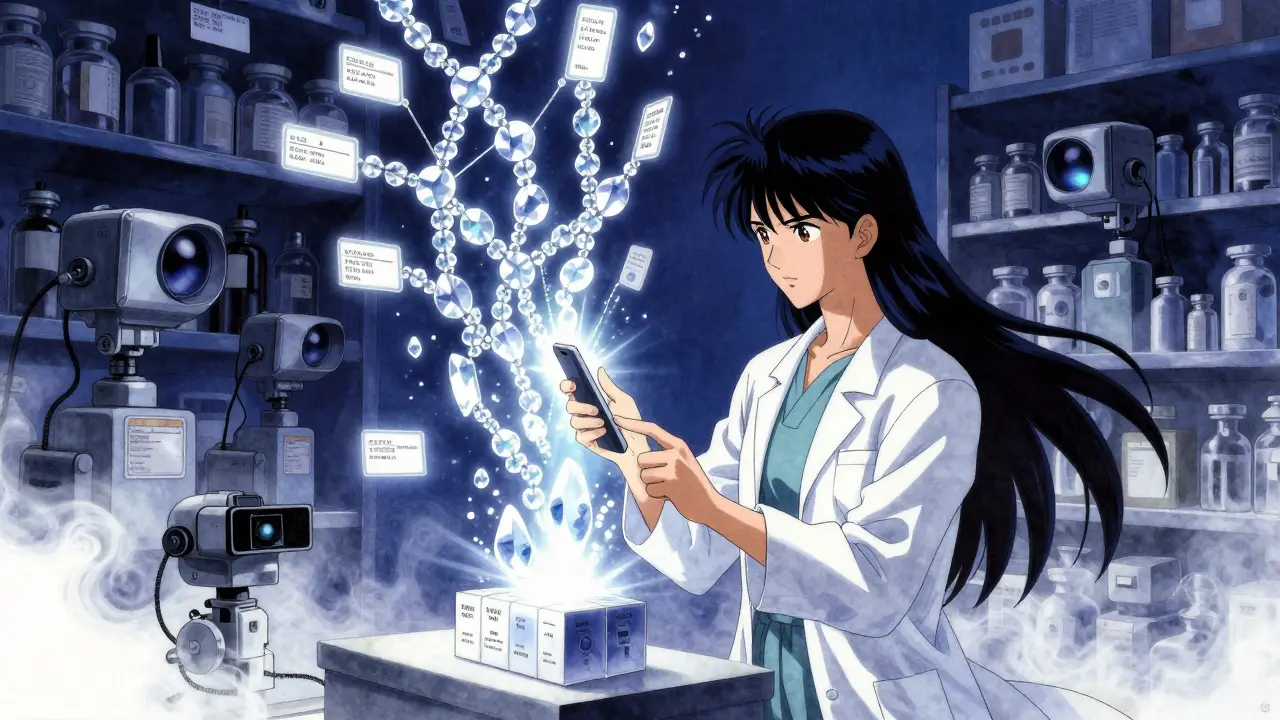
What if the medicine itself carried a biological signature? That’s what DNA-based authentication does.
Scientists embed tiny, synthetic DNA strands into the drug’s coating or ink. These strands are unique to each batch - like a genetic barcode. To verify, you need a portable DNA reader. It’s not something a pharmacist carries. But customs agents, inspectors, and lab technicians can use it to test suspicious pills on the spot.
It’s the most secure method available. No printer, no scanner, no software can replicate it. Even if someone copies the packaging, the DNA is still missing. The problem? Cost. Each DNA tag adds $0.15 to $0.25 per unit. Standard serialization? Just $0.02 to $0.05.
Right now, it’s used for high-risk products - vaccines, opioids, and biologics. But as the tech improves, prices are falling. By 2028, experts predict DNA tagging will be common in vaccines and other critical medicines.
AI vision systems: The digital eyes watching the supply chain
At the end of the line, where medicine reaches patients, another tool is rising: AI-powered visual inspection.
Cameras mounted on conveyor belts or handheld scanners analyze packaging in real time. They look for tiny differences - a slightly off-color logo, a misaligned font, a missing hologram. In controlled tests, these systems catch 99.2% of fakes. Real-world accuracy has jumped from 89.7% in 2024 to 94.3% in mid-2025.
The challenge? Lighting, packaging materials, and wear-and-tear. A crumpled box or a dirty lens can fool the system. That’s why AI vision isn’t used alone. It’s paired with NFC or serialization. The AI spots something odd. The NFC chip confirms it’s real - or not.
Pharmacies in Brazil and Nigeria are starting to use handheld AI scanners. Pharmacists point the device at a bottle, and within seconds, it says: “Authentic” or “Suspicious.” It’s not perfect - but it’s a powerful second line of defense.
Why the old tricks are dying - and what’s replacing them
QR codes? Too easy to copy. Holograms? Replicated with $500 printers. Tamper-evident seals? Counterfeiters now make fake seals that look real until you open them.
The new standard is multi-layered security. No single technology is enough. It’s NFC + serialization + AI + blockchain - working together. By 2027, 83% of top pharmaceutical companies plan to use at least three layers of protection.
And it’s not just about stopping fakes. It’s about trust. Patients want to know their medicine is safe. Pharmacists want to know they’re not putting lives at risk. Regulators want accountability. Technology is giving them all that - in real time, on a smartphone screen.
Who’s falling behind - and why
Big pharma? Nearly all of them are compliant. 97% of the top 100 companies have rolled out serialization by 2025. But smaller manufacturers? Only 43% have done it. Why? Cost. Training. Legacy systems.
And then there’s the tariff problem. In April 2025, new U.S. tariffs on pharmaceutical imports from China and India raised production costs by 12-18%. Shipping delays stretched from weeks to over a month. That’s forced many small companies to cut corners - or delay upgrades.
Some are trying to skip ahead. One company tried to save money by using unencrypted QR codes. Result? A $147 million recall in Q3 2025. The fake drugs weren’t just sold - they were distributed through major pharmacy chains. Patients got sick. The company’s reputation collapsed.
There’s no shortcut. Cutting corners on security doesn’t save money - it costs more in the end.
What’s coming next
By 2027, the EU will require every medicine package to have a Digital Product Passport - a code that links to the drug’s entire lifecycle: ingredients, manufacturing date, storage conditions, and more. That’s not just anti-counterfeit tech. It’s full transparency.
Materials are changing too. More companies are switching to recyclable packaging that still holds secure tags. Some are embedding traceable markers directly into the plastic - so even the bottle itself is part of the verification.
And counterfeiting? It’s evolving. Fraudsters are using AI to generate fake labels and deepfake packaging. But so are the defenders. AI is now used to spot new fake patterns before they spread. It’s a race - and right now, the good guys are pulling ahead.
What you can do - as a patient or caregiver
You don’t need to be a tech expert to protect yourself.
- If your pharmacy offers a phone app to verify medicine, use it. Most now support NFC or QR codes.
- Check the packaging. Is the seal intact? Are the fonts and colors sharp? Blurry printing is a red flag.
- Buy from licensed pharmacies. Avoid websites that sell prescription drugs without a prescription.
- If something feels off - a strange taste, unusual side effects, or packaging that looks wrong - report it. Your local health agency or pharmacy can test it.
Technology is making fake drugs harder to make - and easier to catch. But it still needs people to pay attention. Your eyes, your phone, your questions - they’re part of the system now.
How can I tell if my medicine is fake?
Look for tamper-evident seals, sharp printing, and consistent branding. Many medicines now have NFC chips - tap your phone on the package to verify. If your pharmacy has a verification app, use it. If the medicine looks, smells, or tastes wrong - or if you didn’t get it from a licensed pharmacy - don’t take it. Contact your pharmacist or local health authority.
Are QR codes on medicine safe?
Only if they’re cryptographically secured. Most QR codes on medicine today are not. They can be copied and printed onto fake packages. In 2025, a major U.S. recall happened because counterfeiters cloned unencrypted QR codes. Always verify through official apps or NFC, not just a QR scan. If the app asks you to enter a code manually, that’s a sign it’s not secure.
Is blockchain used in all drug tracking?
No. Blockchain is mostly used by large manufacturers for high-value drugs like cancer treatments or biologics. It’s expensive and takes over a year to implement. Most drugs still use simpler serialization with unique codes. But blockchain is growing fast - especially in Europe and North America - because it provides full traceability from factory to patient.
Can I verify my medicine without a smartphone?
Yes. Pharmacists and regulators have handheld scanners that read serialized barcodes or NFC tags. If you’re unsure about your medicine, take it to a licensed pharmacy. They can check it using professional tools. You don’t need to verify it yourself - but you should ask if they can.
Why are fake drugs so common in some countries?
Weak regulation, lack of enforcement, and poor supply chain tracking make it easier for fake drugs to enter the market. In low- and middle-income countries, up to 1 in 10 medicines are counterfeit. But it’s not just about geography - fake drugs are now being shipped globally through online pharmacies and dark web markets. The problem is global, but the tools to fight it are becoming global too.
so like... we're basically trusting our lives to tiny chips in pill bottles? wild. i mean, i tap my phone to pay for coffee, now i gotta tap it to not die? feels like we're living in a sci-fi movie where the only thing keeping us alive is bluetooth.
india has been making medicine for the world since colonial times and now you want us to use nfc chips and blockchain? what next? quantum encrypted aspirin? we feed the planet with generics and you treat us like criminals with your overengineered western solutions
this whole thing is a money grab. serialization costs millions? blockchain takes two years? please. big pharma just wants to jack up prices under the guise of 'security'. meanwhile, people in rural africa still die because they can't afford the real stuff, not because someone cloned a qr code.
There's something profoundly human about this entire endeavor - the fact that we've built entire technological ecosystems not just to track substances, but to preserve trust. Every NFC chip, every DNA tag, every blockchain node is an attempt to say: your life matters enough to be verified. We're not just preventing fraud; we're rebuilding the covenant between patient and medicine, between science and society. It's quiet, it's invisible, but it's one of the most tender revolutions of our age.
i love that pharmacists can just tap and know. my grandma used to stare at pill bottles like they were ancient scrolls. now she taps her phone and goes 'oh good' and swallows it. no stress. no panic. just... peace. this tech isn't flashy but it's healing in a way no ad campaign ever could.
dna tagging sounds like overkill until you realize most people can't even read the label on their own meds. the real problem isn't counterfeits its the fact that half the population doesn't know what ibuprofen is
The shift from paper trails to digital verification isn't just about security - it's about dignity. Every person deserves to know their medicine is safe, no matter where they live or how much they earn. These technologies, when scaled equitably, don't just prevent death - they restore hope. And that’s worth every dollar, every delay, every upgrade.
In South Africa, we’ve seen fake antiretrovirals kill more people than HIV ever could. So yes, we need blockchain. Yes, we need DNA. Yes, we need AI. And no, we will not accept excuses from Western corporations who think 'affordable' means 'untraceable'.
i think its cool that even small pharma can start with serialization and grow into nfc later. its not about being perfect its about being better than yesterday. i hope more devs build open tools so clinics in villages can use this too
Please, please, please - if you're reading this, and you're taking meds: check the packaging. Check the seal. Check the expiration. Don't assume. Don't trust blindly. Technology helps - but your eyes? Your instincts? Those are the last line of defense. Don't outsource your safety.
i just scanned my blood pressure pill with the app and it said authentic. felt like i just won the lottery. also, why does my phone have to be on for this? can't it work offline? 😅