
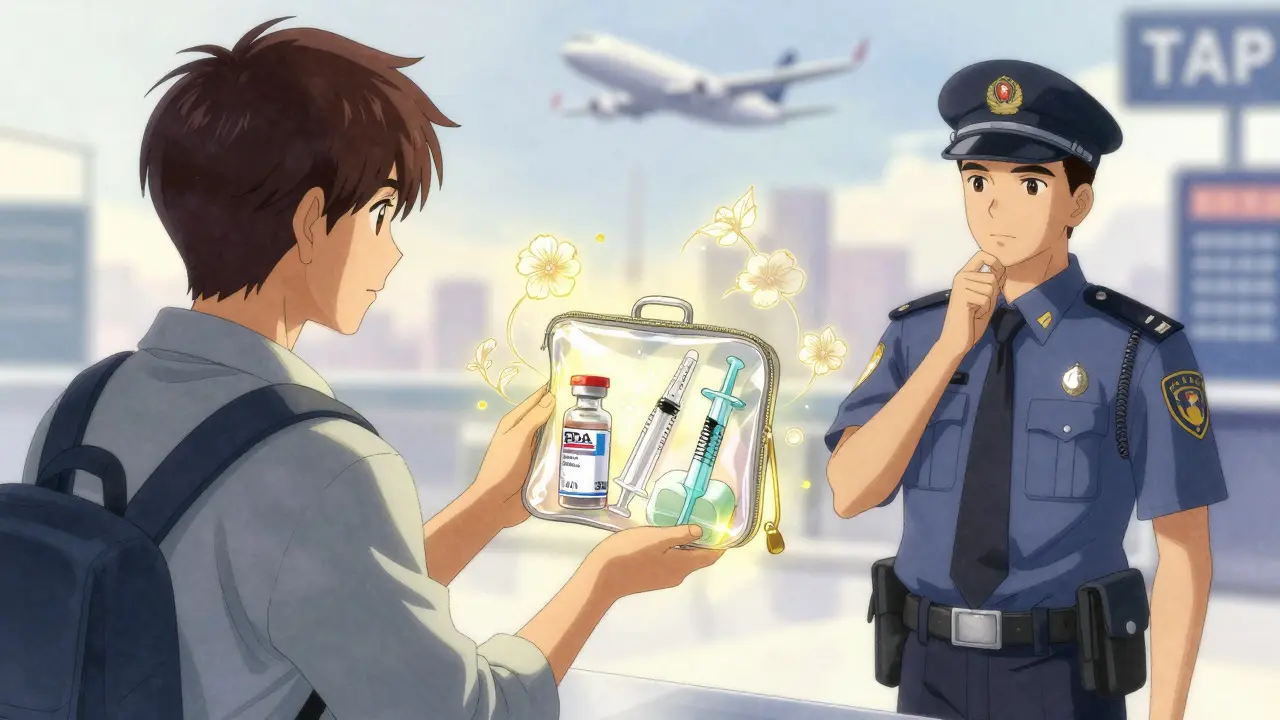
Traveling with insulin, EpiPens, or other injectable medications doesn’t have to be stressful-if you know the rules.
You’ve got your flight booked, your hotel confirmed, and your meds packed. But then it hits you: Can I bring syringes on a plane? What about used needles? Do I need a doctor’s note? Will TSA take them away?
The short answer: Yes, you can fly with injectables, syringes, and sharps. But how you pack them makes all the difference. Thousands of people travel with diabetes, multiple sclerosis, rheumatoid arthritis, and other conditions requiring injections every year. Most make it through security without issue. But a surprising number face delays, confusion, or even confiscation-not because they broke the rules, but because they didn’t follow them correctly.
This isn’t about guessing. It’s about knowing exactly what to do.
What the TSA Actually Allows (No Guesswork)
The Transportation Security Administration (TSA) clearly states: medically necessary injectables, syringes, and sharps are allowed in both carry-on and checked bags. There’s no limit on the number of syringes or vials if they’re for personal medical use. That includes insulin, glucagon, epinephrine, growth hormone, and any other prescribed injectable.
But here’s the catch: syringes must be accompanied by the medication they’re meant to deliver. You can’t bring a box of 50 empty syringes and expect to walk through security. TSA officers need to see the connection between the needle and the drug. If you’re carrying insulin, have the vials with you. If you’re using an insulin pen, bring the pen and the cartridges.
Liquid medications over 3.4 ounces (100ml) are exempt from the standard 3-1-1 liquids rule-but you must declare them at the checkpoint. Don’t wait for them to ask. Say it upfront: “I have medically necessary liquid medication.” That simple step cuts screening time in half.
Sharps Containers: Not Just a Good Idea-A Requirement
Used syringes? You can’t toss them in your purse, backpack, or ziplock bag. That’s a safety hazard-and a violation. TSA requires used sharps to be stored in an FDA-approved sharps disposal container.
What counts as approved? Look for these features:
- Rigid, puncture-resistant plastic
- Secure, child-resistant lid
- Universal biohazard symbol (the three-bladed icon)
- Meets ANSI/ISEA Z308.1-2021 or IATA Packing Instruction 650 standards
You can buy these at any pharmacy-many are under $10. Some brands even make travel-sized versions that fit in a coat pocket. Don’t use empty soda bottles, coffee containers, or pill bottles. They’re not safe, and TSA officers will likely ask you to repack them on the spot-delaying your flight.
Pro tip: Keep the sharps container in your carry-on. Checked baggage gets handled roughly. A punctured container in the cargo hold could endanger baggage handlers.
Documentation: Do You Need a Doctor’s Note?
TSA doesn’t require a doctor’s note. But here’s the truth: having one can save you hours of hassle.
Not because it’s mandatory-but because not all TSA officers are trained equally. At smaller airports or during busy times, you might get someone who’s never seen an insulin syringe before. A note from your doctor (on letterhead, with your name, medication, and dosage) removes doubt. It says: “This isn’t suspicious. This is medicine.”
Even better? Use the official TSA Notification Card. Download it, print it, and keep it in your wallet. It’s a one-page form that explains your medical needs in plain language. Since its rollout in 2022, it’s cut screening miscommunications by 29%, according to TSA’s own data.
Temperature-Sensitive Medications: Keep Them Cool
If your medication needs to stay cool-like insulin, certain biologics, or growth hormone-you can bring ice packs or gel packs. No size limits. No need to declare them as liquids. But they will be screened separately.
Here’s how to do it right:
- Use reusable medical-grade cooling packs, not regular ice cubes (they melt and leak)
- Wrap the pack around your medication vials in a small insulated pouch
- Don’t freeze your meds unless the manufacturer says it’s safe
- Ask for a visual inspection instead of X-ray if you’re worried about damage
TSA allows this because they know losing your insulin mid-flight isn’t just inconvenient-it’s life-threatening. In 2023, a passenger in Atlanta avoided a diabetic emergency during a 12-hour layover because she had her insulin properly cooled and declared. That’s the kind of scenario TSA trains for.
International Travel: Rules Change Outside the U.S.
Domestic U.S. flights? TSA rules apply. International? You’re playing by someone else’s rules.
For example:
- Japan: Requires a special permit for any syringes over 10 units. Apply at least 30 days before departure.
- United Kingdom: No permit needed, but you must carry medication in original packaging with your name on the label.
- Germany: Requires a doctor’s note in German or English, and sharps must be in approved containers.
- Australia: Allows injectables with proof of prescription. Sharps containers must be labeled in English.
Some countries ban syringes entirely unless you have a medical visa. Others require you to declare them at customs, not just security. Don’t assume U.S. rules apply abroad. Check your destination’s health ministry website or contact their embassy at least 60 days before you fly.
Airlines and Security: What You’ll Actually Experience
Not all airports are the same. At major U.S. hubs like Atlanta, Chicago, or LAX, TSA officers are trained to handle medical supplies. You’ll likely get waved through quickly.
But at smaller regional airports-especially those handling under 5 million passengers a year-staff may have less experience. Reddit users report delays of 20+ minutes at places like Fargo, Bismarck, or Charleston. That’s not because you did anything wrong. It’s because the officer has never seen a sharps container before.
Here’s what works:
- Arrive 45 minutes early for medical screening
- Put your meds and sharps in a clear, separate pouch
- Keep everything in your carry-on
- Speak up before you reach the X-ray machine: “I have medical equipment to declare.”
Passengers using TSA PreCheck report 50% faster screening times. If you fly often, it’s worth the $78 fee. You’ll skip the shoe removal, belt check, and often the extra bag search for your meds.
What Not to Do
People make the same mistakes over and over. Avoid these:
- Don’t pack sharps in checked luggage. Bags get tossed. Needles can puncture other bags.
- Don’t bring syringes without medication. Even if you plan to use them later, TSA sees it as a risk.
- Don’t hide your meds. Trying to sneak them through looks suspicious.
- Don’t rely on airport pharmacies to replace your meds. They won’t have your brand or dosage.
- Don’t assume your airline will help. They’re not medical providers-they’re transporters.
Real Stories from Travelers
A woman from Michigan flew to Florida with her 8-year-old daughter who has type 1 diabetes. She packed insulin, syringes, and a sharps container. At security, the officer didn’t recognize the container. She showed the TSA Notification Card and a doctor’s note. Within 90 seconds, she was through. No delays. No stress.
A man in Seattle tried to bring insulin in a pill bottle because he forgot his sharps container. He was held for 25 minutes while TSA tried to find a proper container. He missed his connecting flight.
A couple in Texas used a travel-sized sharps container they bought online. It had the biohazard symbol and was labeled in English. They sailed through security at 10 different airports over three weeks. No questions asked.
The difference? Preparation.
What’s Changing in 2025-2026
TSA is rolling out a new Medical Screening Enhancement Initiative at 50 major U.S. airports by the end of 2024. These lanes have officers trained specifically in medical equipment. They’ll have handheld devices that can scan liquid medications without opening them.
By 2026, global standards are expected to improve. The World Health Organization is working on unified rules for medical travel, which could mean fewer surprises abroad.
For now, though, the rules are clear: know them, follow them, and you’ll be fine.
Final Checklist Before You Fly
- ✅ All injectables in original packaging with patient name matching ID
- ✅ Syringes with corresponding medication (no empty needles)
- ✅ Used sharps in FDA-approved, labeled container
- ✅ Liquid meds over 3.4 oz declared at checkpoint
- ✅ Cooling packs for temperature-sensitive meds
- ✅ TSA Notification Card printed and ready
- ✅ Doctor’s note (recommended, not required)
- ✅ Destination country rules checked and followed
- ✅ All items in carry-on, not checked luggage
You’ve got this. Millions of people travel with injectables every year. You’re not an exception. You’re just prepared.
Can I bring insulin on a plane in my carry-on?
Yes, insulin and other injectable medications are allowed in carry-on bags with no quantity limits, as long as they’re for personal medical use. You must declare liquid medications over 3.4 ounces at the security checkpoint. Keep them in original packaging with your name on the label.
Do I need a doctor’s note to fly with syringes?
TSA doesn’t require a doctor’s note, but it’s highly recommended. Many travelers report faster screening and fewer questions when they carry a note on letterhead explaining their condition and medication. It’s especially helpful at smaller airports or international destinations.
Can I put sharps in my checked luggage?
No. TSA requires used sharps to be carried in your carry-on bag inside an FDA-approved sharps container. Checked baggage is handled roughly and can damage containers, risking injury to baggage handlers. Always keep sharps with you.
What if I forget my sharps container?
If you forget your sharps container, ask a TSA officer for help. Most major airports have sharps disposal containers at security checkpoints or in restrooms. If not, you may be asked to repack your used needles into a rigid container like a plastic bottle with a tight lid-but this isn’t ideal. It’s better to carry one with you.
Can I bring ice packs for my insulin?
Yes. TSA allows ice packs and gel packs for temperature-sensitive medications like insulin, with no size limits. They’ll be screened separately, but you don’t need to declare them as liquids. Keep them wrapped with your meds in an insulated pouch.
Are there restrictions on injectables for international flights?
Yes. Rules vary by country. Japan requires permits for more than 10 syringes. The UK and Australia require original packaging with your name. Some countries ban syringes entirely unless you have a medical visa. Always check your destination’s health ministry website at least 60 days before travel.
Can I use TSA PreCheck with medical supplies?
Yes. TSA PreCheck lanes often have officers trained to handle medical equipment faster. Travelers report 50% less screening time for medical supplies when using PreCheck. It’s worth the $78 fee if you fly more than twice a year.
Life is a needle and a vial. You don’t need permission to survive. Just carry your truth in a container that won’t break. TSA doesn’t own your body. You do.
And if they blink? You smile. And walk through.
The regulatory framework governing medical device transportation is unequivocally codified under TSA Directive 1542.45. Non-compliance with container specifications, particularly regarding puncture resistance and biohazard labeling, constitutes a Class III security infraction. All travelers must adhere to ANSI/ISEA Z308.1-2021 standards without exception.
I used to panic every time I flew with my insulin. Then I got the TSA card. Now I just hand it over like a coffee receipt.
They nod. I nod. We both breathe.
It’s not magic. It’s just being prepared. ❤️
Carry your meds in original packaging. Declare liquids. Use approved sharps containers. That’s it. No drama needed.
People still don’t get it. You think your insulin is special? It’s not. You’re not special. You’re just lazy. If you can’t pack a needle properly, maybe you shouldn’t be traveling. This isn’t a support group. It’s an airport.
Let’s be real-TSA is a performance art piece disguised as security. The ‘TSA Notification Card’? A corporate placebo. The real power move? Walking up with your sharps container in one hand, your insulin pen in the other, and your eyes locked on the officer like you’re the only one who knows what freedom looks like.
They’ll clear you. Not because you followed the rules. But because you refused to be invisible.
I’ve flown 47 countries with a pump and 12 syringes. No note. No container. Just my skin and my will.
They ask. I say ‘medical necessity.’ They look confused. I walk.
Rules are suggestions for people who fear their own bodies.
You don’t need to be afraid of the system. You need to be prepared for it. This guide? It’s not about compliance. It’s about dignity.
Carry your life. Carry it well.
I don’t trust any of this.
What if TSA is secretly tracking our meds? What if they’re selling our insulin data to Big Pharma?
I saw a guy in Denver get pulled aside for having a gel pack. He came back shaking. Said they took his pen and scanned it for ‘bio-signatures.’
They’re building a database. They already know who needs what.
And if you’re on insulin? You’re on a list.
Don’t be fooled by the ‘notification card.’ It’s a trap.
I now carry my meds in a hollowed-out Bible. No one checks that.
And I pray. Every time.
This is the kind of guide that saves lives. Thank you for writing it. I’ve been flying with my EpiPen for 12 years. Still, I get nervous. This? This is the calm I needed.
I’m from Cape Town. We don’t have this luxury. In Johannesburg, you need a permit just to buy a syringe. And here you are, talking about TSA cards like it’s a spa day.
Maybe your privilege is showing.
But hey, at least you have access to FDA-approved containers. Most of us are lucky if we get a sealed plastic bag.
The paradigm shift here isn’t logistical-it’s epistemological. We’re moving from a model of reactive compliance to proactive medical sovereignty. The FDA-approved sharps container isn’t just a vessel-it’s a semiotic assertion of bodily autonomy within a biopolitical regime.
And the TSA Notification Card? It’s the first digital artifact of patient-led institutional negotiation.
This isn’t travel advice. It’s a manifesto.
Honestly? If you need all this information just to fly, maybe you shouldn’t be flying.
It’s exhausting.
Why can’t people just stay home?
And why does the world have to accommodate every single medical need?
It’s not a public service. It’s a burden.
And now you’re making it worse with your ‘TSA card’ and your ‘cooling packs’ and your ‘doctor’s note.’
Grow up.
You think this is about convenience?
No.
This is about who gets to be seen.
And who gets to be ignored.