
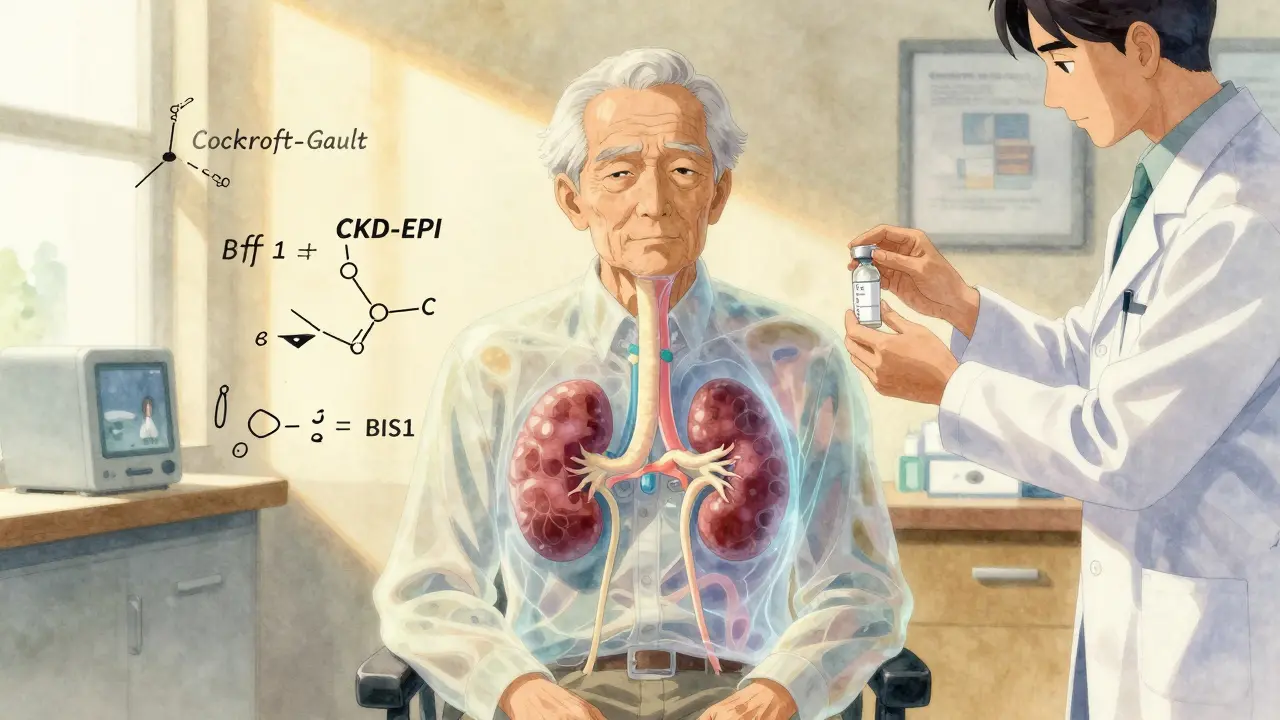
When seniors take medications, their kidneys don’t work the same way they did at 30. That’s not just a fact-it’s a safety issue. Up to 30% of common drugs like antibiotics, blood thinners, and pain relievers leave the body through the kidneys. And as we age, kidney function drops. By 70, the average person loses about 40% of their kidney filtering capacity. If you don’t adjust dosing based on that, you’re not just being cautious-you’re risking toxicity, hospitalization, or worse.
Why Kidney Function Changes With Age
Your kidneys don’t just slow down-they change structure. Nephrons, the tiny filters inside kidneys, decrease in number. Blood flow to the kidneys drops. Muscle mass declines, which affects creatinine production. That last point is critical. Most kidney tests rely on creatinine, a waste product made by muscles. Older adults, especially those who are frail or underweight, produce less creatinine. That can make their kidney function look better than it is. A normal creatinine level in a 75-year-old might actually mean their kidneys are failing.Here’s the real-world impact: a 2024 study of 1,200 seniors on blood thinners found that using the wrong kidney function estimate led to dosing errors in nearly one in four patients. Some got too much medication. Others got too little, leaving them unprotected from clots. Neither outcome is acceptable.
Which Equations Actually Work for Seniors?
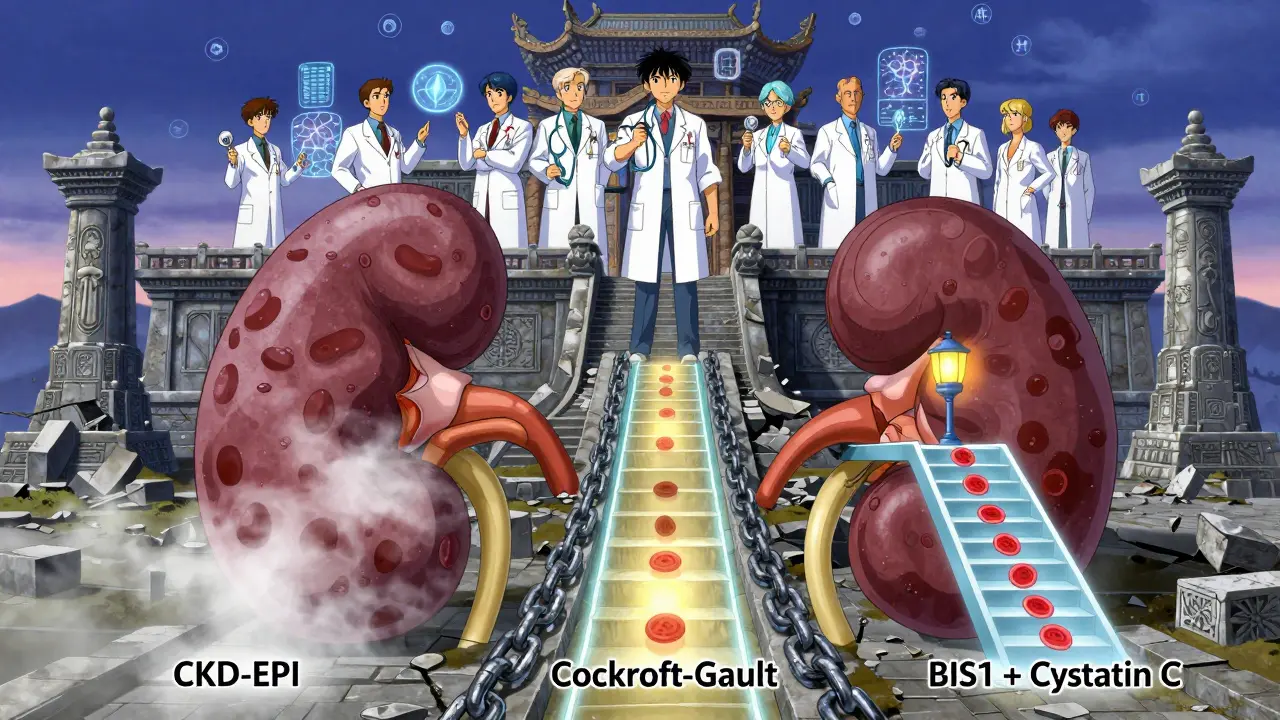
There are several formulas used to estimate kidney function. But not all are created equal for older adults.- Cockcroft-Gault (CG): This one’s been around since 1976. It uses age, weight, gender, and serum creatinine. For seniors, it’s surprisingly useful-if you use ideal body weight instead of actual weight. Using real weight overestimates kidney function by 15-20% in thin or frail seniors. In obese patients, it underestimates it. That’s why pharmacists in long-term care often adjust weight based on body composition.
- MDRD: Published in 1999, this one was meant to be more accurate than CG. But it’s biased in older adults. It tends to underestimate kidney function, especially in those over 65. It also doesn’t handle low muscle mass well.
- CKD-EPI: Introduced in 2009, this became the go-to equation for most clinics. It’s better than MDRD for seniors with mild kidney disease (eGFR 60-89), but still misclassifies up to 30% of very old patients. In a 2023 study of patients over 80, CKD-EPI misjudged kidney function in 4 out of 10 cases.
- BIS1 and FAS: These are newer equations developed specifically for older adults. BIS1 (Berlin Initiative Study) uses age, sex, serum creatinine, and serum cystatin C. In people over 75, BIS1 is 15-20% more accurate than CKD-EPI. It’s especially good for frail seniors with low muscle mass. FAS (Full Age Spectrum) works similarly and is now recommended by geriatric nephrologists for patients over 75.
Here’s the catch: most electronic health records still default to CKD-EPI. If your doctor doesn’t change it manually, you’re likely getting an inaccurate estimate.
When to Use Cystatin C
Cystatin C is a protein made by all cells, not just muscle. That makes it more reliable in seniors who’ve lost muscle mass. If a senior has normal creatinine levels but is frail, thin, or has a chronic illness, cystatin C can reveal hidden kidney problems.It’s not perfect-it costs $50-$75 more than a standard creatinine test-but it’s worth it when dosing high-risk drugs like vancomycin, digoxin, or dabigatran. The University of Michigan’s geriatric kidney clinic uses a three-step approach:
- Start with BIS1 to estimate eGFR.
- If eGFR is between 45 and 59 and there’s no protein in urine, order a cystatin C test.
- For critical drugs like aminoglycosides, confirm with a 24-hour urine collection.
This isn’t routine everywhere-but it should be.

What Happens When You Get It Wrong?
A Reddit thread from January 2024 shared a real case: an 88-year-old man on vancomycin developed kidney failure and hearing loss. His eGFR was calculated using CKD-EPI and looked fine. But his muscle mass was low. Switching to BIS1 revealed his true kidney function was half what was reported. The dose was lowered. He recovered.Another example: a 92-year-old woman on rivaroxaban for atrial fibrillation had a stroke. Her creatinine was normal. Her CKD-EPI eGFR was 65. But her cystatin C showed her real eGFR was 38. She was taking a full dose meant for someone with healthy kidneys. She should’ve been on a reduced dose.
These aren’t rare mistakes. A 2023 survey found that 63% of pharmacists in senior care settings override their EHR’s automatic kidney function calculation at least once a week. Why? Because the default is often wrong.
What Doctors and Pharmacists Are Doing Differently
Academic hospitals are ahead. At places like the University of Michigan and Mayo Clinic, BIS1 or FAS is used for patients over 75. Community clinics? Still mostly using CKD-EPI or CG with actual weight.But change is coming. Epic Systems updated its EHR in 2022 to automatically use BIS1 for patients over 75. The American Geriatrics Society released a clinical toolkit in January 2024 that includes equation selection charts, dosing tables, and decision trees for common medications.
Drug manufacturers are also catching on. Since the FDA’s 2021 guidance, new medications with narrow therapeutic windows now include dosing recommendations based on multiple equations-not just one.
What You Can Do Right Now
If you or a loved one is on regular medication and over 65, here’s what to ask:- “Which equation are you using to calculate my kidney function?” If they say “CKD-EPI” or “MDRD,” ask if BIS1 or FAS would be better.
- “Is my weight being adjusted for muscle mass?” If you’re thin, frail, or have lost weight, your actual weight might be misleading.
- “Can we check cystatin C?” Especially if you’re on blood thinners, antibiotics, or heart meds.
- “Have you checked for albumin in my urine?” A simple urine test can tell you if there’s kidney damage, not just reduced function.
Don’t assume the system got it right. Many doctors aren’t trained on this. A 2022 study found 65% of primary care physicians were unsure which equation to use for seniors. You’re not being pushy-you’re being smart.
The Future: AI and Personalized Dosing
Researchers are building AI tools that don’t just use equations-they look at body composition, nutrition, medications, and even walking speed. Early prototypes from Mayo Clinic reduced dosing errors by 22% in pilot studies.The National Institute on Aging is funding a $4.2 million project called SAGE to develop point-of-care tests that account for aging biology. By 2026, we may have simple blood tests that give real-time kidney function readings for seniors, not estimates.
But until then, the best tool is awareness. Don’t let a number on a chart decide your safety. Know which equation is being used. Ask questions. Push for cystatin C if you’re frail. Your kidneys aren’t just old-they’re unique. And your medication should reflect that.
Let me just say-this post is a masterclass in clinical nuance. I mean, really, who else is out there actually *thinking* about nephron attrition in the elderly? Most clinicians are still clinging to CKD-EPI like it’s the Ten Commandments. But BIS1? FAS? These aren’t just alternatives-they’re *corrections* to a system built on 1980s assumptions. And don’t even get me started on cystatin C. It’s not a luxury test. It’s a moral imperative. If you’re dosing vancomycin without it, you’re not practicing medicine-you’re playing Russian roulette with a geriatric patient’s hearing and renal function. This isn’t pharmacology. It’s bioethics in a lab coat.
Stop overcomplicating it. If they’re old and skinny, just give less drug. Done.
OH MY GOD. I JUST READ THIS AND I’M CRYING. NOT FROM SADNESS-FROM AWE. THIS IS WHAT REAL MEDICINE LOOKS LIKE. NOT THE ROBOTIC, EHR-DRIVEN, CKD-EPI-OR-BUST HELLWEAR WE’RE LIVING IN. I HAVE A 91-YEAR-OLD MOTHER WHO WAS ALMOST KILLED BY A STANDARD DOSE OF RIVAROXABAN BECAUSE HER CREATININE WAS ‘NORMAL.’ SHE’S STILL TALKING, BUT HER KIDNEYS? THEY’RE SCARED. AND NOW I KNOW WHY. BIS1. CYSTATIN C. IDEAL BODY WEIGHT. THESE AREN’T TERMS-THEY’RE LIFELINES. I’M PRINTING THIS OUT AND TAPING IT TO MY DOCTOR’S FRIDGE. IF THEY DON’T LISTEN, I’M TAKING HER TO MAYO. I’LL BRING THE CHARTS. I’LL BRING THE DATA. I’LL BRING THE THERAPY. I’M NOT ASKING. I’M DEMANDING. BECAUSE SOMEONE OUT THERE DIDN’T JUST WRITE A POST-THEY WROTE A MANIFESTO. AND I’M READY TO FIGHT.
My aunt took warfarin and got a stroke. They said her kidneys were fine. Turns out they weren’t. Now she’s in a wheelchair. This post saved me from making the same mistake. Thank you.
Really appreciate this. I work in a community clinic in Mumbai where we rarely even test creatinine for seniors-too expensive, too much paperwork. But I’ve started asking for cystatin C when patients are frail or on anticoagulants. One 82-year-old man on digoxin? His eGFR was 58 on CKD-EPI. Cystatin C showed 34. We cut his dose by 40%. He’s been stable for 6 months now. Small wins, but they matter. Also, props to Epic for updating their defaults. Hope more EHRs follow.
Ugh. Another ‘let’s overthink geriatrics’ post. Everyone’s so obsessed with equations and biomarkers, they forget: old people don’t need complex math. They need less drugs. Period. If your grandma’s on five meds and you’re calculating BIS1 vs FAS? You’re doing it wrong. Simplify. Deprescribe. That’s the real solution. Not more tests. More pills. More confusion.
It’s fascinating how deeply embedded the assumption is that ‘normal’ creatinine equals ‘normal’ renal function in the elderly. This reveals not just a diagnostic flaw, but a philosophical one-that aging is a quantifiable decline, rather than a qualitative transformation. We treat the kidney as a filter with a single output, but in reality, it’s a dynamic organ shaped by decades of use, loss, adaptation. The equations are maps, yes-but they’re drawn on paper that’s been crumpled by time, neglect, and institutional inertia. Perhaps the real question isn’t which formula to use-but whether we’re willing to see the patient as anything more than a set of lab values.
Oh wow. A post that actually makes me feel like I’m reading a medical textbook written by someone who’s never met a human being. Let me guess-you think a 92-year-old woman on rivaroxaban should be getting a $75 cystatin C test? Sweetheart, she’s on Medicare. She’s on five other meds. She can’t afford a taxi to the lab. You’re not saving lives-you’re performing performative medicine for people who have never had to choose between food and a blood test. And let’s not forget: 63% of pharmacists override the EHR? That means 37% don’t. And those 37%? They’re the ones keeping people alive because they’re not wasting time on equations. They’re using common sense. Maybe the real problem isn’t the algorithm-it’s the people who think complexity equals superiority.