

Every year, millions of Medicare beneficiaries miss a chance to save hundreds - sometimes over a thousand - dollars on their prescription drugs. It’s not because they don’t care. It’s because they don’t know where to start. If you take even one medication regularly, the annual Medicare open enrollment period isn’t just a formality. It’s your best shot at controlling costs before the new year begins.
What Is Medicare’s Annual Open Enrollment Period?
From October 15 to December 7 each year, Medicare beneficiaries can change their health and prescription drug plans for the next calendar year. This window, officially called the Annual Enrollment Period (AEP), is your only chance to switch plans without restrictions. Changes made during this time take effect on January 1. Missing it means you’re stuck with your current plan until next year - even if your medications got more expensive or your pharmacy dropped out of the network.This period exists because Medicare plans change every single year. Premiums go up. Formularies get rewritten. Pharmacies drop out. What was covered at Tier 2 last year might be Tier 4 this year - and that could mean your monthly cost jumps from $30 to $120. In 2025 alone, 60% of Part D plans changed at least one medication’s tier status, according to CMS data. If you didn’t review your plan, you paid more.
Why Medication Coverage Changes Matter More Than Premiums
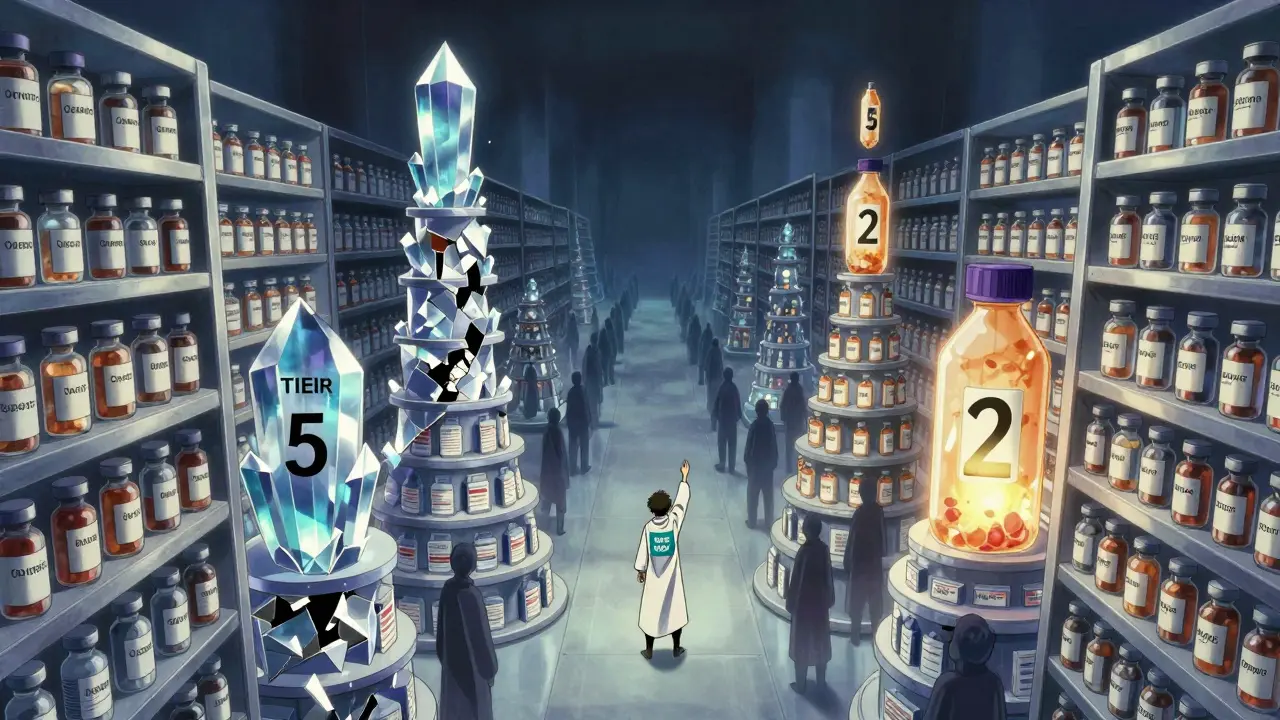
Most people focus on the monthly premium when choosing a plan. That’s understandable - lower is better. But the real savings come from how your medications are covered. A plan with a $10 premium might cost you $800 more in out-of-pocket drug costs than a $40 premium plan if your insulin or Ozempic isn’t on the formulary at a low tier.Medicare Part D plans use a tier system - usually 1 through 5 - to set your cost for each drug. Tier 1 drugs are generics and cost the least. Tier 5 is for specialty drugs like GLP-1s, and those can cost hundreds per month. In 2025, 42% of Medicare Advantage plans increased cost-sharing for specialty tier drugs. That’s not a small bump. That’s a financial shock.
And it’s not just about tiers. Many plans require prior authorization, step therapy (trying cheaper drugs first), or limit how much you can get at once. If your doctor prescribed 90-day supplies last year but your new plan only allows 30-day fills, you’ll pay more in pharmacy trips and co-pays.
How to Compare Plans Like a Pro
The tool you need is the Medicare Plan Finder is a free, official tool from the Centers for Medicare & Medicaid Services (CMS) that lets you compare all available Medicare Part D and Medicare Advantage plans in your area. It’s not perfect, but it’s the only place where you can see side-by-side comparisons of:- Monthly premiums
- Annual deductibles (up to $590 for Part D in 2025)
- Formulary coverage for every drug you take
- Pharmacy network - which pharmacies are preferred and which cost more
- Out-of-pocket maximums (capped at $8,000 for Medicare Advantage in 2025)
Here’s how to use it right:
- Make a list of every medication - name, dose, and how often you take it. Don’t forget over-the-counter drugs your doctor recommends, like daily aspirin or insulin pens.
- Get your current plan’s Annual Notice of Change (ANOC). This arrives in the mail by September 30. It tells you exactly what’s changing next year - premiums, formulary, pharmacy network. Read it before you start comparing.
- Enter your exact medications into the Medicare Plan Finder. Don’t guess. Type in the full name. If you take 10 drugs, enter all 10. The tool will show you how much each plan charges for each one.
- Sort by total estimated cost, not just premium. The tool calculates your projected annual drug cost based on your specific medications. This number is what matters.
- Check your pharmacy. Is your local CVS, Walgreens, or mail-order service in the plan’s preferred network? If not, you’ll pay more. Some plans charge 2-3 times more at non-preferred pharmacies.
People who use this tool are 3.2 times more likely to find a lower-cost plan than those who don’t, according to Medicare.gov’s 2024 survey. That’s not a coincidence. That’s data.
Medicare Advantage vs. Original Medicare + Part D
There are two main paths:- Original Medicare (Parts A and B) + a separate Part D drug plan. This gives you freedom to see any doctor who accepts Medicare. But there’s no out-of-pocket limit. Your drug costs can keep climbing.
- Medicare Advantage (Part C) - a bundled plan that includes Parts A, B, and usually Part D. These often have lower premiums and an annual out-of-pocket cap ($8,000 in 2025). But you’re stuck in a network. If your specialist isn’t in-network, you pay full price.
In 2025, 90% of Medicare Advantage plans included drug coverage. That’s up from 78% in 2015. But here’s the catch: 78% of Medicare Advantage plans changed their provider networks between 2023 and 2024. That means you could be locked into a plan that no longer covers your doctor.
If you take multiple medications and want predictable costs, Medicare Advantage with drug coverage often wins. If you see specialists outside a network or travel often, Original Medicare with a standalone Part D plan gives you more flexibility - but you’ll need to budget for unlimited costs.
What’s New for 2026 Coverage
Starting January 1, 2026, Medicare Advantage plans must cover all Part B drugs given in outpatient settings - like infusions, injections, or chemotherapy. That means if you get an injection at a clinic, it’s now included in your plan’s coverage. This change reduces surprise bills.Also in 2026, the Medicare Plan Finder will add a new feature: a total cost calculator that estimates your annual drug spending based on your exact prescriptions. No more guessing. Just plug in your meds and see which plan saves you the most.
And don’t forget the Inflation Reduction Act. Insulin now costs no more than $35 per month. That’s automatic - no plan choice needed. But for other drugs like GLP-1s (Ozempic, Wegovy), you still need to check formularies. Some plans cover them at Tier 2. Others put them at Tier 5. That difference can be $1,000 a month.

Common Mistakes and How to Avoid Them
Most people make one of these errors:- Ignoring the ANOC - 87% of successful enrollees say reviewing this document first is critical.
- Only checking premiums - a low premium means nothing if your drugs aren’t covered.
- Not checking pharmacy networks - 32% of Reddit users in 2024 reported their pharmacy was removed from the network.
- Missing the December 7 deadline - 12% of first-time enrollees miss it, according to CMS.
- Assuming last year’s plan is still best - 78% of Medicare Advantage plans changed networks. Your plan probably isn’t the same.
Pro tip: Download your ANOC. Print it. Circle every drug you take. Then compare it to the Medicare Plan Finder results. If a drug moved up a tier, ask: Is there another plan where it’s cheaper?
Who Can Help?
You don’t have to do this alone. Every state has a State Health Insurance Assistance Program (SHIP) is a free, local service staffed by certified counselors who help Medicare beneficiaries understand plan options and make informed choices.. They’re trained, unbiased, and they’ve helped over 9,400 counselors across the U.S. since 2024. You can find yours at shipto.org (though links aren’t allowed, this is for context - you can search "SHIP + your state").Or call the Medicare helpline at 1-800-MEDICARE. They can walk you through the Plan Finder tool over the phone. Many beneficiaries say this saved them hundreds - or even thousands - in drug costs.
Real Savings, Real Stories
One woman in Florida switched from a $45/month Part D plan to a $12/month plan because her insulin and metformin were covered at Tier 2. Her annual drug cost dropped from $1,400 to $280 - a $1,120 savings. Another man in Ohio was paying $380/month for Ozempic. His new plan covered it at Tier 2 with a $25 co-pay. He saved $3,600 a year. Conversely, a woman in Texas stayed with her plan because she liked the premium. Her medication moved to Tier 4. She ended up paying $420/month - over $5,000 extra for the year.The difference isn’t luck. It’s knowing what to look for.
What happens if I miss the December 7 deadline?
If you miss the December 7 deadline, you can’t change your plan until next year’s Annual Enrollment Period - unless you qualify for a Special Enrollment Period. These are rare and only apply to specific life events like moving out of your plan’s service area, losing other coverage, or becoming eligible for Medicaid. Missing AEP means you’re locked in for the entire year, even if your meds get more expensive or your pharmacy drops out.
Can I switch Medicare Advantage plans after January 1?
Yes - but only once, and only between January 1 and March 31. This is called the Medicare Advantage Open Enrollment Period (MAOEP). During this time, you can switch from one Medicare Advantage plan to another, or switch back to Original Medicare. You can’t change your Part D drug plan during MAOEP. This is why AEP (October-December) is the main window - MAOEP is a backup with limited options.
Do all Medicare plans cover the same drugs?
No. Each Part D or Medicare Advantage plan has its own formulary - a list of covered drugs. Even two plans from the same insurer might cover your medication differently. One might list your drug as Tier 2 with a $15 co-pay. Another might list it as Tier 4 with a $120 co-pay. That’s why you must enter your exact medications into the Medicare Plan Finder - not just assume your current plan is best.
Is there help for low-income beneficiaries?
Yes. If your income is limited, you may qualify for Extra Help - a federal program that lowers your Part D premiums, deductibles, and co-pays. In 2025, the income limit is $22,590 for an individual and $30,660 for a couple. You can apply through Social Security or your state Medicaid office. Even if you’re on Medicaid, check if you qualify for Extra Help - some states offer additional savings.
Why do drug costs change so much between years?
Drug manufacturers raise prices, insurers negotiate new deals, and plans adjust their formularies to manage costs. A drug that was covered last year might be moved to a higher tier, require prior authorization, or be removed entirely. Plans also change their pharmacy networks - so even if your drug is still covered, you might pay more if your local pharmacy is no longer preferred. The key is to review every year - don’t assume stability.
If you take medications regularly, your annual open enrollment isn’t paperwork. It’s protection. The difference between a good plan and a great one isn’t about branding - it’s about matching your drugs to the right formulary. Do the work once a year. Save hundreds. Or even thousands.
I swear, if I see one more person say 'just stick with your current plan' I'm gonna scream. My mom did that last year and ended up paying $400 extra for her insulin because it got moved to Tier 4. She didn't even know until January. Don't be her. Seriously. Open enrollment isn't a chore - it's your annual drug discount code. Do the 20 minutes. Save the cash.
I find it fascinating how we treat Medicare Part D like a static contract, when in reality it's a dynamic negotiation between pharmaceutical companies, insurers, and federal policy. The formulary changes aren't arbitrary - they're economic signals. Yet most beneficiaries treat them like weather forecasts: 'It'll probably be fine.' But when your Tier 5 drug becomes Tier 5+ with prior auth? That's not an inconvenience. It's a financial rupture.
I just got off the phone with my Medicare rep. They said I could switch plans if I 'experience a significant life event.' So I told them I'm moving from Ohio to Mars. They paused. Then said, 'Sir, we don't cover extraterrestrial residences.' I said, 'Then why does my plan cover Ozempic but not my thyroid meds?' Silence. Then they hung up. I think I won.
The structural inefficiencies in the Part D formulary ecosystem are non-trivial. The tiered cost-sharing model introduces significant behavioral friction, especially for polypharmacy patients. When formulary alignment is misaligned with clinical pathways - particularly for GLP-1 agonists - the out-of-pocket burden becomes a compliance barrier. One must conduct a cost-benefit analysis across pharmacy networks, prior authorization thresholds, and step therapy protocols. It's not enrollment. It's actuarial warfare.
You don’t need to be an expert to save money. You just need to be consistent. Every year, set a calendar reminder for October 1. Spend 15 minutes on Medicare.gov. Enter your meds. Compare. Done. That’s it. No magic. No tricks. Just showing up. Thousands do it. You can too.
This whole system is a scam. You think you're saving money? You're just being herded into plans that push expensive drugs so the insurers get kickbacks from pharma. The 'free' tool? It's designed to make you think you're in control. You're not. You're a data point.
The real win is when you find a plan that covers your 10 meds at Tier 2 and your pharmacy’s in-network. I did that last year. Saved $2,100. Didn’t even have to change doctors. Just clicked a few buttons. Funny how the system works when you stop ignoring it.
I just want to say thank you for writing this. I’m a 72-year-old widow on a fixed income. I didn’t know about the ANOC. I didn’t know about the Plan Finder. I thought I had to just ‘live with it.’ This changed everything. I switched plans. My out-of-pocket dropped from $1,200 to $310. I’m not crying. I’m just... quietly relieved.
I read the ANOC. I used the Plan Finder. I compared. I switched. I saved $800. And then I got a letter saying my pharmacy was removed. So I called. They said I could appeal. I said 'no thanks, I’ll just go to CVS.' They said 'but we have a 30-day grace period.' I said 'cool, I’ll be there tomorrow.' They said 'okay.' I hung up. I won.
The notion that open enrollment is a 'chance to save' is a misleading construct perpetuated by bureaucratic marketing. The real issue is the commodification of healthcare access. You are not 'saving' - you are negotiating survival within a broken architecture. The $35 insulin cap? A PR stunt. The real cost? The anxiety. The time. The exhaustion. This is not empowerment. It is austerity dressed in Excel sheets.
Just did it! 🎉 Switched to a new plan and my Ozempic went from $320/month to $25. I cried a little. Then I bought myself coffee. You guys? Do the thing. It’s not scary. It’s just paperwork. And the reward? More coffee. More groceries. Less panic. You got this 💪❤️