

When someone is having a severe allergic reaction, every second counts. Anaphylaxis can turn deadly in minutes - breathing stops, blood pressure drops, and the body goes into shock. The only thing that can stop it? Epinephrine. And if you or someone you care about has a serious allergy, knowing how to use an epinephrine auto-injector isn’t just helpful - it’s life-saving.
What Exactly Is an Epinephrine Auto-Injector?
An epinephrine auto-injector is a simple, handheld device that delivers a single, pre-measured dose of epinephrine (also called adrenaline) into the muscle. It’s designed for people with severe allergies to foods, insect stings, medications, or other triggers. When used quickly, epinephrine reverses the worst symptoms of anaphylaxis: swelling in the throat, wheezing, low blood pressure, and rapid heartbeat.
It’s not a cure. It’s a bridge - a way to buy time until emergency help arrives. The FDA and major medical groups like the American Academy of Allergy, Asthma & Immunology agree: epinephrine is the only first-line treatment for anaphylaxis. Antihistamines like Benadryl? They help with mild itching or hives, but they won’t stop a life-threatening reaction. Delaying epinephrine increases the risk of a second, even deadlier wave of symptoms.
How It Works: The Science Behind the Shot
Epinephrine works fast. It tightens blood vessels to raise blood pressure, opens up airways so you can breathe, and boosts heart function. The auto-injector is built to do this right - no guessing, no measuring. Most devices deliver either 0.15 mg (for kids 33-66 lbs) or 0.3 mg (for adults and older children).
The needle goes into the outer thigh - not the arm, not the butt, not the stomach. Why? Because the thigh muscle is thick, easy to reach, and absorbs the medicine quickly. The device activates with a spring-loaded needle that pushes through clothing and delivers the full dose in under 3 seconds. You don’t need to see the needle. You don’t need to aim. Just press and hold.
Step-by-Step: How to Use an Epinephrine Auto-Injector
Here’s how to use it correctly - no matter the brand. The steps are nearly identical across EpiPen, Auvi-Q, Adrenaclick, and Neffy.
- Recognize the signs. Look for trouble breathing, swelling of the tongue or throat, hives, vomiting, dizziness, or a feeling of impending doom. Don’t wait for all symptoms. If in doubt, use it.
- Call 911. Do this immediately - even before using the injector. Emergency responders need to know what’s happening.
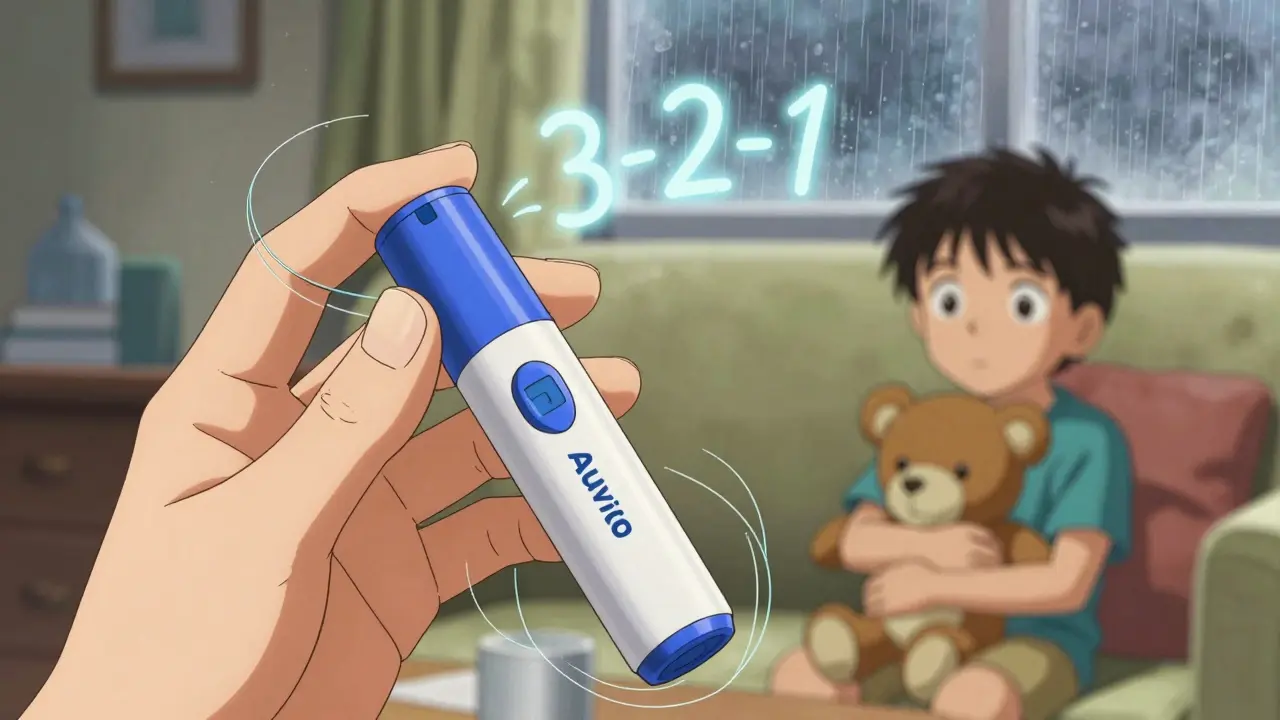
- Remove the safety cap. Most devices have a blue (or gray) cap on the end. Pull it off. Some, like the Auvi-Q, will start talking to you as soon as you remove it.
- Position the person. Have them lie flat on their back. If they’re having trouble breathing, let them sit up slightly. Never let them stand or walk - it can cause a dangerous drop in blood pressure.
- Place the injector on the outer thigh. Aim for the middle of the thigh, halfway between hip and knee. You can inject through clothing if needed. Jeans, leggings, shorts - it doesn’t matter.
- Press hard and hold. Push the injector firmly against the thigh until you hear a click. Keep it pressed for 3 full seconds. This ensures the full dose gets delivered.
- Remove and massage. Pull it away. Rub the injection site gently for 10 seconds. This helps the medicine absorb faster.
- Wait for help. Stay with the person. If they feel better, that’s good - but they still need emergency care. Anaphylaxis can come back.
- Be ready for a second dose. If symptoms don’t improve or get worse after 5-10 minutes, give a second injection. Always have two on hand.
Which Device Should You Choose?
Not all auto-injectors are the same. Here’s how the main ones compare:
| Device | Dose | Key Feature | Cost (Cash Price) | Best For |
|---|---|---|---|---|
| EpiPen | 0.15 mg or 0.3 mg | Simple, widely recognized | $679 | Most users, especially those who need familiarity |
| Auvi-Q | 0.15 mg or 0.3 mg | Voice-guided instructions | $4,229 (with assistance programs) | People who panic under stress, caregivers of young children |
| Adrenaclick | 0.15 mg or 0.3 mg | Manual activation, lower cost | $195 | Cost-conscious users, those with insurance coverage |
| Neffy | 0.3 mg | Needle-free nasal spray | $295 (estimated) | People afraid of needles, or with needle phobia |
EpiPen is still the most common - used by 85% of people in the U.S. But Auvi-Q’s voice prompts help users who freeze during emergencies. Adrenaclick is cheaper but requires an extra step: you have to manually push a plunger after removing the cap. Neffy, the new nasal spray, is promising - especially for kids or needle-phobic adults - but it doesn’t work for everyone. Studies show about 1 in 3 people don’t use it correctly the first time.
Common Mistakes (And How to Avoid Them)
Real-world data shows most people don’t use these devices right. Here’s what goes wrong - and how to fix it:
- Waiting too long. People wait for hives to spread or for breathing to get worse. Don’t. Use it at the first sign of trouble.
- Not holding it long enough. A 2022 study found 61% of users removed the injector before the full 3 seconds. Hold it. Count it out: “One-Mississippi, Two-Mississippi, Three-Mississippi.”
- Injecting in the wrong spot. The thigh is the only reliable spot. Don’t guess. Don’t use the arm or stomach.
- Forgetting the second dose. Symptoms can return. Always carry two. If they’re still struggling after 5-10 minutes, give another.
- Not calling 911. Even if they feel better, they need to go to the hospital. Anaphylaxis can rebound.
Storage and Maintenance
Epinephrine doesn’t last forever. Most devices expire after 12-18 months. Keep them at room temperature - between 59°F and 86°F. Don’t leave them in the car, in a hot glove compartment, or in the freezer. Check the solution through the viewing window. If it’s brown or cloudy, replace it.
Practice with a trainer device - the ones that don’t have medicine. Many pharmacies give them out for free. Do a drill every few months. Teach your kids, your partner, your coworkers. The more people who know how to use it, the better.
What to Do After the Injection
Even if they feel fine after the shot, they need to go to the ER. Why? Because anaphylaxis can come back - sometimes hours later. Emergency staff will monitor them, give more epinephrine if needed, and make sure they’re stable.
Afterward, replace the used injector. Talk to your allergist about why it happened. Maybe you need to adjust your avoidance plan. Maybe you need to carry two instead of one. Maybe you need to update your school or workplace emergency plan.
Real-World Impact
Studies show that when epinephrine is given within 5 minutes of symptom onset, hospitalization drops by nearly half. Death risk drops by 75%. But only 42% of people actually get it in time. Why? Fear. Confusion. Lack of training.
At schools, 72% of nurses have seen a student get injected wrong - often because someone forgot to take off the blue cap. On Reddit, parents share stories of accidental injections from the orange tip being pressed against a pocket. That’s why practice matters.
There’s hope. Newer devices like Auvi-Q and Neffy are making it easier. The FDA is pushing for better designs - like audible clicks that confirm the shot was delivered. And more states are requiring schools to stock epinephrine and train staff.
Final Rule: When in Doubt, Use It
Epinephrine is safe. Side effects like a racing heart, shaking, or anxiety are scary - but they last less than 30 minutes. Untreated anaphylaxis? That’s permanent. That’s fatal.
Don’t overthink it. Don’t wait for permission. Don’t hope it gets better. If you suspect anaphylaxis - use the injector. Call 911. Then call again if you need to give a second dose.
It’s not about being brave. It’s about being ready.
Can I use an epinephrine auto-injector on someone else?
Yes. If someone is having an anaphylactic reaction and you have access to an auto-injector, you can and should use it - even if it’s not prescribed to them. Most states have Good Samaritan laws that protect you from liability when helping in an emergency. Epinephrine is safe for most people, even if they don’t have allergies. The risks of not using it far outweigh any side effects.
What if I accidentally inject myself?
Accidental injections happen - often from the orange tip being pressed against a pocket or purse. If you inject yourself in the hand or finger, go to the ER. Epinephrine in small areas can cause tissue damage. If you inject yourself in the thigh, you’re probably fine. Monitor for side effects like a fast heartbeat or shaking. Call your doctor to report it. Always keep two injectors: one for emergencies, one as backup.
Do I need a prescription to buy an epinephrine auto-injector?
Yes, in the U.S., you need a prescription to buy an auto-injector. But some states allow pharmacists to prescribe them under standing orders. Check with your local pharmacy. Also, many manufacturers offer savings programs - some even give them away for free if you qualify based on income.
Can I use an expired auto-injector?
If it’s your only option during an emergency, yes - use it. Epinephrine doesn’t suddenly stop working the day after expiration. Studies show it often retains at least 90% of its potency for months past the date. But don’t rely on expired ones. Replace them as soon as possible. Always check the expiration date and replace before it runs out.
Why do I need to lie down after using epinephrine?
Epinephrine can cause a sudden drop in blood pressure. If you’re standing or walking, you could faint and fall. Lying flat helps blood flow to the brain and heart. If breathing is hard, you can sit up slightly with legs stretched out - but never stand. This is why schools and workplaces are trained to have people lie down after injection.
Used an EpiPen on my kid last year during a peanut reaction. Scared the hell out of me, but following the steps exactly saved his life. The key is not hesitating. I used to think Benadryl was enough until I saw what happens when you wait. Now I carry two everywhere. Practice with the trainer device every few months. It makes a difference.
just press and hold. dont overthink it. my bro once used it on a stranger at a concert. no idea who he was. guy lived. 911 called right away. epinephrine > benadryl. period.
What strikes me most is how this device transforms fear into action. In a world where we overcomplicate survival, the auto-injector strips everything down to a single, decisive motion. It doesn’t ask for permission. It doesn’t require expertise. Just presence. And yet, we still undertrain, underprepare, and underestimate its power. The real crisis isn’t the allergy-it’s our collective complacency.
India has 400 million people with allergies and still no national program for free auto-injectors. Meanwhile, Americans spend $700 on one device like it’s a luxury iPhone. This is why we need global equity in life-saving tech. Also, Neffy? No way. Needle phobia is a first-world problem. We need more education, not gimmicks. 🇮🇳
Let’s be real-this whole guide is over-engineered. You don’t need 9 steps. You don’t need to know the difference between Auvi-Q and Adrenaclick. You don’t need to know the exact dosage by weight. Just press it on the thigh. Hold for 3 seconds. Call 911. Done. Most people who die from anaphylaxis aren’t using it wrong-they’re not using it at all. Stop making it complicated. It’s not rocket science. Also, why does the FDA allow these things to cost $700? That’s criminal. And don’t get me started on the fact that schools still don’t stock them. Lazy.
Imagine this: your child’s lips swell. Their eyes roll back. You’re screaming for help. The world slows down. And then-CLICK. That sound. That single, mechanical click. It’s not just a shot. It’s a heartbeat returning. A breath pulled from the void. I’ve held that device in my hand during a panic attack. I’ve trained my 7-year-old to do it blindfolded. This isn’t medicine. It’s a lifeline woven into muscle memory. And if you’re still hesitating? You’re not just unprepared. You’re playing Russian roulette with someone’s life.
why do you need to lie down? i thought you just use it and run to the hospital. also why do you need two? i only have one. its expensive. also i used it once and my heart felt like it was gonna explode. is that normal? lol
Epinephrine is the original Hail Mary. It’s not elegant. It’s not pretty. But in the chaos of anaphylaxis, it’s the only thing that speaks the language of survival. The fact that we’ve built devices that talk to you (Auvi-Q), or skip needles entirely (Neffy), shows how far we’ve come. But here’s the real win: when a stranger uses it on someone they don’t know? That’s humanity in its rawest form. No paperwork. No consent forms. Just instinct. And yeah, the side effects? Racing heart, shaking, panic? That’s just epinephrine saying, ‘I’m alive.’ And that’s worth every second.
✅ Press
✅ Hold 3 sec
✅ Call 911
✅ Lie flat
✅ Second dose if needed
✅ Replace expired one
✅ Train everyone you know
Just do it. No excuses. 🚨❤️