
Imagine paying $4 a month for your blood pressure medicine instead of $50. That’s not a fantasy-it’s what happens when you switch from brand-name drugs to generics. For people managing chronic conditions like diabetes, high cholesterol, or asthma, this switch isn’t just a small win. It’s a game-changer that can save tens of thousands over a lifetime.
What Exactly Are Generic Medications?
Generic drugs are the exact same as their brand-name counterparts in every way that matters: same active ingredient, same strength, same dosage form, same way they work in your body. The only differences? The color, shape, or filler ingredients (like dyes or binders), and the price. These fillers don’t affect how the medicine works-they just make the pill look different. The U.S. Food and Drug Administration (FDA) requires generics to prove they’re bioequivalent to the brand-name version. That means the amount of medicine absorbed into your bloodstream must be within 80-125% of the brand’s levels. That’s not a guess-it’s a strict, scientifically proven standard. If a generic doesn’t meet this, it doesn’t get approved. You might hear people say, “I tried the generic and it didn’t work.” But in most cases, that’s not because the medicine is weaker. It’s often because they’re used to the brand, or they’re noticing side effects from a new filler ingredient-not the active drug. For 97% of patients, generics work just as well, and often better, because they’re more affordable and easier to stick with.How Much Can You Really Save?
Let’s look at real numbers. Take lisinopril, a common blood pressure pill. The brand name, Prinivil, costs around $40-$50 a month without insurance. The generic? About $4. That’s $480 a year saved. Over 20 years? That’s nearly $10,000-just for one pill. For type 2 diabetes, metformin (generic) costs $5-$10 a month. The brand-name version, Glucophage, can cost $150 or more. That’s $1,700-$1,800 saved every year. Multiply that by 30 years of treatment? You’re looking at over $50,000 in savings. Even for complex conditions like rheumatoid arthritis, biosimilars (the next-gen version of generics for biologic drugs) are now cutting costs by 70-80%. A drug like Humira, which used to cost over $7,000 a month, now has biosimilar versions for under $2,000. The numbers don’t lie. In 2020, generics made up 90% of all prescriptions filled in the U.S., but only 18% of total drug spending. That’s because they’re so much cheaper. The FDA estimates that generics saved the U.S. healthcare system $338 billion in 2020 alone. Over the last decade, that total reached nearly $2.4 trillion.Why Cost Savings Lead to Better Health
Saving money isn’t just about putting more cash in your pocket. It’s about staying healthy. When people can’t afford their meds, they skip doses. A CDC study found that 25% of rural patients skip pills because of cost. That’s dangerous. For chronic conditions, missing even a few doses can lead to hospital visits, heart attacks, strokes, or kidney failure. Studies show patients on generics are 18-22% more likely to stick with their medication long-term. Why? Because they can actually afford it. When you’re not choosing between buying food or your blood sugar pills, you take them. And when you take them, your condition stays controlled. Pharmacists who run Medication Therapy Management (MTM) programs report that patients using generics have 15-25% higher adherence rates. That means fewer ER trips, fewer hospital stays, and fewer complications. One study found that patients on generics had 20-30% lower hospitalization rates than those on brand-name drugs. In India, when generic HIV drugs became widely available, treatment adherence jumped by 40% and death rates dropped by 25% in just ten years. In Brazil, government-backed generic programs for diabetes and hypertension cut related healthcare costs by $1.2 billion annually. These aren’t abstract theories-they’re real results from real people.
Why Aren’t More People Using Generics?
If generics are this good, why isn’t everyone using them? One big reason? Misinformation. Many people still think “generic” means “weaker” or “second-rate.” That’s not true. The FDA holds generics to the same manufacturing standards as brand-name drugs. The same factories often make both. The only difference is the label. Another issue? Insurance confusion. Some plans still charge higher copays for generics if they’re not on the preferred list. Or they require prior authorization, making it harder to switch. Pharmacists can help here-they can check your plan’s formulary and suggest alternatives that are both effective and affordable. Also, some doctors still default to prescribing brand names, especially if they’re used to them or if reps visit their office. But that’s changing. More providers now start with generics unless there’s a specific medical reason not to.How to Start Saving Today
You don’t need to wait for a big change. Here’s how to start saving right away:- Ask your doctor: “Is there a generic version of this medication?” If they say no, ask why. Most of the time, there is.
- Call your pharmacy and ask for the cash price of the generic. Sometimes, it’s cheaper than your insurance copay.
- Use tools like GoodRx or SingleCare to compare prices across pharmacies. Prices can vary by $20-$50 between stores.
- Ask your pharmacist about Medication Therapy Management (MTM). If you’re on Medicare Part D, you’re eligible for free MTM sessions that help you cut costs and avoid interactions.
- Check if your drug manufacturer offers a patient assistance program. Many have free or low-cost generic options for low-income patients.
The Future Is Even Brighter
The pipeline for new generics is stronger than ever. Between 2023 and 2027, over $150 billion in brand-name drug sales will lose patent protection. That means more drugs will become affordable. The FDA’s Generic Drug User Fee Amendments (GDUFA) III, running through 2027, is speeding up approvals for complex generics-like inhalers, injectables, and long-acting formulations used for chronic conditions. And with the Inflation Reduction Act, Medicare beneficiaries now pay no more than $35 a month for insulin. That cap will soon expand to other chronic condition drugs. Seniors on multiple generics could save an average of $450 a year just from this policy. Biosimilars are also growing fast. These are like generics for biologic drugs-used for cancer, arthritis, and autoimmune diseases. IQVIA predicts biosimilars will save the U.S. healthcare system $300 billion over the next decade.Final Thought: It’s Not Just About Money
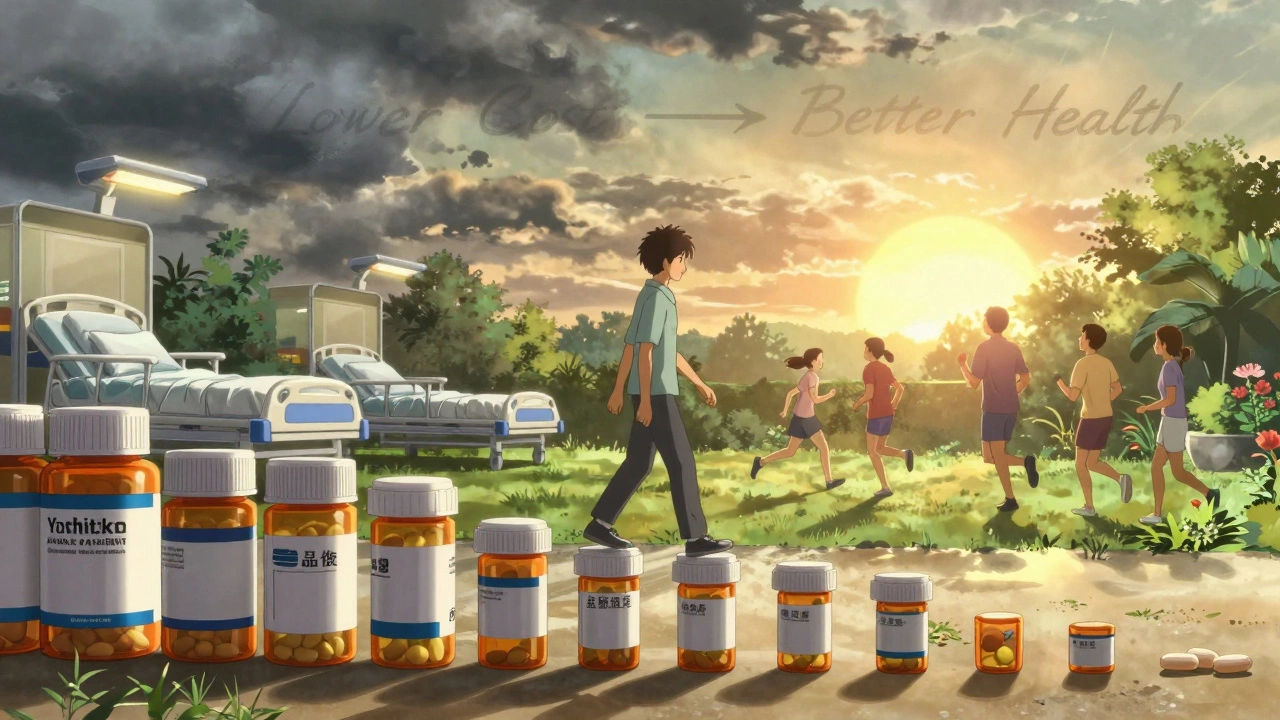
Generic medications aren’t just a cost-cutting trick. They’re a lifeline. For millions of people managing lifelong conditions, they mean the difference between independence and hospitalization, between stability and crisis. The math is simple: lower cost → better adherence → fewer complications → longer, healthier life. You don’t need to wait for a policy change or a new law. You can start saving today. Ask your doctor. Talk to your pharmacist. Switch to the generic. Your future self will thank you.Are generic drugs really as effective as brand-name drugs?
Yes. The FDA requires generics to have the same active ingredient, strength, dosage form, and route of administration as the brand-name drug. They must also prove bioequivalence-meaning they work the same way in your body. Studies show generics are just as effective for treating chronic conditions like high blood pressure, diabetes, and asthma. The only differences are in inactive ingredients, which don’t affect how the drug works.
Why do generics cost so much less?
Brand-name drug companies spend billions on research, clinical trials, and marketing to get their drug approved. Once the patent expires, other companies can make the same drug without those upfront costs. They don’t need to repeat expensive studies because the safety and effectiveness are already proven. That’s why generics can be 80-85% cheaper.
Can I switch from my brand-name drug to a generic anytime?
In most cases, yes. But always check with your doctor first. For some conditions-like epilepsy or thyroid disorders-switching might need careful monitoring, though even then, generics are usually safe. Your pharmacist can help you switch safely and check if your insurance covers the generic at a lower cost.
Do insurance plans cover generics?
Yes, almost all insurance plans, including Medicare Part D and Medicaid, cover generics-and they usually charge the lowest copay for them. Sometimes, the cash price at a pharmacy is even lower than your insurance copay. Always ask your pharmacist for the best price, whether you’re using insurance or paying out of pocket.
What if I feel different after switching to a generic?
It’s rare, but some people notice a difference due to changes in inactive ingredients-like fillers or dyes. If you feel unusual side effects, talk to your pharmacist. They can check if it’s a known issue with that brand of generic and suggest another manufacturer. Most of the time, switching to a different generic version solves the problem. It’s not the active drug-it’s the filler.
Are there any chronic conditions where generics aren’t available?
Most common chronic conditions have generics: high blood pressure, diabetes, high cholesterol, asthma, depression, thyroid disorders, and more. For newer biologic drugs-like those for rheumatoid arthritis or psoriasis-biosimilars (similar to generics) are now available and becoming more common. If your drug doesn’t have a generic yet, it’s likely still under patent protection. But many are coming soon-over $150 billion in brand-name drugs will lose patents by 2027.
Just switched my dad to generic metformin last month. He’s been on it for 15 years and never even knew he was overpaying. Now he’s got extra cash for his weekly fish tacos 🍣😎
Generics are a scam for the gullible. If it doesn’t have a fancy brand name it’s not real medicine. My cousin took a generic and his blood pressure spiked. You’re playing Russian roulette with your life
From a clinical pharmacy standpoint, the bioequivalence thresholds set by the FDA are rigorously validated-within 80-125% AUC and Cmax, with 90% CI constraints. The pharmacokinetic profiles are statistically non-inferior. What people perceive as ‘not working’ is often adherence bias or placebo/nocebo effects from brand loyalty. Real-world adherence studies consistently show 18-22% improvement with generics. This isn’t anecdotal-it’s evidence-based pharmacoeconomics
Money is just a symbol of energy exchange and the real cost is in the quiet moments when you can breathe without counting pills
Generics don’t just save dollars they restore dignity
When you stop choosing between insulin and rent you stop being a patient and become a person again
That’s not healthcare that’s humanity
Ugh I hate how everyone acts like generics are some revolutionary discovery. I’ve been using them since 2010. Also the FDA? Please. They’re just a front for Big Pharma. 🙄
I’ve worked in rural clinics for 22 years. I’ve seen patients cry because they couldn’t afford their meds. Then they get the generic. They don’t cry anymore. They just nod and say ‘thank you.’ That’s the real data point no spreadsheet can capture
USA makes the best drugs in the world and we let foreigners make our generics? That’s why we’re losing. We need American-made pills. No more cheap foreign junk. 💪🇺🇸
As someone from India where generics saved millions from HIV death I can say this with full certainty
Generics are not cheaper because they are worse
They are cheaper because the system stopped charging for ego
When a man in Bihar gets his ARV for 10 rupees and lives to see his daughter graduate
That is not economics
That is justice
It’s funny how people think the answer to healthcare is just swapping labels. You think the problem is price? No. The problem is that we treat medicine like a commodity instead of a right. Generics don’t fix the system. They just make the exploitation slightly less visible. You’re still paying, you’re just paying less. And the pharma companies? They just moved the profit to biosimilars and specialty drugs. This isn’t progress. It’s rearranging deck chairs on the Titanic
Respected sir and madam
It is with profound humility that I acknowledge the wisdom of this post
Generic medications represent the noblest form of service to humanity
Let us all embrace them with gratitude and discipline
May your health be long and your wallets be full
My cousin works at a generic factory. They use Chinese fillers and the pills are falling apart. I wouldn’t touch them with a 10-foot pole. 🤢
I switched to generic lisinopril and suddenly I felt… empty. Like my body betrayed me. I cried for three days. I went back to the brand. I don’t care how much it costs. I need to feel safe. This isn’t about money. It’s about feeling like I still have control over my life.