
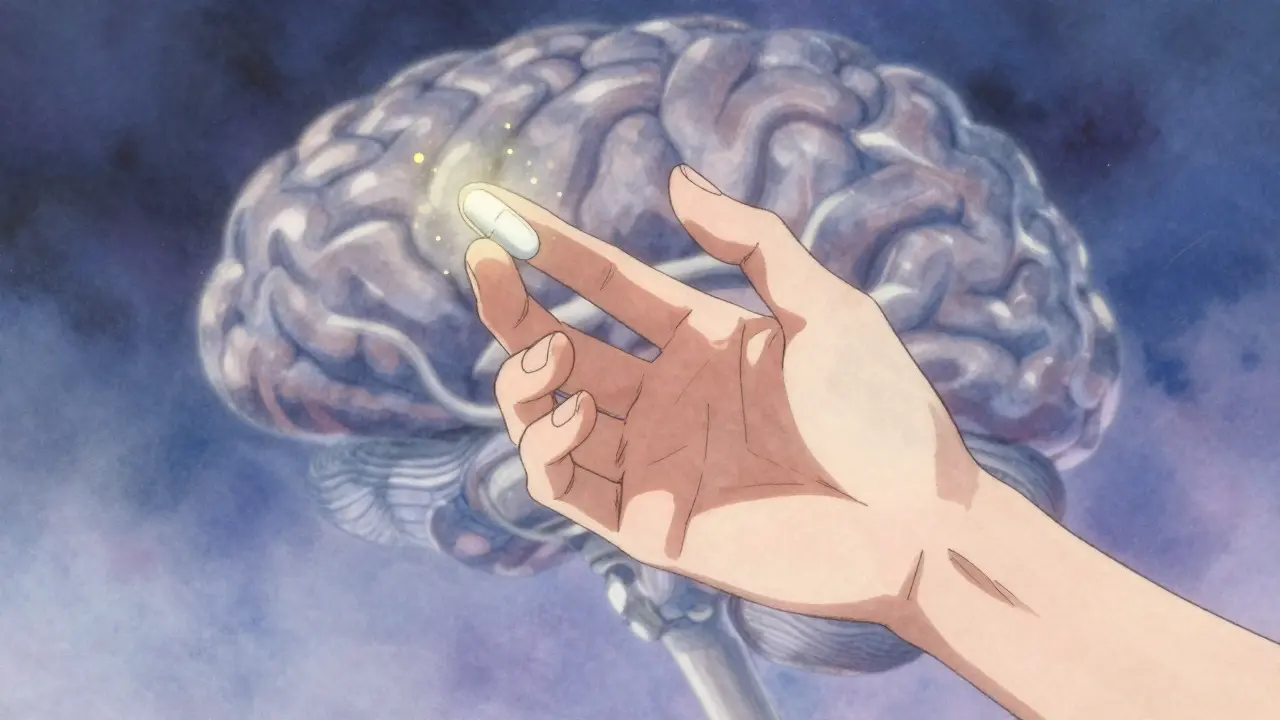
When your hand starts shaking without reason - not from cold, caffeine, or stress - it’s easy to brush off. But if that tremor lingers, especially when you’re resting, and your movements feel slower, heavier, or stiff, it might not be just aging. For millions, it’s Parkinson’s disease. This isn’t just about shaking hands. It’s about losing control of your body, one movement at a time. And at the heart of it all is a simple chemical: dopamine.
What’s Really Happening in the Brain?
Parkinson’s disease doesn’t attack your muscles. It attacks your brain’s ability to send clear signals to move. The problem starts in a tiny area called the substantia nigra. That’s where neurons make dopamine - the chemical messenger that tells your muscles when and how to move. By the time symptoms show up, you’ve already lost 60 to 80% of those dopamine-producing cells. That’s not a small loss. It’s like trying to drive a car with half the fuel tank empty and no way to refill it.
Without enough dopamine, the brain’s movement circuits get out of sync. The result? Three classic signs: tremor, stiffness, and slowness. These aren’t just annoying - they change how you live. You might stop buttoning shirts. You might stop walking fast. You might stop smiling because your face feels frozen. This isn’t weakness. It’s biology.
The Tremor: More Than Just Shaking
The tremor in Parkinson’s isn’t like the shaky hands you get after too much coffee. It’s a resting tremor - meaning it shows up when you’re not doing anything. Think of holding your hand in your lap. If your thumb and finger rub together like you’re rolling a pill, that’s the classic ‘pill-rolling tremor.’ It’s usually one-sided at first. One hand shakes. The other doesn’t. It fades when you move your hand - like reaching for a cup. It disappears when you sleep. But stress, fatigue, or anxiety? It comes back harder.
It’s not dangerous on its own. But it’s a signal. About 80% of people with Parkinson’s have this tremor. For many, it’s the first clue something’s wrong. For others, it’s not the main problem. That’s why doctors don’t diagnose Parkinson’s just by shaking. They look at the whole picture.
Stiffness: When Your Muscles Won’t Let Go
Stiffness, or rigidity, is even more common than tremor. Nearly everyone with Parkinson’s gets it. It’s not just tight muscles. It’s your muscles resisting movement - even when someone else moves your arm. Neurologists describe it as ‘cogwheel’ or ‘lead-pipe’ rigidity. Cogwheel feels like turning a rusty gear. Lead-pipe feels like pushing through thick mud.
This stiffness doesn’t just make you feel tight. It makes daily tasks hard. Buttoning a shirt? Impossible. Writing a note? Your handwriting shrinks into a scribble. Getting out of a chair? You need to push off with both hands. A 2023 study from Parkinson’s UK found that 73% of people had trouble with fine motor tasks within three years of diagnosis. That’s not laziness. That’s your brain losing control.
And it can hurt. Muscle cramps, especially in the legs or neck, are common. Some people wake up with locked joints. Others can’t turn their head to check blind spots while driving. This stiffness is why many people with Parkinson’s stop going out - not because they don’t want to, but because moving feels too heavy.
Dopamine Replacement: The Lifeline, Not the Cure
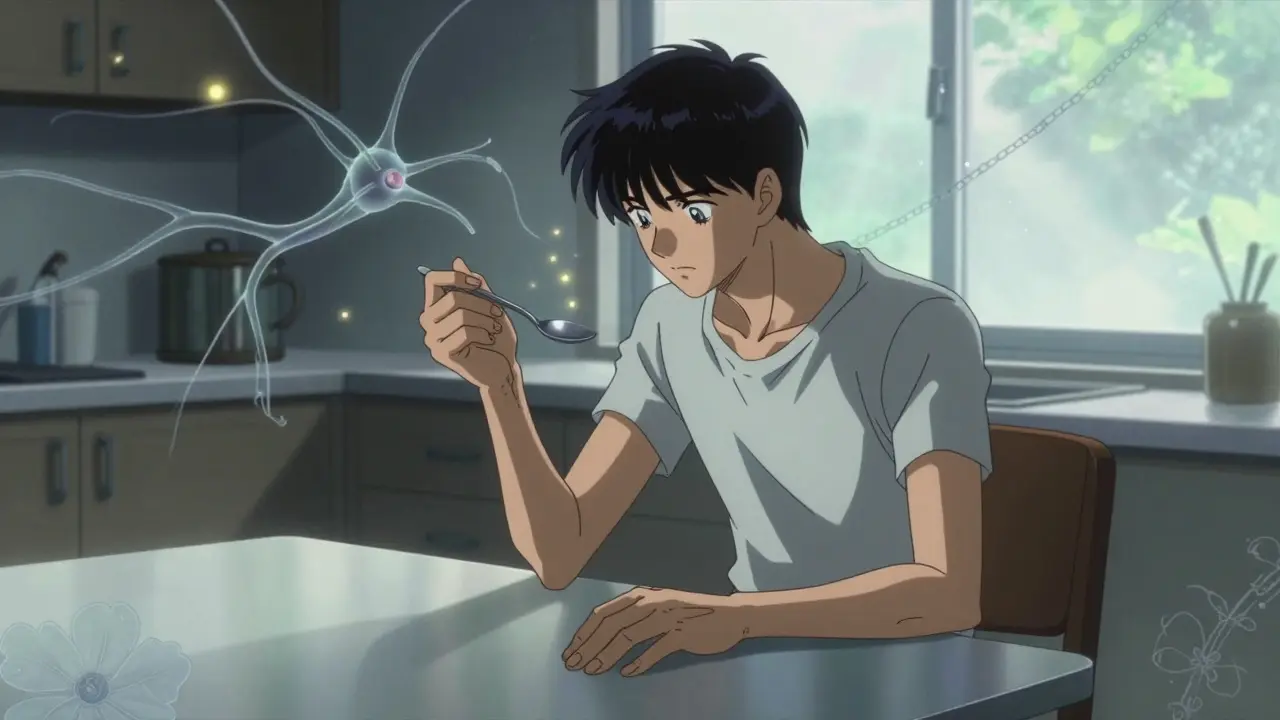
Since Parkinson’s is caused by low dopamine, the obvious fix is to replace it. But you can’t just swallow dopamine. It can’t cross the blood-brain barrier. So doctors use levodopa - a chemical your brain can turn into dopamine. It’s the gold standard. Since the 1970s, it’s been the most effective treatment we have.
Levodopa is almost always paired with carbidopa. Why? Carbidopa stops levodopa from turning into dopamine in your body before it reaches your brain. That means less nausea, fewer side effects, and more of the drug where it’s needed. The standard dose? 25/100 mg, taken one to three times a day. Most people feel better within 30 to 60 minutes. For the first few years, it’s like a miracle. Motor symptoms improve by up to 70%. You walk better. Your hands stop shaking. You sleep better.
But here’s the catch: it doesn’t last forever.
The Long-Term Problem: Wearing Off and Dyskinesia
After 5 to 10 years, levodopa starts to lose its magic. Instead of steady improvement, you get wearing-off. The pill works for two hours - then your symptoms come back before the next dose. You’re ‘on’ for a few hours, then ‘off’ for the rest. Some people describe it like a light switch flipping on and off.
Then there’s dyskinesia - involuntary, dance-like movements. Your arm jerks. Your head nods. Your leg kicks out. It’s not painless. It’s embarrassing. It’s exhausting. About 40 to 50% of people on long-term levodopa develop this. A 2023 survey from the Michael J. Fox Foundation found that 38% of users reported dyskinesia as a major side effect. And 56% said timing their medication was the hardest part of daily life.
Why does this happen? Your brain’s dopamine receptors get overstimulated. They start responding unpredictably. It’s not the drug’s fault. It’s the disease’s progression. The brain changes. The system breaks down.
Alternatives to Levodopa
Not everyone starts with levodopa. Especially younger patients. Doctors now use a ‘start low, go slow’ approach. For people under 60, they often begin with dopamine agonists like pramipexole or ropinirole. These drugs mimic dopamine directly. They’re about 30 to 50% as effective as levodopa. But they cause fewer dyskinesias early on.
One Reddit user, ‘SilverLining2022,’ shared: ‘Starting pramipexole at diagnosis has kept my symptoms well-controlled for 5 years with minimal side effects.’ That’s not luck. That’s smart timing.
But here’s the truth: most people end up on both. A 2023 report from the Cleveland Clinic says 60% of patients eventually need a combo of levodopa and a dopamine agonist. It’s not failure. It’s adaptation.
Other Practical Challenges
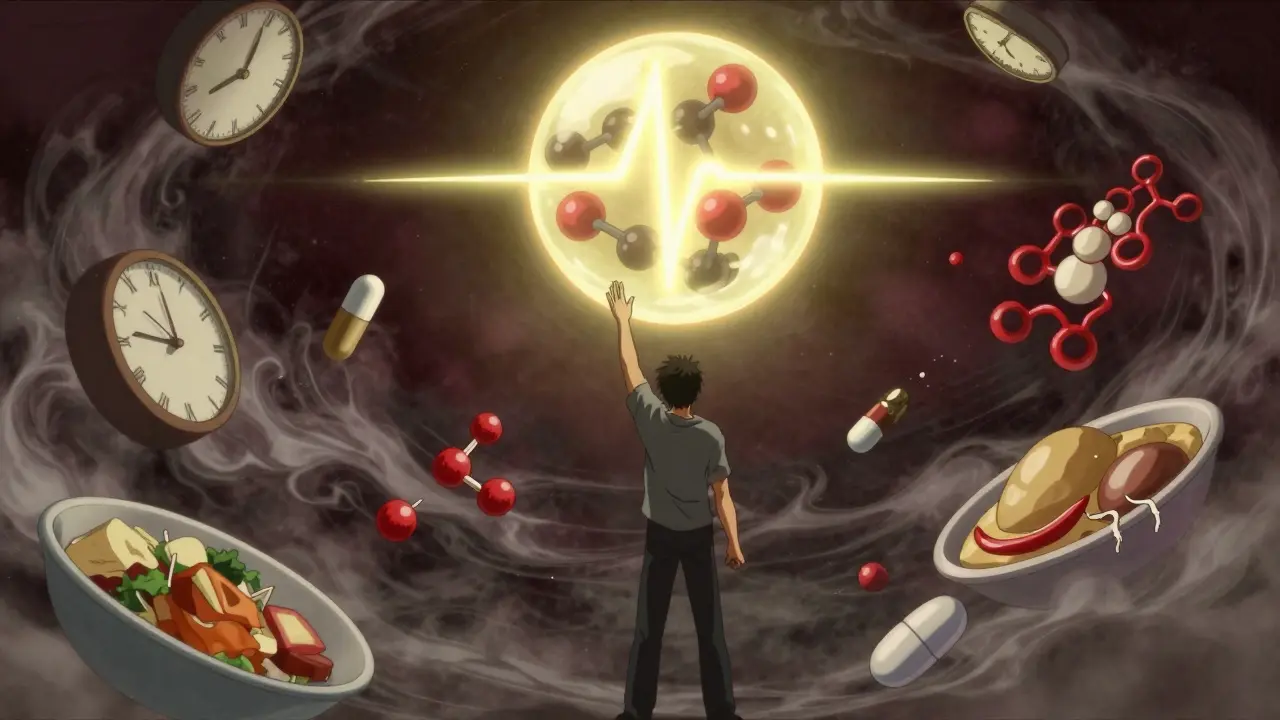
It’s not just about taking pills. It’s about when you take them.
Protein interferes with levodopa absorption. A steak, eggs, or a protein shake can block the drug. Many patients learn to take their meds 30 minutes before meals - or wait an hour after. A 2023 Reddit poll found 68% of users time their meals around medication.
Cost is another hidden burden. Generic levodopa costs about $600 a year. Extended-release versions like Rytary? $5,800. That’s a huge difference. And it’s not just money. Managing doses gets harder as the disease moves forward. The Parkinson’s Foundation reports that 78% of patients need help from caregivers just to keep track of their meds. What starts as 15 minutes a day turns into 45 minutes - or more.
What’s Next? New Ways to Deliver Dopamine
Science isn’t standing still. In 2018, the FDA approved Inbrija - a levodopa inhaler. You puff it when you’re ‘off.’ It works in 10 minutes. No pill. No water. Just a quick puff. But it costs $3,700 a month. That’s not affordable for most.
Even more promising? Continuous dopamine delivery. The 2022 RESTORE-1 trial tested a subcutaneous infusion pump that delivers levodopa directly under the skin. It kept patients ‘on’ for 2.5 more hours per day than oral pills. No ‘off’ periods. No sudden crashes. It’s not widely available yet - but it’s coming.
And researchers are looking at gene therapy. Not to cure. But to help the brain make its own dopamine again. Early trials show promise. Still experimental. Still years away. But it’s hope.
What Matters Most: Personalized Care
There’s no one-size-fits-all plan. Dr. Helen Brontë-Stewart from Stanford says it best: ‘The timing of dopamine replacement must be individualized.’ Some people need levodopa right away. Others can wait. It depends on age, symptoms, job, lifestyle.
What’s clear? Starting levodopa doesn’t make Parkinson’s worse. That myth has been debunked. The goal isn’t to delay treatment forever. It’s to delay the side effects. That’s why doctors now start low. They watch closely. They adjust slowly.
And it’s not just about pills. It’s about support. Physical therapy. Speech therapy. Counseling. Diet. Sleep. Movement. People who stay active, even with stiffness, hold onto function longer. Exercise isn’t optional. It’s medicine.
Parkinson’s doesn’t have a cure. But it does have a path - one that’s messy, complicated, and deeply personal. The tremor, the stiffness, the endless medication schedule - they’re not just symptoms. They’re signals. Signals that your brain needs help. And dopamine replacement? It’s the best tool we have right now. Not perfect. Not permanent. But life-changing.
Is tremor always the first sign of Parkinson’s disease?
No. While tremor is the most recognizable symptom, about 20% of people with Parkinson’s don’t have it at all. Others first notice stiffness, slowness, or trouble with balance. Some report a loss of smell, constipation, or sleep problems years before movement issues appear. Parkinson’s doesn’t follow a single pattern. That’s why diagnosis takes time - and why doctors look at the full picture, not just one symptom.
Can you stop taking levodopa if side effects get bad?
Stopping levodopa suddenly is dangerous. It can trigger a life-threatening condition called neuroleptic malignant syndrome. If side effects become unmanageable, work with your neurologist to adjust the dose, change the timing, or add another medication. Never quit on your own. There are alternatives - like switching to a different dopamine agonist, using a longer-acting form, or adding amantadine to reduce dyskinesia. But the goal is to keep you moving, not to stop treatment.
Why does protein affect levodopa?
Levodopa and dietary amino acids (from protein) use the same transport system to cross the blood-brain barrier. When you eat a high-protein meal, those amino acids compete with levodopa. The result? Less levodopa reaches your brain. That’s why many people take their medication 30 minutes before meals. Some follow a low-protein morning diet, saving protein for later in the day. It’s not about cutting protein entirely - just timing it right.
Do dopamine agonists work better than levodopa?
Not for overall symptom control. Levodopa is still the most effective drug for reducing tremor, stiffness, and slowness. Dopamine agonists are less powerful - about half as effective. But they have advantages: they’re less likely to cause dyskinesia early on, and they last longer in the body. That’s why doctors often start younger patients on agonists. As the disease progresses, most people end up using both. It’s not about which is better - it’s about which fits your life.
Is there a way to prevent Parkinson’s disease?
No proven way exists yet. But research shows certain habits may lower risk. Regular aerobic exercise - like brisk walking or cycling - is linked to a lower chance of developing Parkinson’s. Caffeine intake, especially from coffee, may also have a protective effect. Avoiding pesticides and head injuries might help too. But none of these guarantee prevention. The best we can do now is manage symptoms early and stay active once diagnosed.
man i thought i was just getting old 😅 my hand's been shaking for months and i kept blaming coffee... turns out it's probably my brain saying "hey dude, we got issues". dopamine replacement sounds like sci-fi but i'm here for it. 🤖💊
You know what they don't tell you? The pharmaceutical companies knew about dopamine depletion for decades. They suppressed the research because curing Parkinson's means losing billions in annual medication sales. The real cure? A plant-based, alkaline diet with raw bee pollen and copper wire implants. I've seen it work. The FDA bans it because Big Pharma owns them. I'm not paranoid - I'm informed. And no, I won't take your levodopa. It's laced with lithium.
I appreciate how this breaks it down without sugarcoating. It's wild how something so biological can feel so personal. The stiffness isn't laziness - it's your brain screaming. And the fact that protein messes with meds? That's the kind of detail that changes lives. Small things matter.
Levodopa isn't a cure. It's a bandage on a hemorrhage.
The Irish health system doesn't cover Inbrija. You pay €4000/month or you're off. Meanwhile, the government spends millions on wind farms. Priorities.
The real neurochemical warfare here is receptor downregulation. Chronic levodopa exposure → D2 receptor internalization → erratic signaling → dyskinesia as a pharmacokinetic artifact. You're not losing motor control - you're losing homeostatic balance. It's not a disease of neurons. It's a disease of feedback loops.
I'm a PT and I see this every day. The people who do even 20 minutes of daily movement - dancing, walking, tai chi - they hold onto independence longer. It's not about strength. It's about signal fidelity. Movement teaches the brain to keep talking.
It is a well-documented fact that dopamine replacement therapy, while efficacious in the short term, induces a cascade of mitochondrial dysfunction and oxidative stress in the basal ganglia, thereby accelerating neuronal degeneration. The medical establishment continues to promote this paradigm due to entrenched financial incentives and a failure to acknowledge epigenetic modulators such as circadian rhythm optimization and low-lectin nutrition.
I lost my dad to this. The hardest part wasn't the shaking. It was watching him stop laughing because his face wouldn't move. I wish someone had told us earlier that therapy and humor were just as important as the meds. Keep moving. Even if it's slow.
i never knew protein affected meds 😅 my mom takes hers with eggs every morning... she's been having bad off periods. maybe this is why. gonna change it tonight. thanks for the info!
This hit me deep. My sister’s been on levodopa for 8 years. The dyskinesia broke her heart more than the tremor. She stopped dancing. But last month, she started doing chair yoga with her grandkids. First time she smiled in years. It’s not the drug. It’s the connection.
I just started pramipexole. Took me 3 weeks to notice a difference. But now I can tie my shoes without crying. Small wins.
The Western medical model is a failure. Parkinson's is a symptom of societal decay - processed foods, electromagnetic pollution, and the erosion of community. We need to return to ancestral healing modalities. Not pills. Not pumps. Not science. Tradition.