
Every year, millions of people around the world receive fake or substandard medicines. These aren’t just poor-quality pills-they can be deadly. A counterfeit cancer drug might contain sugar instead of chemotherapy. A fake antibiotic could have no active ingredient at all. And when these drugs slip through the supply chain, pharmacists are often the last line of defense. That’s why pharmacist education on counterfeit detection isn’t optional-it’s lifesaving.
Why Pharmacists Need This Training
Pharmacists don’t just fill prescriptions. They verify that what’s in the bottle matches what’s on the label. But counterfeiters are getting smarter. Today’s fake drugs look identical to the real thing. The packaging is perfect. The barcodes scan. Even the pill imprint matches. Traditional checks-like comparing lot numbers or calling the manufacturer-are too slow and unreliable. In 2024, global law enforcement uncovered over 6,400 incidents of counterfeit, stolen, or illegally diverted drugs across 136 countries. These involved more than 2,400 different medicines-from insulin to heart medications to vaccines. The Pharmaceutical Security Institute found that criminal networks are now targeting high-value drugs like biologics and oncology treatments, which are harder to replicate but carry much higher profit margins. The U.S. has the most advanced drug tracking system in the world thanks to the Drug Supply Chain Security Act (DSCSA), passed in 2013. But even there, counterfeit drugs still make it through. In developing countries, infrastructure gaps make detection nearly impossible without proper training. That’s why education isn’t just about knowing what to look for-it’s about building a mindset of skepticism and verification.What Modern Training Covers
Today’s pharmacist education programs go far beyond basic awareness. They teach concrete skills grounded in real-world scenarios. Here’s what’s included in leading programs:- Recognizing red flags: A drug priced 40% below the wholesale acquisition cost? That’s a major warning sign.
- Verifying distribution channels: Specialty drugs like Humira or Keytruda only flow through authorized distributors. Pharmacists must check manufacturer websites to confirm legitimacy.
- Understanding supply chain breaks: Counterfeiters often exploit gaps between manufacturers, wholesalers, and pharmacies. Training helps identify where those breaks occur.
- Spotting online scams: Since 2020, illegal online pharmacies have surged. Training now includes how to identify fake websites, suspicious social media ads, and unlicensed sellers.
- Using verification tools: New handheld devices use spectral analysis and AI to detect chemical differences invisible to the eye. These tools give results in seconds.
Technology Is Changing the Game
Gone are the days of flipping through paper catalogs or calling a 1-800 number. Today, tools like RxAll’s handheld devices let pharmacists scan a pill and instantly compare its chemical signature against a verified database. The device doesn’t just tell you if it’s fake-it shows you exactly how it differs: a slightly different molecular absorption pattern, an off-color coating, or a trace contaminant. These aren’t luxury gadgets. They’re becoming essential. In community pharmacies, staff report that using these tools cuts verification time from 15 minutes to under 30 seconds. More importantly, confidence in their judgment skyrockets. One pharmacist in Ohio told a colleague, “I used to second-guess every unusual shipment. Now I know. And I can prove it.” Training platforms like TrainingNow.com offer mobile-friendly courses that take under an hour. These include interactive scenarios-like a patient bringing in a “discounted” diabetes medication from a website-and ask pharmacists to make decisions based on real data. Completion rates are high because they’re practical, not theoretical.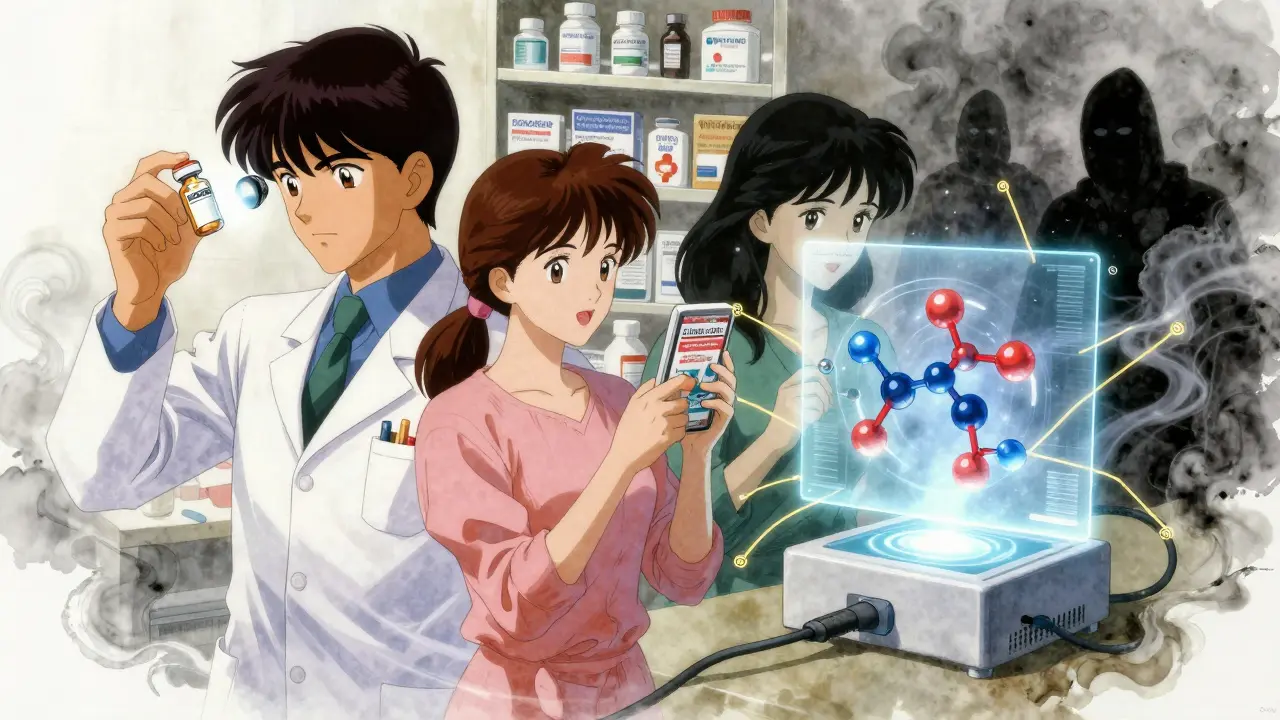
Global Efforts and Gaps
The U.S. leads in infrastructure, but it’s not enough. In 2025, Interpol’s Operation Pangea XVI involved 90 countries. They shut down 13,000 illegal websites, seized 50.4 million counterfeit doses, and made 769 arrests. The scale is staggering. But many countries still lack basic detection tools, trained staff, or even reporting systems. That’s why WHO is rolling out an updated global toolkit in late 2024. It expands the successful African pilot program to include regions with weak supply chains-Latin America, Southeast Asia, and parts of Eastern Europe. The focus? Online counterfeit sales. Since the pandemic, fake drugs sold via Instagram, WhatsApp, and dark web marketplaces have exploded. Training now includes how to spot phishing links, fake customer reviews, and counterfeit payment portals. Pfizer’s Anti-Counterfeiting Program has trained law enforcement in 183 countries since 2004. Their message is simple: pharmacists, customs agents, and police need to work together. One pharmacist in Nigeria identified a fake batch of malaria drugs after noticing inconsistent packaging glue. She reported it. Police traced it to a warehouse in Ghana. That chain of action only happened because someone was trained to act.What Pharmacists Should Do Now
You don’t need to wait for a formal program. Start today:- Check the manufacturer’s website for authorized distributors. If your supplier isn’t listed, question it.
- Don’t ignore unusually low prices. Counterfeiters undercut legitimate suppliers to lure buyers.
- Use verification tools if your pharmacy has them. If not, push for them. The cost of one fake drug is far higher than the cost of a device.
- Join online forums like RxAll’s community. Pharmacists there share real cases-what they saw, how they caught it, what happened next.
- Report suspicious drugs. In the U.S., use the FDA’s MedWatch system. In other countries, contact national health regulators.
The Bigger Picture
This isn’t just about pills. It’s about trust. When a patient takes a medication they believe is safe, they’re trusting the pharmacist. That trust can’t be rebuilt once broken. A single counterfeit drug can kill. It can destroy a pharmacy’s reputation. It can erode public confidence in healthcare. The good news? We have the tools. We have the training. We have the data. What’s missing is consistent implementation. Every pharmacist, in every country, deserves access to this education. And every patient deserves to know their medicine is real.What are the most common signs of a counterfeit drug?
Common signs include mismatched packaging (wrong font, color, or logo), inconsistent pill appearance (different size, shape, or imprint), unusual odors or textures, and prices far below the wholesale cost. Also, if the drug comes from an unverified online source or an unfamiliar distributor, treat it as suspect until proven otherwise.
Can pharmacists really detect fake drugs without special equipment?
Yes, but it’s risky. Trained pharmacists can spot many fakes by visual inspection, checking batch numbers, and verifying distribution channels. However, modern counterfeits are nearly identical to real products. Without tools like spectral analyzers or AI verification, detection rates drop significantly. Technology doesn’t replace training-it enhances it.
Is counterfeit drug training required by law?
In the U.S., the Centers for Medicare & Medicaid Services (CMS) requires all pharmacy staff to complete Fraud, Waste, and Abuse (FWA) training within 90 days of hire. While this doesn’t mandate counterfeit-specific content, many employers now require it as part of compliance. In other countries, requirements vary widely. The WHO and FIP are pushing for global standards, but enforcement remains patchy.
How can a pharmacy afford verification technology?
Costs have dropped sharply. Basic handheld devices now start under $1,000, and some manufacturers offer leasing or grant programs. The return on investment is clear: one counterfeit drug incident can cost tens of thousands in liability, recalls, and reputational damage. Many pharmacies find that just one device prevents multiple incidents in a year.
Are online courses enough for pharmacist training?
Online courses are a strong foundation, especially for awareness and compliance. But they’re not enough alone. Hands-on practice with verification tools, real case studies, and peer discussions are critical. The best programs combine e-learning with live simulations, lab sessions, and mentorship from experienced pharmacists.
This is so needed. I work in a community pharmacy and we just got our handheld scanner last month. First time we used it, we caught a fake version of metformin that looked *identical* to the real thing. No one would’ve flagged it without the tech. Pharmacist training isn’t optional anymore-it’s survival.
Yessss! 🙌 I’ve been pushing my clinic to invest in these devices for years. The cost is peanuts compared to the liability of one patient getting a fake statin. We’re talking about people’s lives here-not inventory spreadsheets. Let’s stop treating this like a ‘nice-to-have’ and start treating it like the emergency it is.
I’ve been thinking a lot about trust lately. Not just the kind between patient and pharmacist, but the deeper, quieter trust we place in systems-the supply chain, the regulatory bodies, the manufacturers. When you realize that a pill you’ve handled for years could be nothing but starch and glitter, it changes how you see everything. It’s not just about detection tools. It’s about rebuilding a worldview that’s been quietly eroded. And honestly? I don’t know if we can. But we have to try anyway.
Let’s be real. This whole ‘counterfeit drug’ thing is just a cover. The real issue? The government and Big Pharma are in cahoots. They *want* people to get bad meds so they can push more expensive ‘verified’ versions. You think the scanner costs $1k? Try the monthly subscription fee. They’re locking us into a pay-to-play system. And don’t get me started on how the FDA ‘misses’ 90% of the fakes. Coincidence? I think not.
So like yeah the scanners are cool but like why are we even still using physical pills anyway like why not just go full digital like QR code on your skin or something idk its 2025 why are we still handing out little tablets like its 1998
I’m sorry, but this entire narrative feels… too neat. The WHO? FIP? Pfizer? All these ‘global efforts’-who funds them? Who benefits? The real problem isn’t counterfeit drugs-it’s the systemic collapse of public health infrastructure. And instead of fixing that, we’re giving pharmacists gadgets and calling it a solution. It’s like giving a Band-Aid to a hemorrhage. And don’t even get me started on the ‘online courses’-they’re not training, they’re compliance theater.
As a pharmacist from India, I can say this: the real heroes are the ones working in rural clinics with no scanners, no internet, no training budget. They use their eyes, their instincts, their years of experience. One of my colleagues once noticed a pill was slightly heavier than usual-turned out it was fake. No tech. Just attention. We need to honor that wisdom too, not just chase shiny gadgets. Technology helps-but human vigilance saves lives.
I love how this post ends with ‘every pharmacist who learns to spot a fake drug is one more life protected.’ That’s the kind of line that gives me chills. Honestly? I’ve been in this field for 18 years and I’ve seen so much burnout. But this-this feels like a mission. Not just a job. I just finished the FIP course last week. Took me two nights. I cried at the end. Not because it was sad-because for the first time in years, I felt like I mattered. Like my hands could actually change something.
If you’re not using verification tools, you’re negligent. Period.
Oh great. Another ‘training module’ that takes 45 minutes and ends with a quiz on how many fake pills you’d catch if you were a robot. Meanwhile, real pharmacists are juggling 80 scripts an hour, no time to Google distributors, and the boss says ‘just give it to them if it looks right.’ You can’t fix systemic neglect with a PowerPoint. Also, the scanner costs $1k? Try $3k with shipping. And yes, I’ve been asking for one since 2022. Still waiting. #PharmacyLife
I appreciate the optimism here. I really do. But I also know that in a lot of places, the biggest barrier isn’t ignorance-it’s resources. A small pharmacy in rural Kentucky can’t afford a $3k device. And if they can’t, then what? We need policy, not just personal responsibility. Education matters. But so does funding.
I’ve used the RxAll device. It’s a game-changer. But honestly? The best part isn’t the tech. It’s the confidence. Before, I’d second-guess every odd-looking batch. Now? I know. And I can show the patient. That’s powerful. Not just for safety-for trust.
I just want to say thank you to the person who wrote this. It’s rare to see a post that doesn’t just scream ‘do this!’ but actually shows you why it matters. I’m a new grad and I’ve been feeling so overwhelmed. This reminded me why I chose this job. Also-yes, the scanner. Please get one. Even if you have to beg.
Lmao fake drugs? More like fake healthcare system. 🤡
While I commend the initiative, I must emphasize that the ethical imperative to ensure pharmaceutical integrity is not merely a professional obligation-it is a solemn covenant between caregiver and patient. The integrity of the dispensing process is foundational to the social contract of medicine. One must not underestimate the gravity of this responsibility.