

When you pick up a generic pill from the pharmacy, you assume it works just like the brand-name version. But what happens to that pill over time? What if it breaks down before the date on the label? This isn’t just a theoretical concern-it’s a real safety issue that affects millions of people every year.
The shelf life of a medication isn’t just a date printed on the bottle. It’s the result of rigorous science, controlled testing, and strict regulatory standards. For generic drugs, this process is even more complicated. Unlike brand-name drugs, which undergo years of clinical testing before approval, generics are approved based on bioequivalence. They must deliver the same active ingredient at the same rate and extent. But what about what happens after packaging? That’s where stability testing comes in-and where things can go wrong.
What Does Stability Actually Mean?
Stability isn’t just about whether a pill still looks the same. It’s about whether the chemical structure of the drug remains intact, whether the formulation still dissolves properly in your body, and whether harmful breakdown products haven’t formed. The U.S. Food and Drug Administration (FDA) defines stability as the extent to which a product retains its properties and characteristics throughout its shelf life. That includes:
- Chemical stability: The active ingredient doesn’t degrade into harmful impurities. HPLC testing checks for degradation products above 0.1%, as required by ICH Q3B.
- Physical stability: The pill doesn’t change color, crack, or clump. For liquids or suspensions, viscosity and particle size matter-especially for nanoparticles. In cystic fibrosis treatments, particles larger than 200nm lose their ability to reach lung tissue.
- Microbiological stability: No dangerous bacteria or mold grows in the product. Non-sterile products must stay below 100 CFU/g, per USP <61>.
- Functional stability: The delivery system still works. A metered-dose inhaler must deliver 90-110% of its labeled dose.
These aren’t optional checks. They’re required by law under 21 CFR 211.166. If a drug doesn’t meet these standards, it’s not just ineffective-it’s unsafe.
How Is Shelf Life Actually Tested?
There are two main ways to test stability: real-time and accelerated.
Real-time testing means storing the product under normal conditions-usually 24-25°C (75-77°F) and 60% humidity-and checking it at 0, 3, 6, 12, 18, 24, 36 months. This is the gold standard. But it takes years.
Accelerated testing speeds things up by using harsher conditions: 40°C and 75% humidity for 6 months. The idea is that if the drug survives this, it’ll last longer under normal conditions. But here’s the catch: heat doesn’t always mimic real-world degradation.
A quality assurance professional on the American Pharmaceutical Review forum shared a costly mistake: their accelerated test showed zero degradation, but after 24 months in real storage, the drug crystallized. Why? A polymorphic transition-a hidden change in the drug’s molecular structure-that only shows up at room temperature. That mistake cost them $250,000 and 18 months.
Regulators know this. ICH Q1A(R2) allows companies to extrapolate shelf life up to twice the length of their real-time data-but only if changes are minimal. Many companies push this limit. And when they do, they risk putting unsafe drugs on the market.
Why Generic Drugs Are More Vulnerable
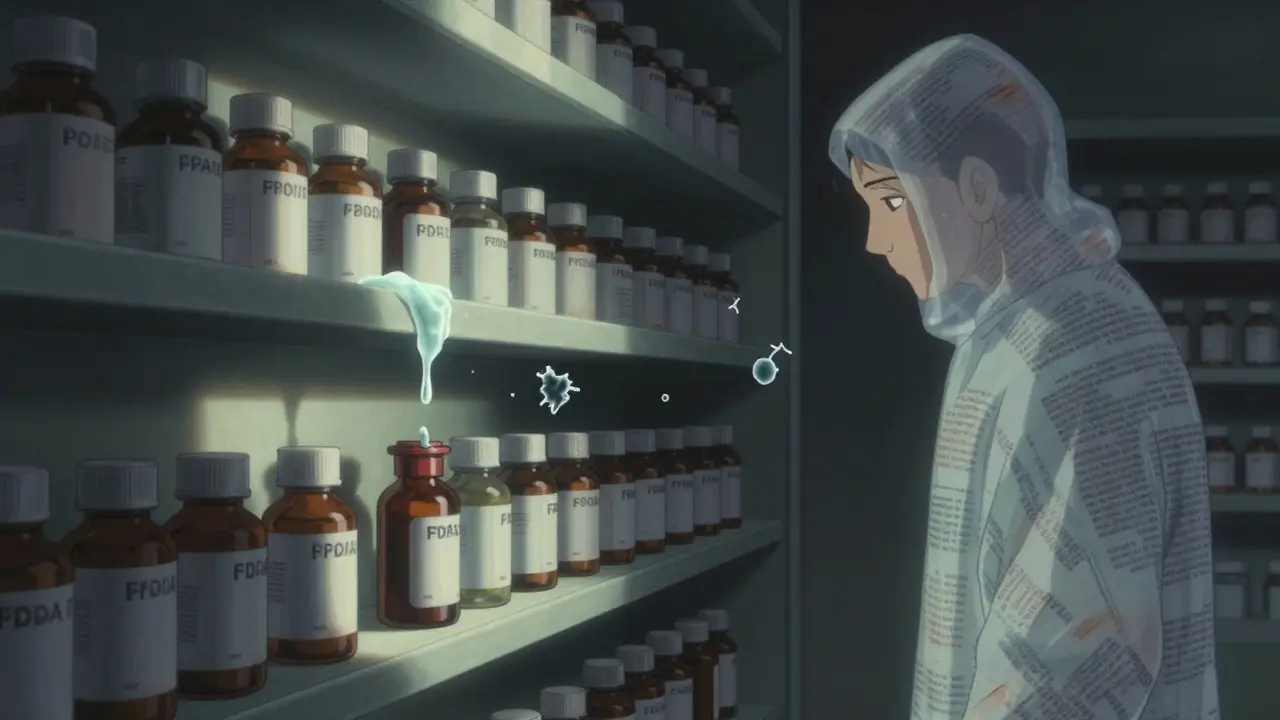
Generics are cheaper because they don’t repeat the expensive clinical trials of the original drug. But they also don’t always replicate the exact formulation. Excipients-fillers, binders, coatings-can be different. And those differences matter.
A 2020 FDA study found that 17.3% of generic levothyroxine products had stability issues not seen in Synthroid, the brand version. The problem? Moisture. Some generics used packaging that didn’t block humidity well. Over time, water got in. The active ingredient degraded. Patients got less medication than prescribed. Some ended up with under-treated hypothyroidism-fatigue, weight gain, even heart problems.
Another issue: nanoparticles. Drugs like those used for cystic fibrosis rely on tiny particles to reach deep into the lungs. But if those particles clump together above 200nm, they can’t penetrate. One Texas A&M study found that generic versions sometimes failed this test because their manufacturing process didn’t control particle size as tightly.
And it’s not just drugs. Food products face similar challenges. A food scientist reported that using Kappa Laboratories’ moisture and pH monitoring system extended the shelf life of refrigerated soups by 22%. Why? Because standard tests didn’t account for how water activity affects mold growth. The same principle applies to pills: if humidity control is off, degradation accelerates.
The Hidden Risks Nobody Talks About
Most people think expiration dates are about potency. But the bigger risk is safety.
Take preservatives in liquid medications. If the water activity changes-because of poor packaging or storage-the preservative can lose effectiveness. The Parenteral Drug Association found that 41.3% of stability-related recalls in the last five years were due to microbial growth in preservative systems. That’s bacteria. Mold. Fungi. In a vial meant for injection.
And then there’s documentation. The FDA issues Form 483s-inspection warnings-for the smallest oversights. In 80% of stability-related citations, companies were fined for not properly documenting storage conditions. Saying “room temperature” isn’t enough. The FDA requires exact temperature ranges: 15-30°C. If your warehouse hits 31°C for a week, your stability data is invalid. And if your drug degraded during that time? You’ve got a public health risk.
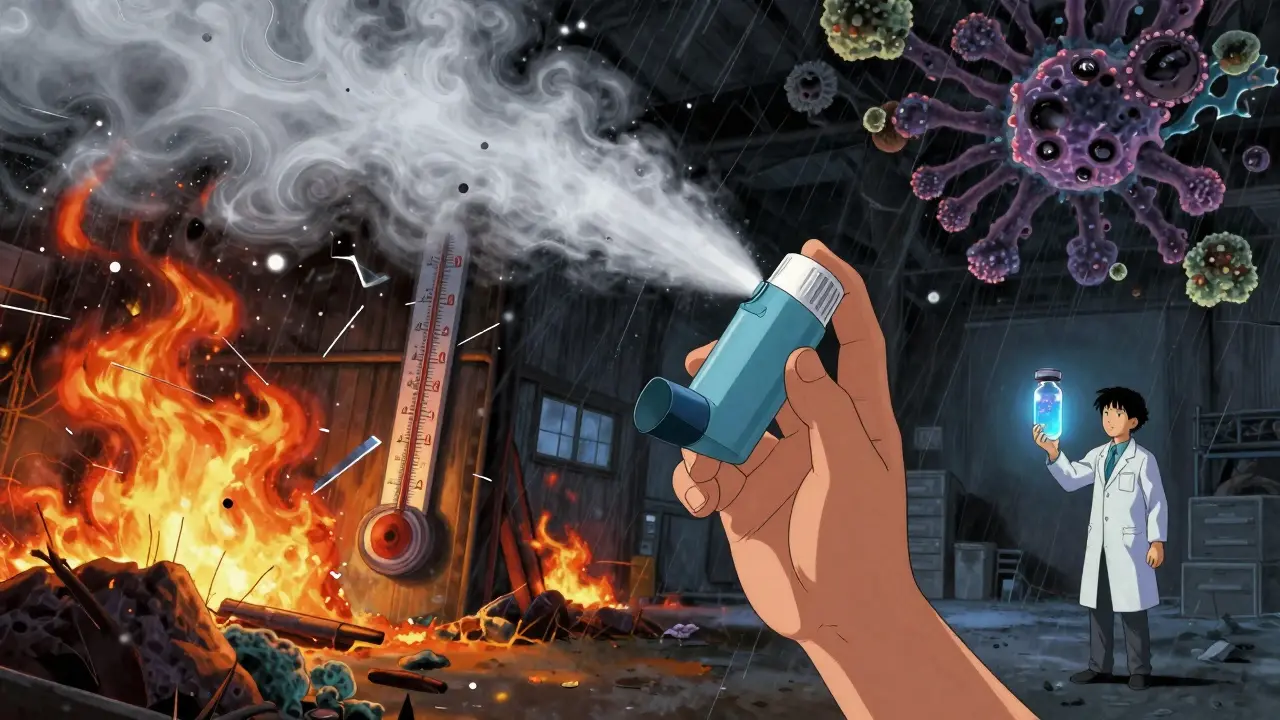
Climate change is making this worse. A 2022 MIT study projected that by 2050, rising global temperatures could reduce average drug shelf life by 4.7 months. Warehouses in major distribution hubs will exceed 30°C for more than 87 days a year. That’s not a future scenario-it’s already happening in places like Melbourne, where summer temperatures regularly hit 40°C.
What You Can Do
You can’t test your own pills. But you can protect yourself.
- Store medications properly. Keep them in a cool, dry place-not the bathroom, not the dashboard of your car. The ideal spot is a closet or bedroom drawer.
- Check packaging. Is the bottle sealed? Is the capsule discolored? Does the liquid look cloudy? If yes, don’t take it.
- Ask your pharmacist. If a generic looks different from last time, ask if it’s the same manufacturer. Switching between generic brands can change stability profiles.
- Don’t rely on expiration dates alone. If a drug has been stored poorly, it may degrade before the date. If it’s been sitting in a hot garage for six months, toss it.
Manufacturers are starting to use predictive models to shorten testing times. The IQ Consortium’s Risk-Based Predictive Stability (RBPS) tools cut shelf-life determination by 30% in pilot studies with Amgen and Merck. But regulatory agencies still don’t fully accept them. Until they do, real-time testing remains the safest path.
The Bigger Picture
The global stability testing market is worth $2.84 billion-and growing. But behind those numbers are real people. A child with asthma using an inhaler that doesn’t deliver the right dose. A senior with heart failure taking a degraded beta-blocker. A diabetic whose insulin lost potency because it sat in a warehouse without climate control.
Stability testing isn’t just science. It’s ethics. It’s accountability. And for generics, it’s the thin line between affordable access and hidden danger.
Are expiration dates on generic drugs reliable?
Expiration dates are based on stability testing, but generics are more vulnerable to degradation than brand-name drugs due to differences in excipients, packaging, and manufacturing. A 2020 FDA study found 17.3% of generic levothyroxine products had stability issues not seen in the brand version. If stored improperly-especially in heat or humidity-generic drugs can degrade before their labeled date.
Can I trust accelerated stability testing for generics?
Accelerated testing uses high heat and humidity to predict shelf life faster, but it doesn’t always reflect real-world degradation. Some drugs undergo chemical changes at room temperature that don’t occur at 40°C. The FDA allows extrapolation up to twice the real-time data, but only if changes are minimal. Many stability failures occur because companies rely too heavily on accelerated data without enough real-time validation.
What happens if a generic drug degrades?
Degraded drugs can lose potency, making them ineffective, or form toxic byproducts. For example, degraded tetracycline can cause kidney damage. Levothyroxine that loses potency can lead to untreated hypothyroidism. In liquid medications, microbial growth can occur if preservatives break down, risking serious infections. These aren’t rare cases-they’re documented in FDA recalls and Form 483 inspections.
How are stability tests regulated?
In the U.S., the FDA requires stability testing under 21 CFR 211.166, following ICH Q1A(R2) guidelines. Testing must include chemical, physical, microbiological, and functional parameters. Methods must be validated under ICH Q2(R1). In Europe, the EMA enforces similar standards under Directive 2001/83/EC. Failure to comply can lead to product recalls, warning letters, or bans.
Why do some generics have different stability profiles than brand-name drugs?
Generics must match the active ingredient but can use different fillers, coatings, or packaging. These differences affect how the drug responds to heat, moisture, and light. For example, a generic might use a less moisture-resistant capsule, leading to faster degradation. Nanoparticle drugs are especially sensitive-small changes in manufacturing can cause particles to clump, making them ineffective. These subtle differences aren’t always caught during bioequivalence testing.
i swear i’ve had generics that looked like they’d been through a desert storm. one time my thyroid med turned yellow and i didn’t think twice till my heart started acting up. now i keep ‘em in the fridge like a damn salad. who knew pills needed a climate control contract?
also, why do pharmacies not tell you this? like, i pay for a bottle, not a science experiment. they just hand it over like it’s a candy bar.
OMG THIS IS SO REAL 😭 I had a friend who went into cardiac arrest because her generic beta-blocker degraded in her car during a Texas summer. She thought the expiration date was a suggestion. It’s not. It’s a lifeline. 🚨
Also-why are we still letting companies use accelerated testing like it’s a magic 8-ball? If your drug turns into a rock at 40°C, it’s gonna do the same in your attic. STOP CUTTING CORNERS.
This whole thing is just another reason why America needs to stop importing cheap foreign generics. If you want safe meds, buy American. Period. We’ve got the labs, the standards, the tech. Why are we letting India and China cut corners on our medicine? This isn’t about cost-it’s about national security.
Interesting read. I work in pharma logistics in Bangalore. We handle a lot of generic exports. What’s rarely discussed is how humidity swings in monsoon season affect packaging integrity-even if the drug is stable, the blister pack can fail. We’ve had batches rejected because the foil peeled off in transit. It’s not always the drug. Sometimes it’s the box.
It is imperative to emphasize that regulatory compliance is not a suggestion but a foundational requirement for public health safety. The FDA’s 21 CFR 211.166 mandates comprehensive stability protocols, and deviations-however minor-constitute significant violations. Manufacturers must prioritize validated storage conditions and documented environmental monitoring to ensure patient safety and uphold scientific integrity.
The water activity (aw) metrics are CRITICAL here. If your packaging doesn’t maintain aw < 0.6 for hygroscopic APIs, you’re playing Russian roulette with microbial proliferation. We’ve seen this with amoxicillin suspensions-once aw breaches 0.7, mold blooms in 72hrs. And no, your ‘cool closet’ isn’t enough if it’s 32°C with 70% RH. Use a hygrometer. Seriously.
I can’t even. I took a generic for my anxiety last year and it felt like I was on a sugar high then crashed into a black hole. My therapist said it was probably degraded. I cried for an hour. Then I Googled and found out 1 in 6 generics have stability issues. Why isn’t this on every pill bottle? Like, a warning label? A tiny skull? I’m not joking. I need a warning label.
expiration dates are a scam.
In Indonesia, we don’t even have climate-controlled pharmacies. Pills sit on open shelves in 35°C heat for months. I’ve seen kids take antimalarials that looked like they’d been baked. No one checks. No one cares. The FDA standards? Beautiful. But they’re a luxury here. We need global standards, not just American ones.
The assertion that accelerated stability testing is inherently unreliable is an oversimplification. ICH Q1A(R2) permits extrapolation under rigorous statistical modeling, provided the degradation kinetics are first-order and the activation energy is well-characterized. The issue is not the method per se, but the lack of analytical validation and poor selection of stress conditions. The FDA’s RBPS initiative is a step forward, but regulatory acceptance requires harmonized validation frameworks across ICH regions.